Indian Railways is as diverse as the people of our country. There are different categories of train which include luxury trains like Palace on Wheels, modern trains like Vande Bharat, affordable options like Amrit Bharat trains and many short route trains for local passengers. Even in a single train there is a huge diversity. There are sleepers, chair cars, 1A, 2A and 3A coach in train as well.

The majority of the passengers in Indian trains are from humble backgrounds. For them, sleeper is the mainstay. AC coaches are a luxury for them. To make AC coaches accessible for all of the passengers, Indian Railways has 3A in train which strikes a delicate balance between affordability and comfort. The prices here are not too high as 1A in train, however with air conditioning and bedding facilities, the service is a significant upgrade from the Sleeper coaches in train.
In this blog, we will explain in detail about the 3A coach in train, what it is, the seat layout, pricing for different trains, facilities that are provided in these coaches, some helpful railway tools as well as how you can get train food delivery in this 3A coach.
What Is a 3A Coach in Train?
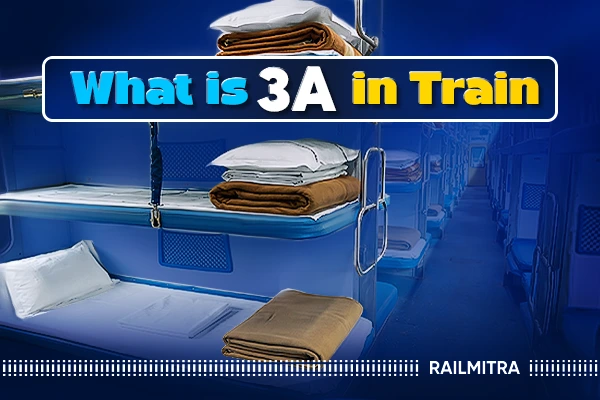
3A Coach in train is the name for air-conditioned sleeper coaches which are three tiered, i.e., lower, upper and middle. There are two side berths as well with one being the side lower and other being the side upper.
There are usually 64 berths in every 3A coach. Modern LHB 3A coaches have 72 berths per coach. Sometimes there are curtain separating seats, but this is not universal and many trains might lack curtains for 3A. Pillows and blankets are also provided by the Railway staff.
Your ticket or booking confirmation will print this as “AC 3 Tier” or just “3A”, both mean the same thing. The physical coach gets labelled B1, B2, B3 and so on down the rake.
Here is how it compares to the classes around it at a glance:
| Class | Full Name | AC? | Berths per Coach | Approx Fare (1,000 km) |
| SL | Sleeper Class | No | 72 | ₹500 – ₹800 |
| 3A | AC 3 Tier | Yes | 72 | ₹1,050 – ₹1,575 |
| 3E | AC 3 Tier Economy | Yes | 81–83 | ₹945 – ₹1,417 |
| 2A | AC 2 Tier | Yes | 52 | ₹1,575 – ₹2,310 |
| 1A | AC First Class | Yes | 18–24 | ₹3,000+ |
ICF vs LHB: Which Coach Are You Travelling In?
This matters more than most passengers realise. There are two generations of 3A coaches running on Indian tracks right now.
Those blue ICF (Integral Coach Factory) coaches that show up at practically every junction in the country ran as the standard design for over five decades. 64 berths, carbon steel body, speed limit somewhere around 110 km/h. The real problem was not the speed ceiling though. In accidents, these coaches would ride up onto each other rather than staying on the ground. The physics of that is bad enough. The accident record made it worse.
LHB (Linke-Hofmann-Busch) coaches came in through a technology transfer from Germany and fixed most of that. Here is how the two compare:
| Feature | ICF 3A | LHB 3A |
| Body Material | Carbon Steel | Stainless Steel |
| Coach Length | 21.34 m | 23.54 m |
| Max Speed | 110 km/h | 160 km/h |
| Braking | Dual Pipe Air Brake | Pneumatic Disc Brake |
| Coupling | Screw + Buffers | Center Buffer Coupler (CBC) |
| Berth Count | 64 | 72 |
| Noise Level | Louder | ~60 decibels |
| Suspension | Bolster Springs | Fiat Bogies with Air Springs |
That CBC coupling listed above is the main reason LHB coaches do not telescope during a collision. The coaches physically cannot ride up onto each other the way ICF ones did. Railways has set 2030 as the target for retiring ICF coaches from Mail and Express services. Rajdhani, Duronto and trains launched in recent years are already fully LHB. The older Mail Express trains on secondary routes are what remain.
3A Coach Layout: How the Berths Are Arranged
ICF coaches had 64 berths. LHB 3A coaches bumped that up to 72. Every coach is split into 9 bays, 8 berths in each. Within a bay there are two distinct sections.
Main Bay (6 berths per bay)
These berths go across the width of the coach. Two sets of three face each other.
- Lower Berth (LB): the bottom level, used as a seat during daytime hours
- Middle Berth (MB): stays folded down as a backrest while people are sitting, gets raised and locked at night
- Upper Berth (UB): fixed position, only for sleeping
Side Bay (2 berths per bay)
These run lengthwise along the coach, next to the aisle window.
- Side Lower (SL): popular with solo travellers for the window view and some quiet
- Side Upper (SU): a full sleeping berth but the access requires a bit more effort
During the day the middle berth stays folded flat, acting as a backrest for the lower berth seat below. All three passengers in that bay can sit together on the lower berth without any issue.
After 10 PM the middle berth passenger can raise their berth and sleep. That window goes from 10 PM to 6 AM. The railway has set these times officially, though in practice the actual arrangement tends to get sorted out by whatever the passengers in that bay agree on.
Berth Numbering in 3A: How to Read Your Seat Number
Each Bay has 8 berths. The number of seats thus follows this table of 8 and the seat type repeats after every 8 seats. For example the seat numbering begins with a lower seat having the number 1. The same seat in the next Bay would have number 9. Similarly the first side lower would have number 7, with the next one numbered 15. It is important to note here that there are two lower seats in the same Bay facing each other. Therefore both seat number 1 and 4 would be lower berth seats.
| Berth Type | Berth Numbers |
| Lower (LB) | 1, 4, 9, 12, 17, 20, 25, 28, 33, 36, 41, 44, 49, 52, 57, 60, 65, 68 |
| Middle (MB) | 2, 5, 10, 13, 18, 21, 26, 29, 34, 37, 42, 45, 50, 53, 58, 61, 66, 69 |
| Upper (UB) | 3, 6, 11, 14, 19, 22, 27, 30, 35, 38, 43, 46, 51, 54, 59, 62, 67, 70 |
| Side Lower (SL) | 7, 15, 23, 31, 39, 47, 55, 63, 71 |
| Side Upper (SU) | 8, 16, 24, 32, 40, 48, 56, 64, 72 |
On some trains the coach chart uses colour coding. Green is for upper berths, orange for middle, blue for lower. Not every train does this but it is useful when you spot it.
Berth Dimensions: What You Actually Get
Narrower than 2A, and the upper tier headroom is noticeably tighter. The actual numbers:
| Berth | 3A (L × W) | 2A (L × W) |
| Lower (Main Bay) | 182 cm × 60 cm | 185 cm × 67 cm |
| Middle (Main Bay) | 182 cm × 60 cm | Not present |
| Upper (Main Bay) | 182 cm × 64 cm | 182 cm × 64 cm |
| Side Lower | 180 cm × 59 cm | 187 cm × 55.5 cm |
| Side Upper | 180 cm × 59 cm | 187 cm × 54 cm |
Sitting upright on a 2A upper is manageable. On a 3A upper you are ducking. If you are tall or a light sleeper who needs space, factor this in before booking. The side lower berth is 2 cm shorter than the main bay ones. Most passengers do not notice the length difference. What they do notice is the window next to it, which is exactly why side lowers get booked out so fast.
Difference Between 3A and 3E in Train
Check your ticket. If it says M1, M2 or M3 instead of B1, B2 you are travelling in a 3E (AC 3 Tier Economy) coach. The M prefix is the giveaway or the difference between 3A and 3E in train.
3E was introduced to put AC travel within reach of passengers who currently travel Sleeper Class but cannot quite stretch to standard 3A fares. Each train coach has 81 to 83 berths depending upon the type of the train. This is higher than what 3A coaches have and this was achieved by relocating the high-voltage switch gear. This was taking up all the space and after freeing this another bay was added into the 3E coach in train.
What changes in 3E compared to 3A:
| Feature | 3A | 3E |
| Berth Count | 72 | 81–83 |
| AC Type | Centralised Ducting | Individual Vents per Berth |
| Side Bay | 2-tier (SL + SU) | 3-tier in older stock (adds Side Middle) |
| Privacy Curtains | Usually provided | Generally not provided |
| USB Charging | In newer coaches | Standard fitment |
| Coach Code | B1, B2, B3… | M1, M2, M3… |
The biggest con of a 3E coach in train can be found in their side lower berths. The vertical space between the seats is really compacted. Passengers can’t even lift their heads properly. What is even more disheartening is that some 3E coaches might have 3 side lower berths. May god help these passengers.
One good thing about 3E coaches are the focus they have about individuality. Passengers get to have their individual AC vent, reading light and USB ports for charging phones. In fact, the older LHB coaches still rely on centralised ducting.
Vande Bharat Sleeper: The 3A You Did Not Expect
The first commercial runs of Vande Bharat Sleeper happened in January 2026. No locomotive at either end. It is a self-propelled Electric Multiple Unit that accelerates and brakes faster than conventional overnight expresses on the same routes.
A standard 16 coach Vande Bharat Sleeper rake is configured around 3A:
- 11 coaches are 3A (611 passengers)
- 4 coaches are 2A (188 passengers)
- 1 coach is 1A (24 passengers)
The 3A berths in Vande Bharat Sleeper are wider than what you get in standard LHB coaches and the cushioning is noticeably better too. These were built specifically for overnight travel rather than being retrofitted from day coach designs. The gangways between coaches are sealed so dust and outside noise stay out. Toilets use vacuum assist, similar to what aircraft lavatories use. Kavach anti-collision is standard fitment across the rake.
Pricing works out to Rs. 2.40 per passenger per kilometre. Delhi to Mumbai in Vande Bharat 3A costs more than doing that same route in Rajdhani 3A. The gap is not dramatic but it is there. Passengers coming up from regular LHB overnight expresses will feel the difference clearly. Those already on Rajdhani 3A will notice an improvement too, just a subtler one.
3A Ticket Price: What Goes into the Fare
A 3A ticket is not just a base fare. Four or five components stack on top of each other by the time you hit pay. The base fare runs per kilometre across distance slabs, then a flat Rs. 40 reservation charge goes on top. If the train is classified Superfast, add Rs. 45 more. GST is 5% on all AC classes, worth noting that Sleeper and Second Sitting are exempt from this.
Rajdhani, Shatabdi and Duronto have flexi fare on top of all that. The way it works: for every 10% of berths that get booked, the base fare climbs another 10%. There is a ceiling but it takes a while to hit. On these trains the price you see today will not be the price someone else sees after another hundred bookings go through. Early booking is not just convenient, it is cheaper.
On a standard 1,000 km journey the total 3A fare lands somewhere between Rs. 1,050 and Rs. 1,575. A fare revision in late 2025 added 2 paise per kilometre across AC classes, so a 1,200 km ticket now costs roughly Rs. 24 to Rs. 30 more compared to what it was before that change.
Worth knowing: the average rail passenger in India pays about 57 paise for every rupee the journey actually costs to operate. The shortfall gets covered partly by freight revenue and partly by the contribution from 3A and higher classes. So even with the recent fare increase, 3A is not priced anywhere close to full cost recovery.
For current fares and live seat availability in 3A, RailMitra’s seat availability tool pulls real-time data, no need to run through the full booking flow just to check.
Onboard Amenities in 3A
A 3A coach in train comes with standard amenities that separate it from sleeper classes. This includes the bedding kits provided by the Railway officials which usually includes two bedsheets, one pillow and a blanket. The coach itself has modern facilities like 220V sockets for charging phones. Newer LHB coaches might also include USB sockets. New 3A coaches have individual lighting and bio-toilets. Have you noticed how railway stations appear cleaner than earlier? All thanks to bio-toilets where the waste is treated anaerobically.
Most of the long distance trains with 3A coaches do usually have a pantry car. You can get meals with the help of attendants who go on rounds for meals, snacks as well as hot beverages. Passengers who want to try something delicious can also get restaurant quality food on the train. RailMitra delivers food in train at your seat. You just have to enter your PNR and the platform will read your seat details. Select the station, restaurant and food of your choice. You would get your food as soon as the train reaches the selected station.
Reserved Quotas in 3A
Indian Railways holds back certain berths from the general booking pool. Four to five lower berths per coach go to the Senior Citizen Quota for men over 60 and women over 58. A Divyangjan quota covers designated berths with more clearance for wheelchair users. There is also a Ladies Quota: a block of berths reserved for women travelling alone or with young children. None of these show up in the regular availability count, which is why a train that looks full at booking sometimes confirms waitlisted tickets by departure as the quota berths release into the general pool if they go unclaimed.
Track your PNR status in real time through RailMitra’s PNR status tool.
Coach Position on the Platform
A long-distance express with 12 coaches in 3A puts your B7 or M2 quite far from the locomotive end. The coach chart posted at the station is accurate, but it takes time to read in a crowd, especially with luggage.
If you want to know where on the platform your coach stops before you get there, RailMitra’s live train status shows coach composition by train, useful when you are hauling luggage and B7 is nowhere near the entry gate.
Conclusion
The 3A coach in train runs on almost every major express and Mail route in the country. It is the AC class most people end up in, not because it is the cheapest or the fanciest, but because it sits at exactly the right point between cost and comfort for overnight travel. Whether the berth number makes sense now, or you wanted to know what M1 means on your ticket, or you were trying to figure out if 3E is worth the savings, that is what this guide was for.
RailMitra has seat availability checking, PNR tracking and food ordering for 3A travel all in one place.
FAQs for 3A Coach in Train
Q: Is 3A the same as AC 3 Tier?
A: Yes. “3A” is the short form used in booking; “AC 3 Tier” is the full class name. Both refer to the same coach.
Q: What is the difference between B1 and M1 on a ticket?
A: B1 is a standard 3A coach. M1 is a 3E (AC 3 Tier Economy) coach. The M prefix signals higher density: more berths, individual AC vents, but tighter space.
Q: Does the middle berth stay raised all day?
A: No. From 6 AM to 10 PM the middle berth stays folded down and works as a backrest for the lower berth. After 10 PM the passenger on the middle berth can raise it and sleep.
Q: Which berth is best in 3A?
A: Depends on who is asking honestly. Elderly passengers and anyone with knee issues will want the lower berth, numbers like 1, 9, 17 and so on. Solo travellers tend to grab side lower berths like 7, 15, 23 because of the window and a bit more personal space. Upper berths get quieter once the lights go out but you are climbing up and the headroom is genuinely low.
Q: Is GST charged on 3A tickets?
A: Yes, 5% GST applies to all AC class tickets including 3A and 3E. Sleeper Class tickets are outside the GST net entirely.
Q: What is the Vande Bharat Sleeper 3A fare?
A: Works out to around Rs. 2.40 per passenger per kilometre. On a 1,000 km route you are looking at roughly Rs. 2,400 before taxes get added.
Q: Can I check 3A seat availability before booking?
A: Yes. RailMitra’s seat availability checker shows real-time berth availability in 3A and 3E across trains for your route and date.