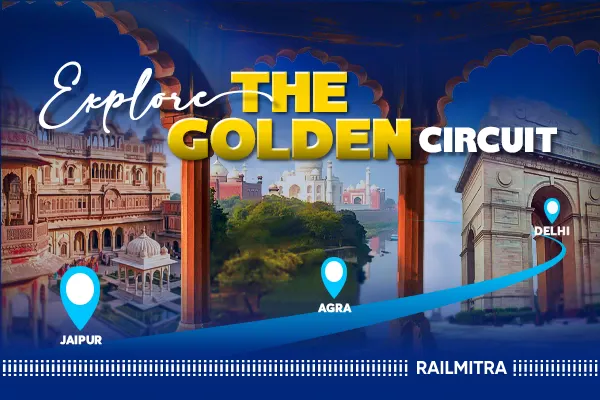
The Golden Triangle connects three cities, in one circuit. Annually, several millions of travellers getting to India through this circuit have it as their first stop, showing the great attraction of Golden Triangle idea. Delhi Agra Jaipur: together they boast of far more UNESCO sites, Mughal structures, and Rajput forts than most nations have. Every point of the triangle is connected with each other by a distance of around 200 to 240 km and travelling by train is not only a brochure promise but actual reality: five hours maximum, sometimes less than two.

Indian families have been taking this circuit for many years, which is a fact that is usually lost when the circuit is portrayed as one for foreign tourists. Long weekends, school holidays, retirement trips. The trains on this corridor are among the busiest ones in North India, Like that the facilities here are good as well.
What Exactly Is the Golden Triangle
Tourism routes are the main connector of the three Indian cities situated in the Northern part of the country – Delhi, Agra, and Jaipur. That’s why, these three cities which form a triangle on the map are known as the Golden Triangle.
Delhi to Agra: approximately 200 km by train.
Agra to Jaipur: approximately 240 km.
Jaipur to Delhi: approximately 270 km.
Entire circuit: approximately 720 km. You can do it during a weekend if you push yourself, or take a week and enjoy it slowly. Generally, people take five to six days.
The circle itself represents a history of Mughals and Rajputs intertwined with each other. Delhi was the hub of the Mughal empire for hundreds of years. Agra was the home of the Taj Mahal and the Red Fort. Jaipur was the main city of the Kachwaha Rajput which was built almost entirely in the 1700s. These are not mere neighbouring cities. One city’s past is intertwined with the other’s.
The Golden Triangle is successful for domestic tourists since these three cities are all decent railway hubs with regular services between them. It is not necessary to hire a car and drive. Also, one can skip airports and their tedious queues with ease. Trains will do the job.
Delhi: Where the Circuit Begins
Majority of the tourists enter the beautiful Golden Triangle from Delhi. Being the capital city, it is a door that shows you many choices such as three large railway terminals, a metro running between these and almost every direction covered by the railway network for further travels.
The New Delhi Railway Station is the heart of the city where numerous long-distance and premium trains are run. Besides many luxury trains, you will find a lot of Shatabdi and Rajdhani at this station. It is divided into two parts, Ajmeri Gate and Paharganj. Since unfamiliar everyone often get mixed up and end up on the wrong side, it is advisable to plan before going to the New Delhi Railway Station.
Hazrat Nizamuddin is the origination of a majority of the trains en route to Agra including the Gatimaan Express, which is the fastest scheduled train between Delhi-Agra as of now.
Even though Old Delhi Railway Station has the highest number of trains among the three, it is not the most suitable one for the Golden Triangle tour.
What to See in Delhi
Red Fort
Red Fort is where most visitors start, sat on the Yamuna, main Mughal residence for close to 200 years. The red sandstone that takes on a different quality in evening light during the sound and show, which is worth staying for if the next morning does not require an early departure.
Qutub Minar
Qutub Minar is located in South Delhi and it takes a full auto ride to reach it as it is separated from the other central monuments. It is a 73-metre high tower that was built in 1193 and nearby there is also an iron pillar which has not rusted for more than 1,600 years even though it has been exposed to the elements all the time. Scientists who study materials still can’t come up with a completely satisfying explanation for the iron pillar, which is something one wouldn’t even expect to be writing about from the 4th century! Plan Qutub as its own outing, not an add-on to Red Fort.
Humayun’s Tomb
Humayun’s Tomb is often left out of most Golden Triangle itineraries as people prefer the Taj Mahal; Still, this is really a paradox because the architect of Humayun’s tomb is the same architect of the Taj team. The formal garden and mausoleum geometry are the places where that design language commenced. Occasionally, individuals who have viewed the Taj initially might get the impression that they saw the ideas in a wrong sequence.
India Gate
India Gate on Rajpath is a war memorial with an eternal flame under the arch and on weekends lawns are full of Delhi families. Before 9 AM, when the crowds haven’t arrived yet, the place looks totally different from what it looks like at noon.
Chandni Chowk
Chandni Chowk leads from Red Fort towards the old town hall, and Parathe Wali Gali is a street off this street and one of the oldest breakfast alley in the city. When you skip it while you are already in Old Delhi, you will be the kind of person who will have to justify your decision to everyone who inquires about your Delhi trip.
Akshardham
Akshardham is located near the Yamuna: it was built in 2005 and made entirely of traditional stone, without steel or concrete in the structure. It would be good if you know in advance that the use of cameras is forbidden inside. The Lotus Temple in South Delhi, the Baha’i house of worship, which is designed in the shape of a blooming lotus flower, attracts a number of visitors that place it among the most visited buildings on the face of the earth. Most of the people find that fact so surprising when they hear it.
Delhi to Agra: Best Train Options
South of Delhi by 200 kilometers sits Agra. Depending on your choice of train, the ride might take just under two hours – or stretch nearly three and a half.
Gatimaan Express (12049): Out of Hazrat Nizamuddin rolls Gatimaan Express, number 12049. Destination? Agra Cantonment. The clock ticks through one hour forty minutes. The journey ends there. Runs Monday through Saturday, no service on Fridays. This is the fastest Delhi-Agra train currently operating. Chair Car and Executive Class only, no sleeper coaches.
Shatabdi Express (12001): New Delhi to Agra Cantonment. Travel time: around two hours. Runs daily, though the primary termination is Bhopal. The Agra stop comes early in the run so the train is usually punctual at that point.
Taj Express (12279): Hazrat Nizamuddin to Agra Cantonment. Morning departure, slower than both options above, but very popular for day trippers.
Intercity Express options: Multiple trains leave from Old Delhi and New Delhi during the day. Duration of the journeys can be from 2 hours 30 minutes to 3 hours 30 minutes according to number of stops.
You can check the train running status in the morning of your trip to get updated departure times and real-time delays before leaving for the station.
What to See in Agra
The Taj Mahal
Sunrise at the Taj is hardly a stale suggestion. The change in light at 6:30 AM sun does white marble is so pronounced that it becomes completely different from what the sun at noon does, and the difference is not even subtle. Shah Jahan constructed it in the 1630s as a tomb for his wife Mumtaz Mahal, and the reasoning behind the construction of the mausoleum is not discernible from the pictures: the four minarets tilt slightly outward by design, so that their fall would be away from the main dome rather than onto it. The garden is divided into four parts which represent the Islamic idea of heaven. Nothing in the symmetry was left to chance.
Agra Fort
Agra Fort is a three-kilometer walk from the Taj: red sandstone, fewer people, and a history that is in some ways even darker than the Taj’s. Shah Jahan in this fort during his last days while his son Aurangzeb was imprisoning him in a tower chamber from which he could see the Taj Mahal across the river. The room is still there. Standing in it and looking out at the mausoleum he built, the specificity of that arrangement is something a history book does not quite get across.
Fatehpur Sikri
Fatehpur Sikri needs its own day trip, 40 kilometres out. A Mughal capital raised in the 1570s and then emptied within 15 years, possibly because the water supply could not hold the population. The city is structurally complete. Just without anyone in it for the past 400 years, which gives the place a quality that is genuinely hard to describe while standing there.
Mehtab Bagh
Mehtab Bagh, on the opposite bank of the Yamuna directly facing the Taj: no ticket queue for the Taj, no tour group between you and the view. Sunset from this garden is the photograph most Agra visitors end up using.
Itmad ud Daula
Itmad ud Daula, the Baby Taj, predates the main Taj by about 20 years and was the first fully white marble Mughal structure. The pietra dura inlay technique here is the same one used later at the Taj, but at considerably smaller scale. Worth an hour of anyone’s time in Agra.
Agra to Jaipur: The Longer Leg
240 km between Agra and Jaipur. This is the longest segment of the three and it crosses a landscape that feels distinctly different from the Delhi-Agra stretch.
Intercity Express (19666 / 12984): Every day, Intercity Express trains – like 19666 or 12984 – make the trip in roughly four to five hours. Timing shifts slightly based on which one you ride. What matters is picking a number that fits your schedule. Some leave early, others later, yet all cover similar ground. Speed isn’t everything when comfort joins the journey.
Marudhar Express: Starting out from Agra, Marudhar Express heads toward Jodhpur before pushing on to Jaisalmer by way of Jaipur. Travelers looking past crowded landmarks might find it works well for reaching quieter corners of Rajasthan.
Aravali Express: Out of Agra toward Jaipur rolls the Aravali Express – slower than most, true. Still, it shows up on time more often than not.
Practical note: Just so you know, trains mostly come through Jaipur Junction, rarely at Jaipur Cantonment. Watch closely which station your train stops at, when locking in tickets.
The trains between stations tool will be of great help here as it is easier to browse all the train options for the route from Agra to Jaipur at once instead of searching them individually. Also, this route has many trains running at different times of day.
What to See in Jaipur
Amber Fort
Perched high on a ridge overlooking Maota Lake, Amber Fort sits eleven kilometers from the city center. Not like the structures found in Agra or Delhi, its design mixes Hindu and Mughal elements, neither overpowering the other. While walking through, notice how each arch and courtyard balances both traditions quietly. This place feels older somehow, even if parts are rebuilt. Shapes curve where they might otherwise meet sharp, and colors linger under stone frames.
City Palace
City Palace in the old city is still partly occupied by the Jaipur royal family, with the museum portions open to visitors. One of the halls holds two silver urns that hold the Guinness record for the largest silver objects in the world, made in 1901 to carry Ganga water to England for the Maharaja’s visit. The courtyard is the venue for various cultural events throughout the year and the entire complex generally needs more time to explore properly than most people allow for it.
Jantar Mantar
Located in the old city as well, Jantar Mantar comprises astronomical instruments made in the 1720s which are still very precise. The biggest sundial can indicate the time with the accuracy of two seconds, which is exceptional for a stone structure that is 300 years old. Designated as a UNESCO World Heritage Site, and unfortunately, the tour groups passing through it often rush; the instruments deserve A lot more time and attention than that.
Hawa Mahal
Hawa Mahal is the five-storey sandstone facade with 953 small windows on essentially every Jaipur photograph. Built so royal women could watch street processions below without being seen from the street. From outside in morning light, genuinely striking. From inside: narrow corridors and windows, which is fundamentally what the structure is.
Nahargarh Fort
Nahargarh Fort is perched on the ridge over the city and the panoramic view of Jaipur you get from there is probably the best one. The caf in the fort is surprisingly good, the sunset viewed from there is so beautiful that it makes the trip worthwhile.
Johari Bazaar and Bapu Bazaar
Most travelers wind up buying stuff they never meant to at Johari Bazaar and Bapu Bazaar. In Jaipur, gems move fast which is a key Asian hub, really with Johari Bazaar putting that world right in front of you. Mojaris, fabrics stamped by hand, blue pottery – Bapu Bazaar has those in full view.
Jaipur to Delhi: Closing the Triangle
Back to the capital is 270 kilometers. Trains here run sharp, almost always on time.
The Shatabdi Express (train number 12015): Leaving just after dawn, train 12015 heads straight from Jaipur toward New Delhi. By late morning it reaches its destination, no delays expected. Covering the route takes under five hours flat. Seating options? There’s a standard chair section along with an upgraded cabin choice. Meals come without extra cost as one hot meal served during the ride, another later on.
The Intercity Express (train number 12985): Leaving Jaipur behind, train 12985 rolls toward Delhi Sarai Rohilla. Slower than Shatabdi, yet kinder on the wallet, it’s a practical ride through northern plains. Time stretches here – minutes pass while rooftops blur past windows. Not fast, though steady, it moves like routines do.
The Ajmer Shatabdi (train number 12015): Out of Ajmer rolls the Shatabdi, numbered 12015. Through Jaipur it moves before heading toward New Delhi. Crowds pack in when Friday night comes around. Morning hours on Sunday see a rush too.
The Double Decker Express: A train called the Double Decker Express moves from Jaipur to Delhi.. It has become quite popular among families for the fun of the upper deck seating.
For the return leg, book well in advance. Jaipur to Delhi on a Sunday evening is one of the busier reservations in this region.
Food Delivery in Train on the Golden Triangle Route
Gatimaan includes meals in the ticket price; fine for under two hours. Shatabdi also comes with catering. The leg that actually needs advance planning is Agra to Jaipur: four to five hours through lunch, and pantry car quality on non-premium trains is the kind of variable that ruins an afternoon.
Using RailMitra to book food in train gets a meal delivered to your seat at a station en route. Useful for Agra to Jaipur specifically, and for the Jaipur to Delhi return if you are moving through the lunch or dinner window.
Delhi station food: unreliable. The Paharganj area near New Delhi station has enough options that eating before departure is not difficult if you have 30 minutes. Hazrat Nizamuddin has fewer choices within walking distance.
Agra food near the Taj Ganj area: rooftop restaurants, quality varies enough that it is worth asking your hotel for a recommendation rather than walking into the first place. Two things to eat regardless of where you end up: daalmoth, a dry spiced snack associated specifically with Agra, and petha, ash gourd sweet in dozens of flavour variations. Packaged petha near the Taj gate travels reasonably well.
Jaipur is worth a proper meal stop. Dal baati churma for one meal at minimum. The lassi shops on MI Road serve in clay cups, have queues that are not decorative. Laal maas if mutton and serious heat both apply.
Essential Tips for Travelling the Golden Triangle by Train
Book the Gatimaan before it fills. One train per day, popular corridor, and the October to March window is the busiest tourist season. Confirmed seats two weeks before departure is not something to assume.
Agra Cantt and Agra Fort station are two different places and you cannot use one instead of the other. The Gatimaan, Shatabdi, and most express services on the Delhi to Mumbai main line are served by Agra Cantt. Then again, Agra Fort station is quite far from it as it is situated at a different part of the city and serves a different set of routes. The names look similar on a hurried read. Check the ticket before the auto.
December and January fog on this corridor is a genuine disruption, not a minor inconvenience. Two to four hour delays on morning trains during dense fog weeks happen regularly. Build buffer days into the itinerary if travelling in that window.
New Delhi Railway Station has 16 platforms and platform numbers sometimes change close to departure. Pulling up train running status 30 minutes before the train is due gives the current allocation.
Tatkal quota opens 24 hours before departure on most express trains. Costs more. Confirmed seating, not waitlist. When general quota shows full, this is the option that remains.
Pre-paid auto counter outside Agra Cantt has fixed rates to the Taj. The drivers who approach before you reach the counter do not use those rates.
Jaipur Junction is close to the old city. Gandhinagar Jaipur and Durgapura are different parts of the city entirely and some express trains halt at one of those instead. Knowing your halt before booking a hotel in the old city area avoids an unexpected auto ride.
PNR Status and Tracking Your Journey
Three legs of the triangle, three separate PNRs.Waitlisted PNRs that have not moved two weeks before travel are problems to solve before leaving home, not at the boarding gate. Check PNR Status at RailMitra for live booking updates.
Train running status shows current station cleared, running delay, and estimated arrival. Night before a fog-season departure is worth a check. So is 30 minutes before you need to be on the platform.
All three PNRs accessible offline. Not just on the phone. Coverage between Agra and Jaipur at smaller halt stations is not guaranteed.
Conclusion
The Golden Triangle by train is manageable, but the details are where things go sideways for people who do not look at them in advance. Gatimaan books out fast. The Agra to Jaipur leg is thinner on options than the rest. Fog in December and January is real disruption, not background noise. And Agra’s two stations have confused enough travellers that it is worth saying again clearly: Agra Cantt and Agra Fort station are not the same place. Get those specifics sorted before departure and the Golden Triangle delivers exactly what it promises: three historically loaded cities, each genuinely different from the other, connected by some of the better rail infrastructure in North India.