
Most people plan a train journey the same way every time. They already know which train to take, they book it, and are done. That works fine until the train is full, or you realise there were three faster options you never checked. Searching trains between two stations before you book takes about two minutes and can save you a lot of avoidable hassle.

Here’s a blog on how to do it on RailMitra, and what to actually pay attention to, once the results come up.
Importance of Trains Between Two Stations Service
Every single day, Indian Railways operates more than 13,000 trains across its network. Along high-traffic routes, say from Patna to New Delhi or Mumbai to Pune, the number of services sharing the track might range from fifteen up to fifty within just one 24-hour period. Most passengers book the first result that comes up. Yet true value doesn’t depend on ranking alone. A top spot might clash with your free hours and also stretch what you can spend.
Looking at all the trains between two stations lets you line up departure schedules right next to one another. Some departures might surprise you. Trains you thought weren’t operating actually run, offering confirmed berths. Waiting isn’t always necessary if better options exist just outside your usual choices.
Frequent expansions mark Indian Railways’ network, while fresh routes emerge over time. A train that skipped your station six months ago might stop there now.
How to Use RailMitra to Search Trains Between Two Stations
No account needed, you can check train availability without logging in at all.
- Go to RailMitra and open the Trains Between Stations search. You can use the website as well as the train application available on Android as well as iOS.
- Start by entering both origin and destination stations: use complete names or known codes like PNBE, NDLS, or MLDT. Suggestions pop up while typing, removing any need to recall abbreviations. As letters appear, matching stops show below automatically. Memory aids become unnecessary once the tool begins predicting choices. Each entry triggers updates without extra steps.
- Select your date of journey. This matters because many trains don’t run daily. Some run only on specific weekdays, the results page shows the running days for each train as a row of letters (S M T W T F S), so you can see at a glance which days it operates.
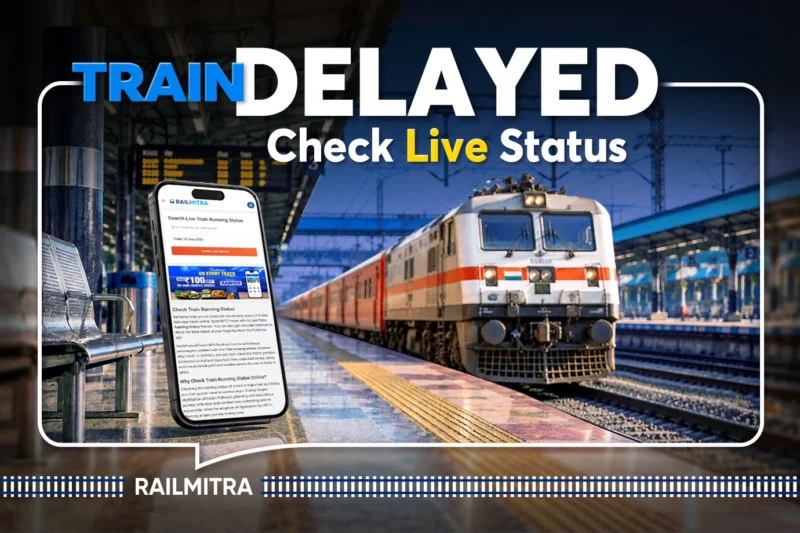
- The findings list each train along the route: its number, name, origin and endpoint codes, alongside how long the journey takes. You can also check the train schedule and the live train running status of the trains here. With just a single touch, access expands beyond basic data into active tracking.
Among India’s large urban centers, Mumbai stands out with multiple rail stations. Not just one or two, but several stations serve its transport needs – CSMT handles historic routes, while LTT manages long-distance services. Dadar links suburban lines efficiently. Even Bandra hosts a key terminal, expanding connectivity further. Trains depart from different points, so verifying departure stations matters greatly. A seat confirmed at a slightly distant stop might be smarter than waiting endlessly for a closer option. Reaching the right platform on time can shift outcomes dramatically.
Reading the results, what each field actually means
The station codes shown are your boarding and deboarding points
The source and destination shown on each train card are filtered for your segment, not the train’s original origin or final terminus. The listed departure reflects when the train goes past your stop, not its origin station. This timing quirk often confuses travelers comparing data across platforms.
Travel duration varies more than you’d expect
Two trains on the same route can differ by 2–3 hours depending on how many halts they make. Traveling along a path shared by multiple rail services, the Arunachal Express requires roughly 17 to 18 hours. In contrast, speedier alternatives complete the journey in fewer than 14. Though following identical tracks, time differences emerge due to varying stop patterns. Some Expresses move more directly through the region. Duration depends heavily on the scheduling choices made by operators. It’s worth sorting by duration if time matters more than comfort class.
SMTWTFS: The Running Days Column
Each letter stands for a day of the week, starting on Sunday. If a train shows SMTWTFS with all letters active, it runs daily. If only certain letters are highlighted, it runs only on those days. If you’re flexible on travel date by even a day, this column can open up more confirmed seat options.
A few things that catch people out
Using city names instead of station codes
Lucknow has three separate stations — LKO, LJN, and LNE. Searching “Lucknow” without specifying can pull up the wrong one. Delhi also features multiple stations – NDLS, NZM, DEE, DLI. If uncertainty arises, rely on the station code; better yet, confirm where your train halts prior to booking. Missing this step could mean arriving at the wrong terminal..
Pair Trains Between Two Stations with Seat Availability
The trains between two stations service provides you with the list of running trains between the entered stations. However, it does not reveal the available seats for booking. You can check it using the train seat availability service. This service will provide the number of seats available across the different train classes and help you select the most appropriate train for your journey.
FAQs on Trains Between Two Stations
Q: Can I search trains between two stations without creating an account?
A: Yes. The trains between stations search on RailMitra is fully open no login required. Booking via IRCTC requires a registered profile. Otherwise, one isn’t necessary at all.
Q: How many trains can I expect to see on a busy route?
A: At busy routes, numbers often hit fifty or higher. Take the trip from Malda Town to Anand Vihar Terminal – this stretch offers 57 train options. When you sort results by travel class or leave times, choices become easier to manage. Though many details exist, focusing on these filters cuts through clutter fast.
Q: Why do the results change when I change the journey date?
A: Every week, train services follow set timetables – some appear each day, others just on specific dates. When the selected date shifts, so does the display: only matching departures stay visible. That way, checking what’s running feels clearer, since irrelevant options disappear.
Q: What if no trains show up for my route?
A: Mistakes in entering a station code might cause issues; alternatively, the chosen path may lack nonstop options. When direct travel isn’t available, break the trip into parts – first locate a train from the departure point to a central hub, afterward explore onward movement from that hub toward the endpoint. Nearly every journey across Indian rail lines works through such single-link routing.
Q: Can I check the running status of a train directly from the results?
A: Each train card shown leads straight to its live tracking page. There is no extra step required after viewing them. A click opens real-time updates without further queries.