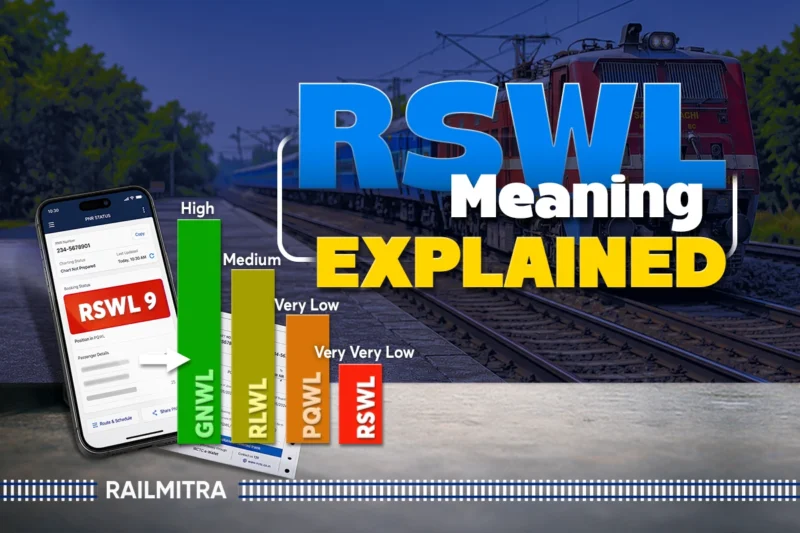
Booked a ticket and got a status that reads RSWL, followed by a number you didn’t expect? That confusion is common, and it happens to first time train travellers just as often as regular ones. RSWL in train bookings refers to a specific waitlist category under Indian Railways, and understanding what it means can save you from a last minute scramble at the station.

This blog breaks down the RSWL meaning, how confirmation actually works, and what you can expect once you’re sitting in that seat, assuming it gets confirmed at all.
RSWL Full Form and Meaning in Railway
RSWL stands for Road Side Waitlist. That’s the official RSWL full form, though most passengers just remember it as one more code among GNWL, RLWL, and PQWL. The RSWL meaning in railway terms is tied to smaller stations along the route, ones that don’t have a large seat quota of their own but still see enough passenger demand to need one.
GNWL covers the whole route. RSWL doesn’t work that way. Suppose, you are travelling on a train from Delhi to Patna route. You have booked the ticket not from a major station but a smaller one situated on the outskirts. A waiting list ticket on this booking would go to RSWL, instead of the GNWL category. This is done because the allocation system shifts your booking if your boarding station is a minor one instead of a major one. Smaller stations have a smaller pool and only a minimal number of seats are allocated for this waiting list. This also explains why this category of waiting list (RSWL) is much harder to get confirmed.
RSWL in Train Booking: How It Works
This is the most interesting part of this kind of booking. RSWL in train booking is decided on the basis of the station you boarded instead of the seats. The booking system accesses your boarding station and the station on which you will deboard. Based on these aspects, the waiting list type is assigned to the passenger.
This is different from how PQWL or RLWL work, both of which follow their own separate logic tied to pooled quotas or remote locations. RSWL sits in its own lane. And because the quota pool for RSWL is usually smaller than general waitlists, seats move faster, for better or worse depending on your position on the list.
What Passengers Actually Get With an RSWL Seat
Now here’s something you only really notice once you’ve travelled on one. RSWL seats, once confirmed, are not inferior seats. They come from the same coach, same berth categories, same everything as a regular confirmed ticket. The only thing different was the route through which your booking got processed.
Passengers who’ve used RSWL a few times will tell you the seat itself never feels like a compromise. What changes is the boarding experience. Since RSWL tickets are often tied to smaller roadside stations, you sometimes board when the train is already midway through its journey, coach lighting dimmed, other passengers settled in for the night. There’s a strange calm to boarding a moving train’s rhythm rather than its starting chaos.
Benefits of RSWL in Train
A few genuine advantages show up once you understand how this quota functions.
Confirmation on RSWL is often quicker than on general waitlists, particularly for shorter routes. Since the quota pool is smaller, movement happens faster too. Passengers boarding from smaller stations get access to berths that might otherwise stay locked behind a general quota they’d never crack.
There’s also a pricing angle. RSWL tickets typically cost the same as any other reserved class ticket, so you’re not paying extra for what is essentially a route specific booking category. And for those travelling on short or medium distance journeys, RSWL often clears well before departure, sometimes within a day or two of booking.
Drawbacks Nobody Tells You About
RSWL in train also have their fair share of disadvantages as well. The booking status awarded to you is hidden from you during the booking process. Until you check the PNR Status you won’t know if the status given to you is RSWL. Passengers who were hoping to get a confirmed seat are now stuck with a waiting list that has a very low chance of confirmation. This is clearly a disadvantage.
The refund timelines can also be a bit different for RSWL tickets than for the GNWL ones. If you are travelling on peak rush periods like during a festival or a long weekend, then you should be careful as RSWL quotas empty faster, given their small base pool. Passengers who want to travel urgently should understand that the confirmation of this type of waiting list is very small.
How to Get RSWL in Train Booking
You can’t get RSWL in train booking on your own. This quota is assigned to you automatically based on your boarding and deboarding stations. As well have discussed earlier the RSWL status is provided by the booking system based on your station codes.
One useful trick experienced travellers use: checking the train schedule beforehand to understand which roadside stations carry RSWL quotas. Routes with several small stations tucked between major junctions tend to have more RSWL allocation, which can occasionally work in your favour if you’re flexible about boarding points.
RSWL Confirmation Chances
This is probably the question passengers care about most. RSWL confirmation chances depend heavily on three factors: distance, season, and how many passengers are already ahead of you on that specific segment’s list.
Short distance RSWL bookings, especially those under three hundred kilometers, tend to confirm at a noticeably higher rate compared to general waitlist tickets on the same train. Why? This is because there are fewer passengers in this particular train quota. RSWL quotas on longer train routes tend to behave differently and the ticket confirmation chances depends on the number of cancellations close to the date of train’s departure.
Book two weeks out or more, and RSWL tends to clear more often. Wait till the last minute, and the odds tilt against you. Nothing about it is a sure thing though. Regular status checks remain the only honest way to know where things stand.
Checking If Your RSWL Ticket Got Confirmed
So your ticket shows RSWL. Now what? Real time tracking happens through the PNR Status service, and that’s genuinely the fastest way to see where your waitlist position sits and whether the seat’s come through yet.
Ten digits, that’s all it takes. Punch in your PNR number and up comes your current berth allocation, coach details, and a confirmation probability drawn from how that particular train has historically behaved. The window that matters most is the final twenty four hours before departure. That’s when cancellations and upgrades pile up, and waitlist movement picks up pace fastest.
Check a day or two out, not at the eleventh hour. Give yourself enough runway to arrange something else if the seat doesn’t clear.
Tracking Your Train Once You’re Confirmed
Got your RSWL seat confirmed? Good, now the next concern is timing. Indian trains, especially on longer routes, don’t always run exactly on schedule, and that’s where the live train running status service becomes genuinely useful.
Train number or train name, either works to pull up real time positions on RailMitra’s platform. Last station crossed, expected delay if there is one, estimated arrival at your boarding point, it’s all there. For passengers boarding from a roadside station under RSWL quota, this matters more than usual since you’re not starting from the originating station, and a delay there changes your whole plan for reaching the platform on time.
Exploring Other Options With Trains Between Stations
Sometimes RSWL just doesn’t confirm, and that’s frustrating, especially close to your travel date. Before panicking, it helps to check the trains between stations feature on RailMitra, which lists every train running between your source and destination, along with seat availability across classes.
This tool becomes particularly handy when your original train’s RSWL quota is packed but a different train on the same route still has open seats. Comparing departure times, journey duration, and class availability across multiple trains in one place saves you from opening five different tabs and cross checking manually.
Food Arrangements During Your RSWL Journey
Long journeys, especially ones where you board midway through the night under an RSWL berth, come with one predictable problem. Food options at smaller roadside stations are limited, sometimes just a few vendors on the platform selling snacks that won’t hold up for a ten hour ride.
RailMitra’s train food booking service solves this by letting you order meals in advance, timed to arrive exactly when your train halts at a selected station. You choose your preferred stop, browse restaurant options nearby, and your food gets delivered straight to your seat. For RSWL passengers boarding from smaller stations where food quality is questionable at best, this turns into less of a convenience and more of a necessity, particularly on overnight routes where dinner timing rarely lines up with what’s actually available on the platform.
Conclusion
RSWL in train bookings isn’t something to fear, though it does demand a bit more attention than a straightforward general quota ticket. The RSWL meaning becomes clearer once you’ve tracked a PNR or two. A backup plan through alternate trains puts you in a far stronger position than passengers who just book and hope. Checking live running status before boarding and arranging food ahead of a long overnight stretch do not take much effort. Yet, they end up mattering more than they seem to at first glance. The next time your ticket shows RSWL, you’ll at least know exactly what you’re dealing with. More importantly, you’ll know what to do about it.