Most passengers board a train without ever looking at the one thing that decides how comfortable the next twelve hours will be: the seat layout. A train seat map is basically the blueprint of a coach. The layout displays each berth or chair, its number, and the view on both sides. If that is not your case, you are most likely stuck outside the lavatory for the entire journey. Get it right and somehow the same journey feels shorter.

Indian Railways has various coaches, and every coach has a different pattern of seat layout. To get an idea of which class of coaches come alongside with each other, one can look up the timetable online with RailMitra before they make reservations as there are some trains that do not have every class.
What Exactly Is a Train Seat Map
Strip away the technical language and a train seat map is just a diagram. It marks berth or seat numbers, shows how close each one sits to a window or aisle, and tells you whether it falls inside a bay, a cabin, or an open row. Airlines have their own version too, usually called a cabin map, though on trains the logic runs a bit differently.
Why bother learning this at all? Because a seat number by itself says almost nothing. Seat 34 in a Sleeper coach and seat 34 in a 3A coach are two completely different experiences. One might be a lower berth near the entrance door. The other could be a middle berth buried deep inside a bay. That gap is exactly what a train seat map closes.
Families booking together tend to check this early, and so do solo travellers with a specific spot in mind. There’s a practical side too. Knowing the layout in advance makes it far easier to request a berth change later, either at the counter or with the TTE once the journey is already underway.
Understanding Train Seat Position Basics
Look closely at any Indian Railways coach and the same logic repeats, class after class. Berths get grouped into bays or cabins, and inside each group, the positions stay fixed: lower, middle, upper, side lower, side upper. Sitting classes break from this entirely, arranging seats in straight rows instead.
Numbering usually runs from one end of the coach to the other without much variation. Take a 72 berth Sleeper coach as an example. It spreads across multiple bays of eight, with six main berths and two side berths in each. Once that pattern clicks, guessing where any seat number falls gets surprisingly easy, no diagram required.
Coach seat position shapes daily comfort more than most people expect going in. Side lower berths near the entrance deal with constant footfall through the night. Middle berths sit cooler in summer, tucked away from direct airflow, but tall passengers find them cramped fast. A booking confirmation never mentions any of this. Only the actual seat map does.
First AC Coach Seat Layout
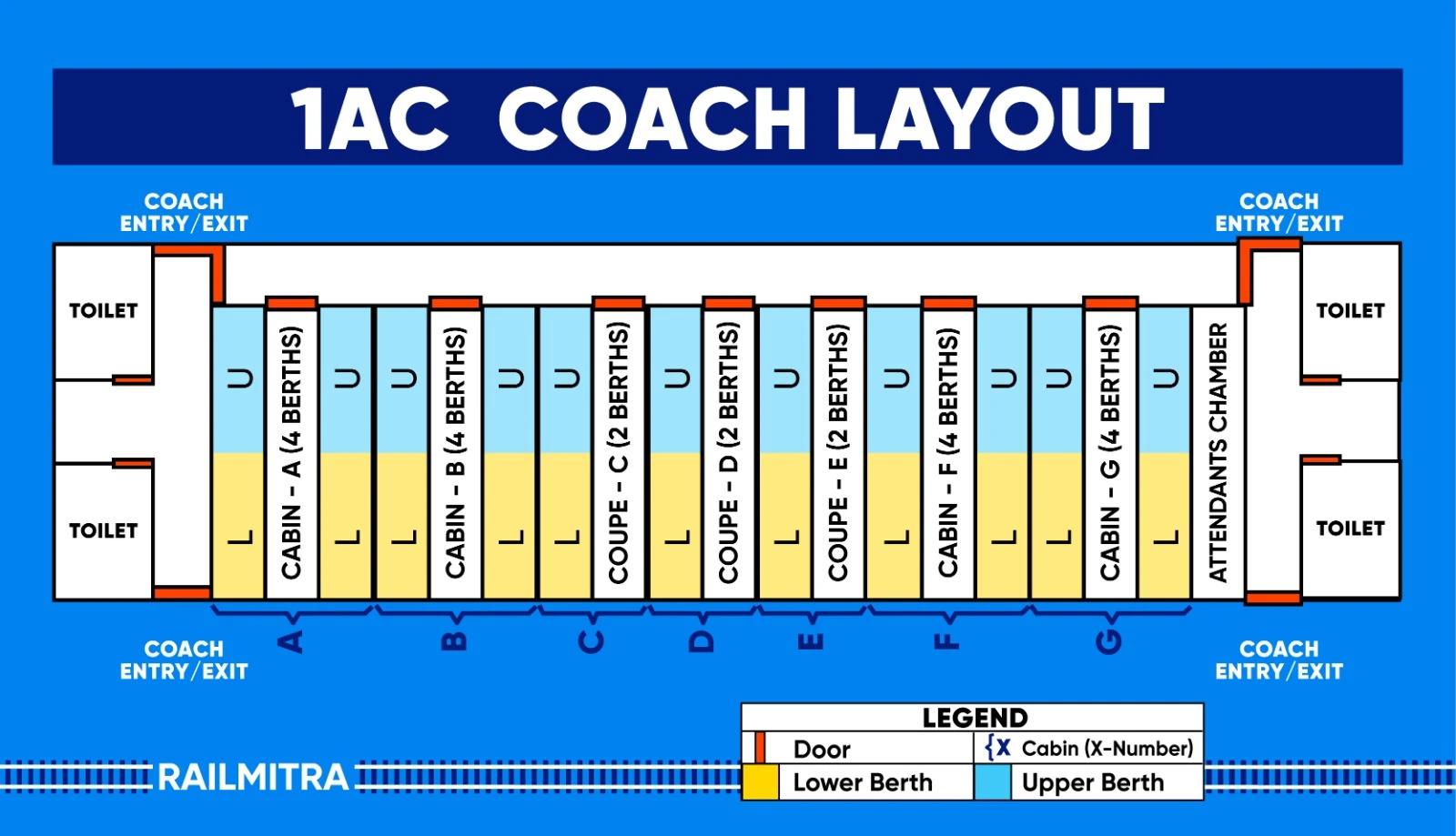
First AC, written as 1A, is the most private class on Indian Railways, and its seat layout reflects that. Instead of open bays, 1A coaches use cabins and coupes. A coupe holds two berths, a cabin holds four, and both come with lockable doors.
Strangers, shared bays, side berths facing an open aisle: none of that applies here. Each cabin works more like a small private room. Besides the fold out table, individual reading lights are also given, and you can draw curtains for the windows for full privacy.
The first-class coach comprises a maximum of 18 to 24 berths with a mix of single cabins and doubles, so to speak. The numbering goes through the cabin rather than through the berths, meaning that people who travel together must exactly request a joint cabin, not simply the adjacent numbers, since just the numbers are not an assurance of sharing a space in 1A coach. Checking seat availability on RailMitra before booking helps confirm whether full cabins are open for a particular date.
Second AC Coach Seat Layout
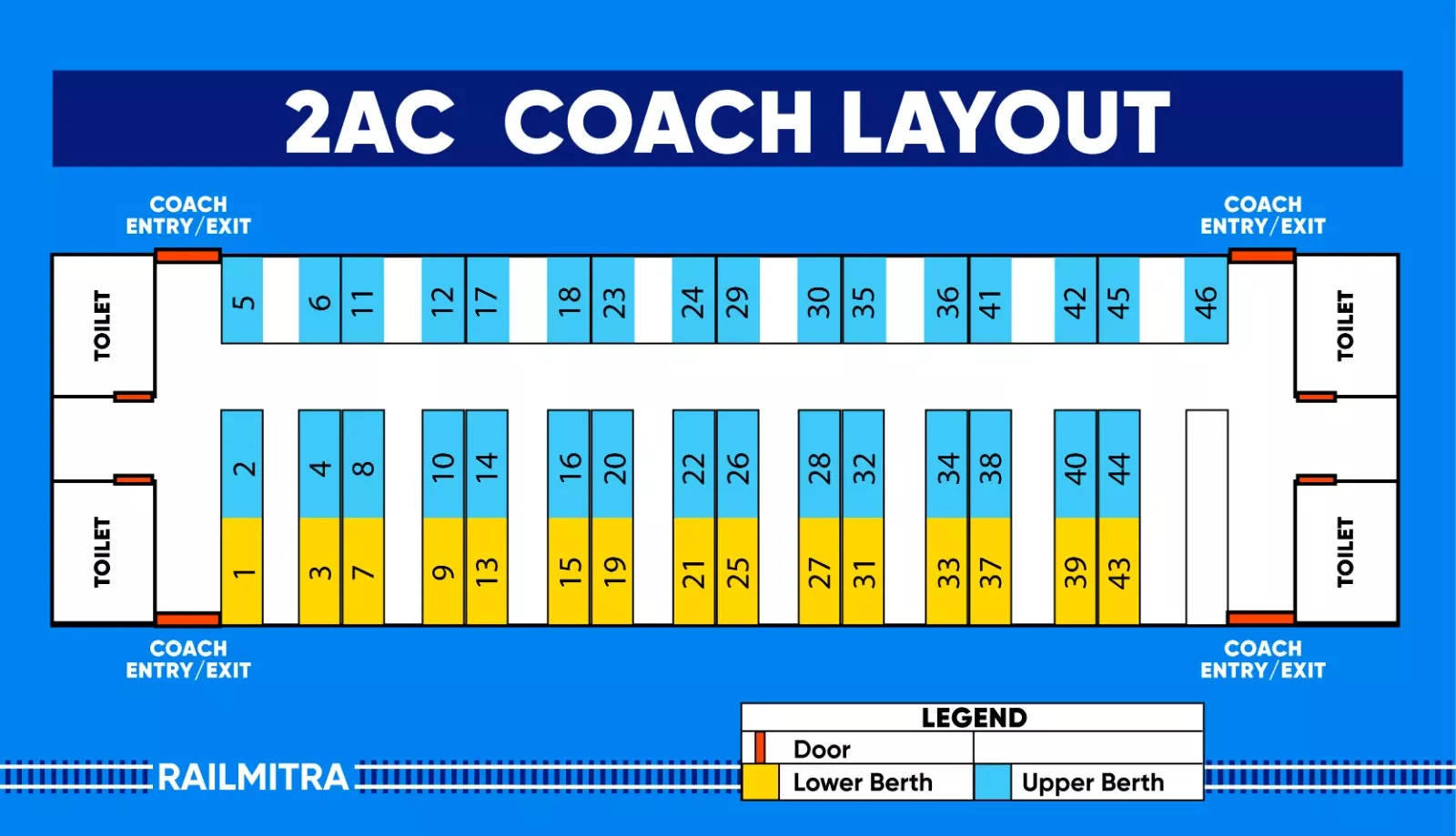
The second AC or 2A in train is just below the 1AC in terms of comfort and privacy. In this coach the seat layout comprises open bays with six berths inside every one of them. Four berths are arranged in groups of two (Upper berth and Lower berth) facing each other while other two berths run sideways and parallel to the direction of the train, i.e., Side upper and side lower berth in train .
Curtains separate each bay from the aisle, which is the defining feature of 2A seat position. Even though the space is shared, the curtain creates a visual boundary that cabins in 1A achieve with actual doors.
A standard 2A coach carries around 46 to 48 berths. Side berths are numbered in pairs and tend to get booked out faster since they offer a bit more openness compared to the enclosed main bay. Families often prefer the three berth combination on one side, since it keeps everyone together without needing the side positions at all.
Third AC Coach Seat Layout
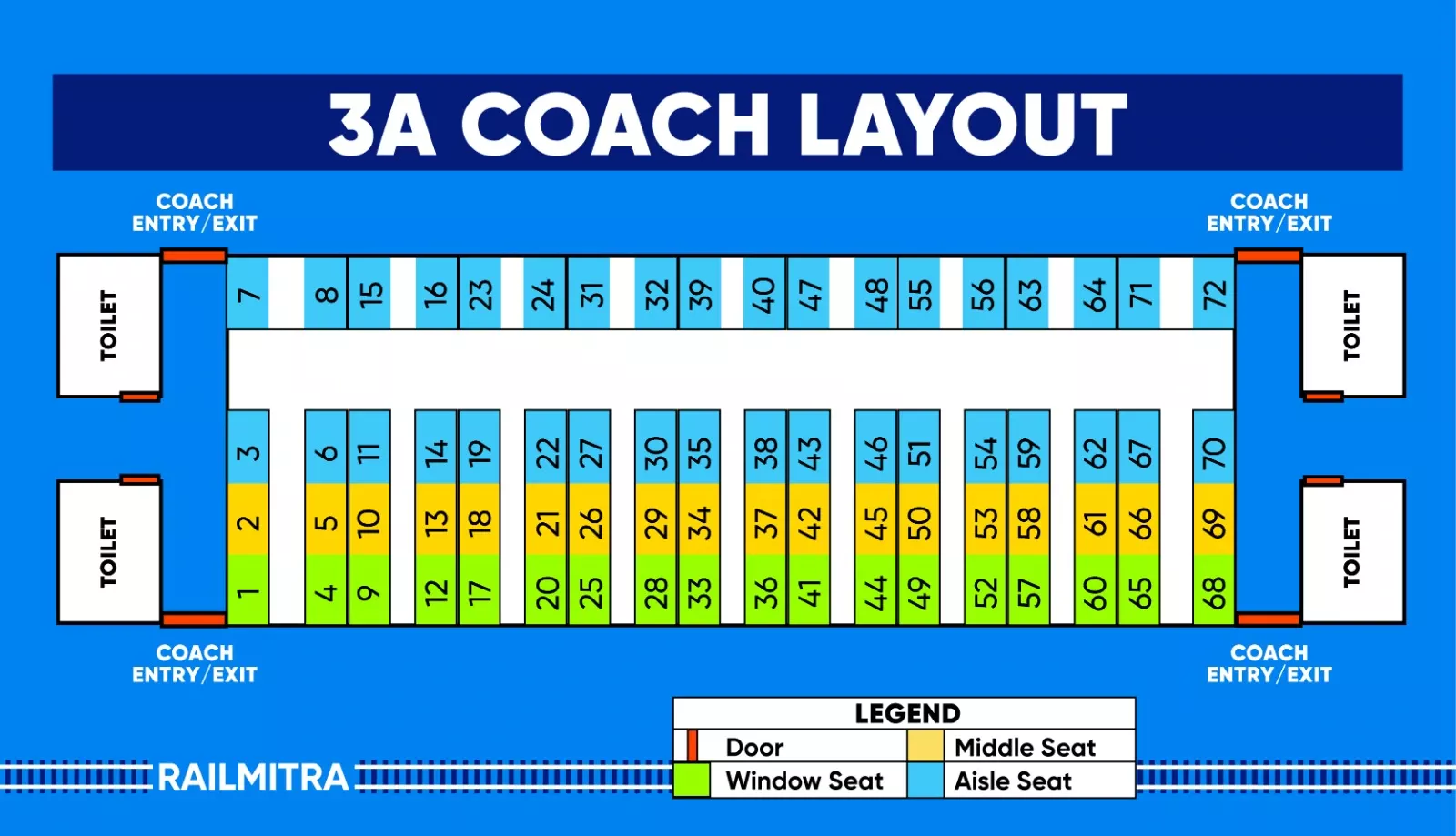
Third AC follows a similar bay structure to 2A but adds one more side berth, making it eight berths per bay instead of six. This single change alters the entire feel of the coach seat position, since three side berths are now used in some bay configurations depending on the coach type.
No curtains here, which is the main visual difference from 2A. The bay stays fully open to the aisle throughout the journey. A few newer 3A coaches on premium trains have started experimenting with curtains as well. It’s not standard yet across the wider network, more of a slow rollout than a rule.
A 3A coach typically holds between 64 and 72 berths, the highest capacity among AC sleeping classes. Its train seat map follows a repeating rhythm across the coach: six main berths, then two side berths, over and over until the layout runs out of length. That capacity, paired with fares lower than 2A, is exactly why 3A ends up as Indian Railways’ most booked AC class.
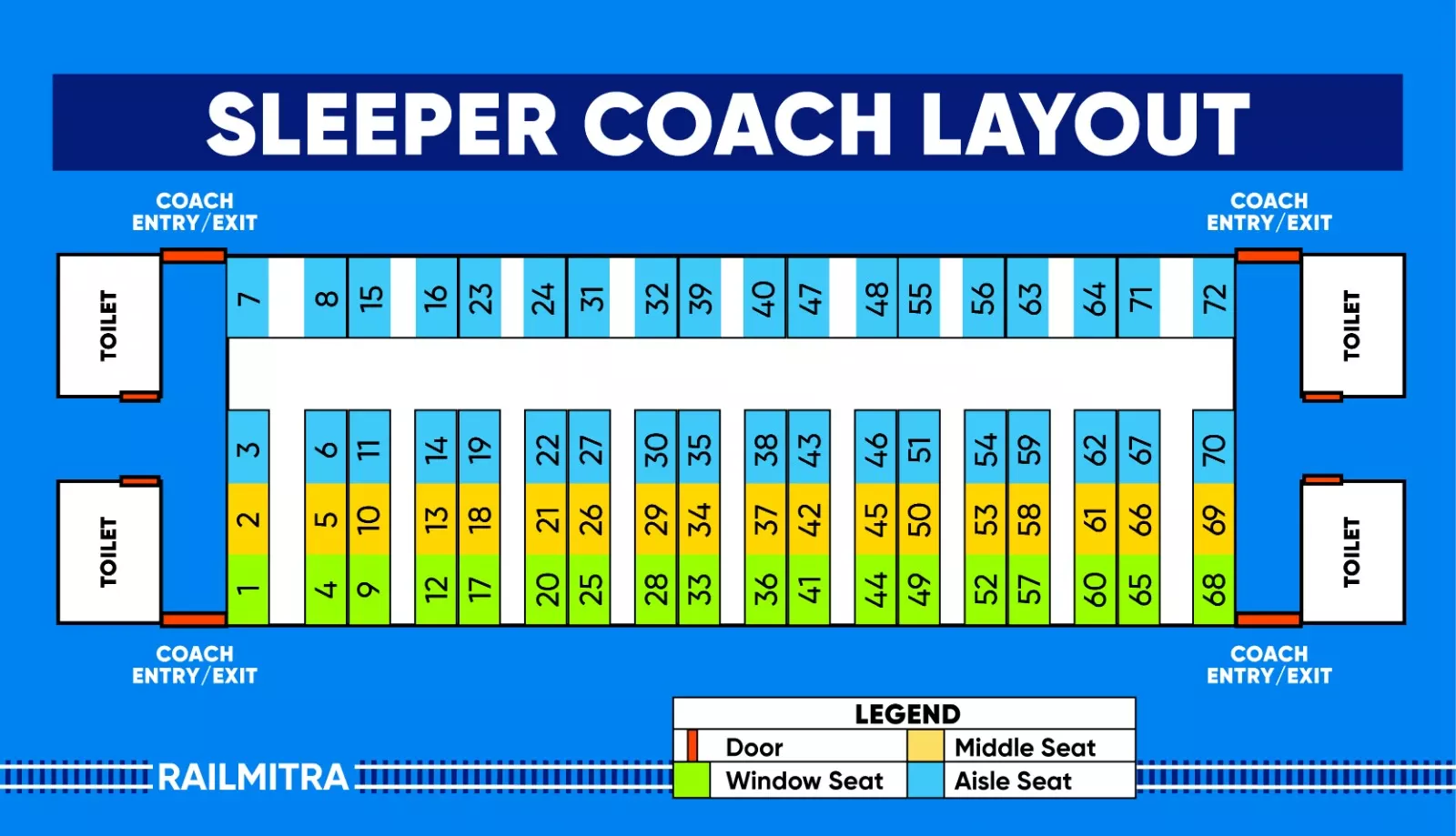
Sleeper Coach Seat Position
Sleeper, marked as SL, is the non AC counterpart to 3A, and the bay structure barely changes: eight berths per bay, six main plus two side. What’s missing is air conditioning. In its place, open windows and ceiling fans do the work.
Seat position logic carries over from 3A almost exactly: lower, middle, upper inside the main bay, side lower and side upper running along the aisle. Between 72 and 80 berths fill a typical Sleeper coach, which makes it the real backbone of long distance capacity across Indian Railways.
Because Sleeper coaches are the most affordable reserved class, competition for lower berths runs especially high, particularly among senior citizens who get priority allocation. Anyone unsure whether their booking confirmed a proper berth position should check PNR status on RailMitra, which shows the exact coach and berth number well before the journey begins.
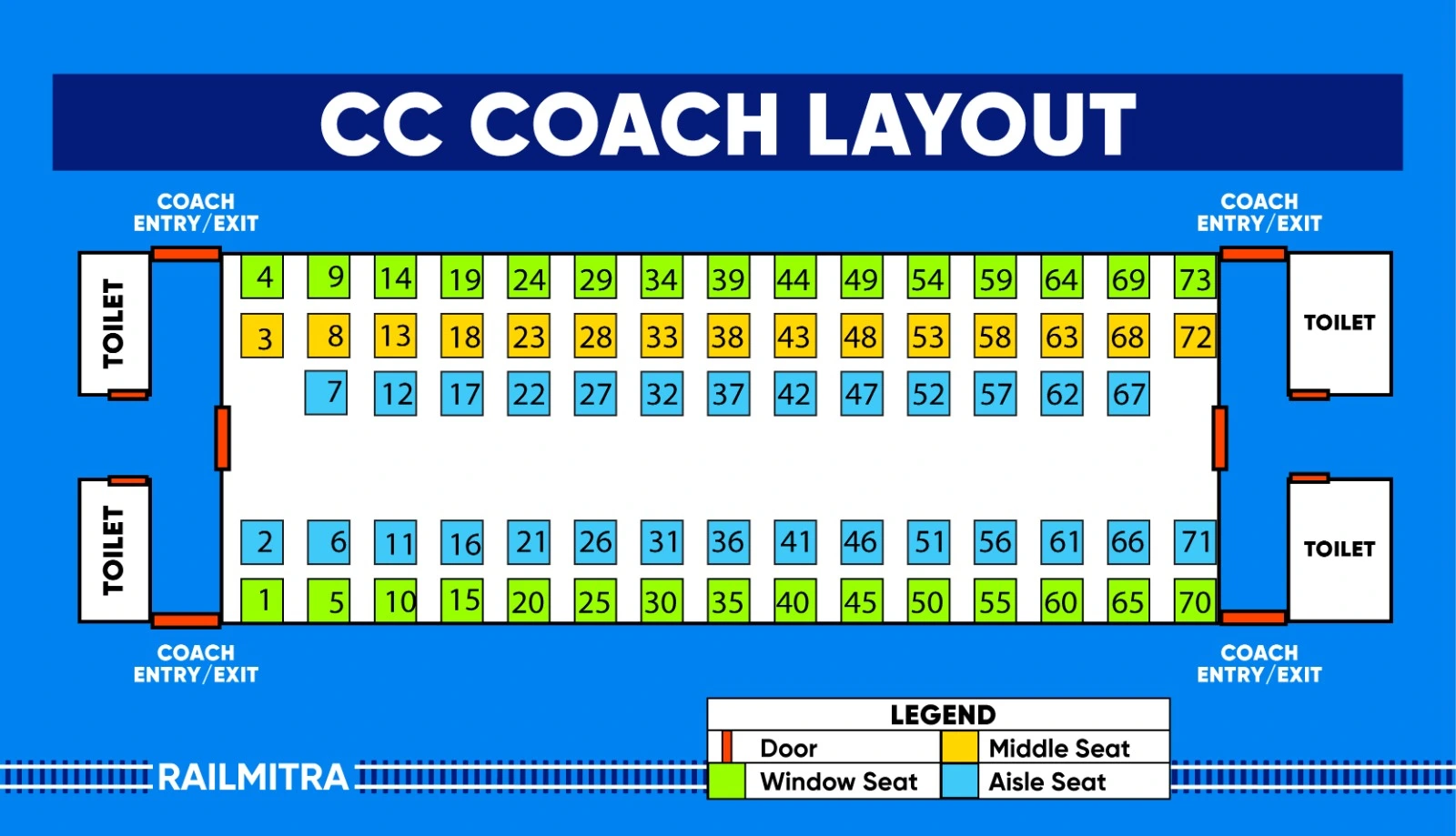
AC Chair Car Seat Layout
Chair Car or AC Chair Car, as it is called in India, doesn’t have sleeping berths. Instead, it offers upright seating that is much reminiscent of a commercial airplane cabin. If you look at it side on, you’ll find 3 seats on one side of the aisle and 2 seats on the other, with no berths visible anywhere, just like in the picture shown below.
Day trains and shorter routes suit this seat position style best, mostly because nobody really needs to lie down for a five or six hour ride. Legroom stays moderate. Seats recline a little, though nowhere near what a berth offers when it folds flat.
A standard CC coach carries around 78 seats, sometimes more depending on the train. Window seats naturally get preferred first, followed by aisle seats near the front for quicker exit access. Trains like Shatabdi Express run almost entirely on CC and EC combinations, skipping sleeping classes altogether since these are meant for same day travel.
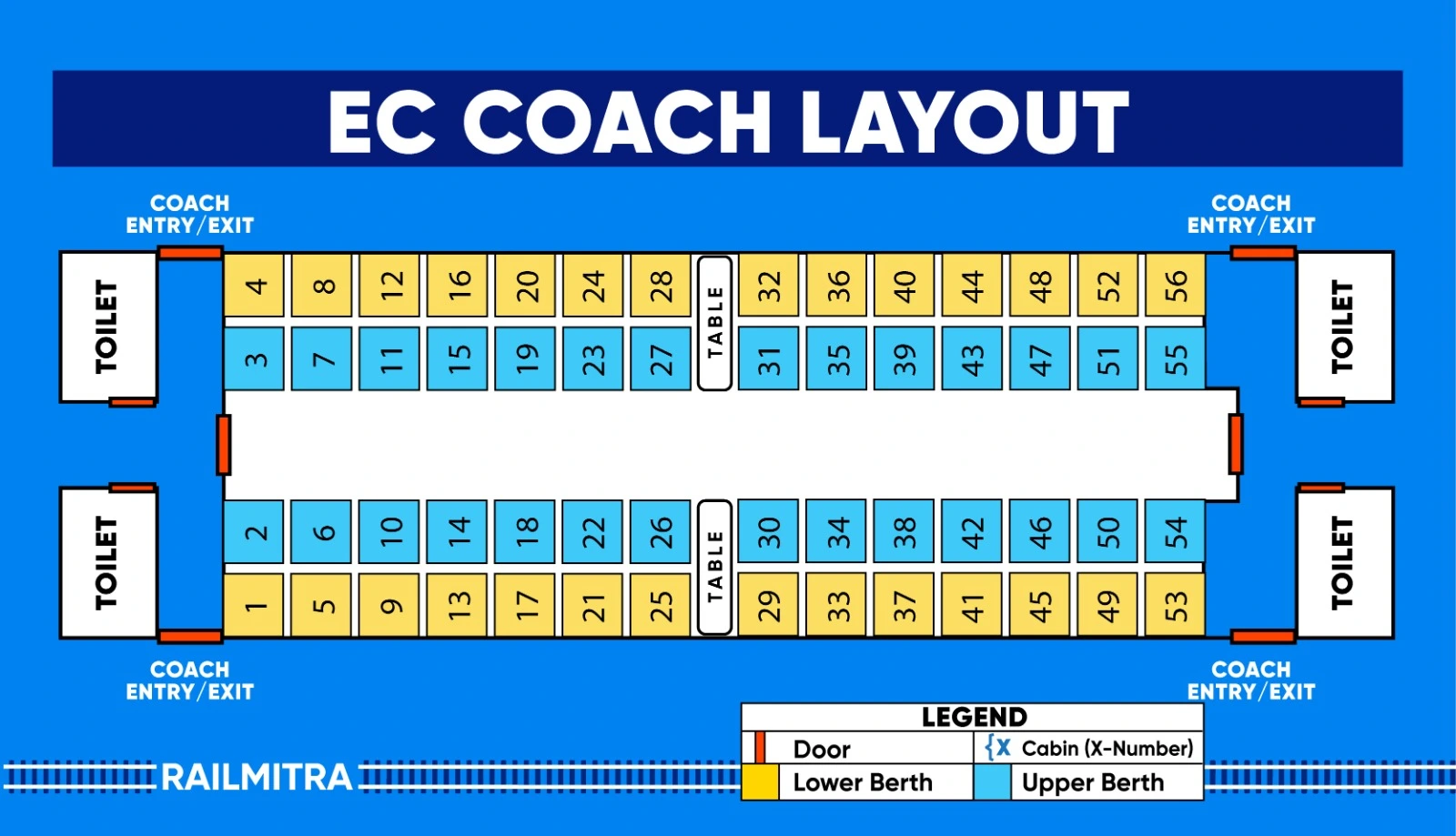
Executive Chair Car Seat Layout
Executive Chair Car, written as EC, sits above regular CC in both comfort and pricing. Instead of the usual 3×2 seating arrangement in CC, the EC coach offers 2×2 seating arrangement. This gives the passengers extra shoulder space which is way more comfortable than the cramped up CC coaches.
Even the cushions are bigger which changes how you recline on these seats. EC seats in newer trains can rotate about 180° which allows passengers to face their seats in the direction of the window or towards their group. The number of rows is similar to a CC coach, however EC coaches have fewer seats per row. This makes the EC coach even more spacious than the CC coach in train.
An EC coach in train usually consists of about 52-56 berths. Clearly, the seat count is lower and comfort level is higher in this coach. Thus the fare of berths in this coach is higher as well. This is the reason why most of the business travellers on the train choose EC coaches and prioritize spaciousness and comfort over pricing.
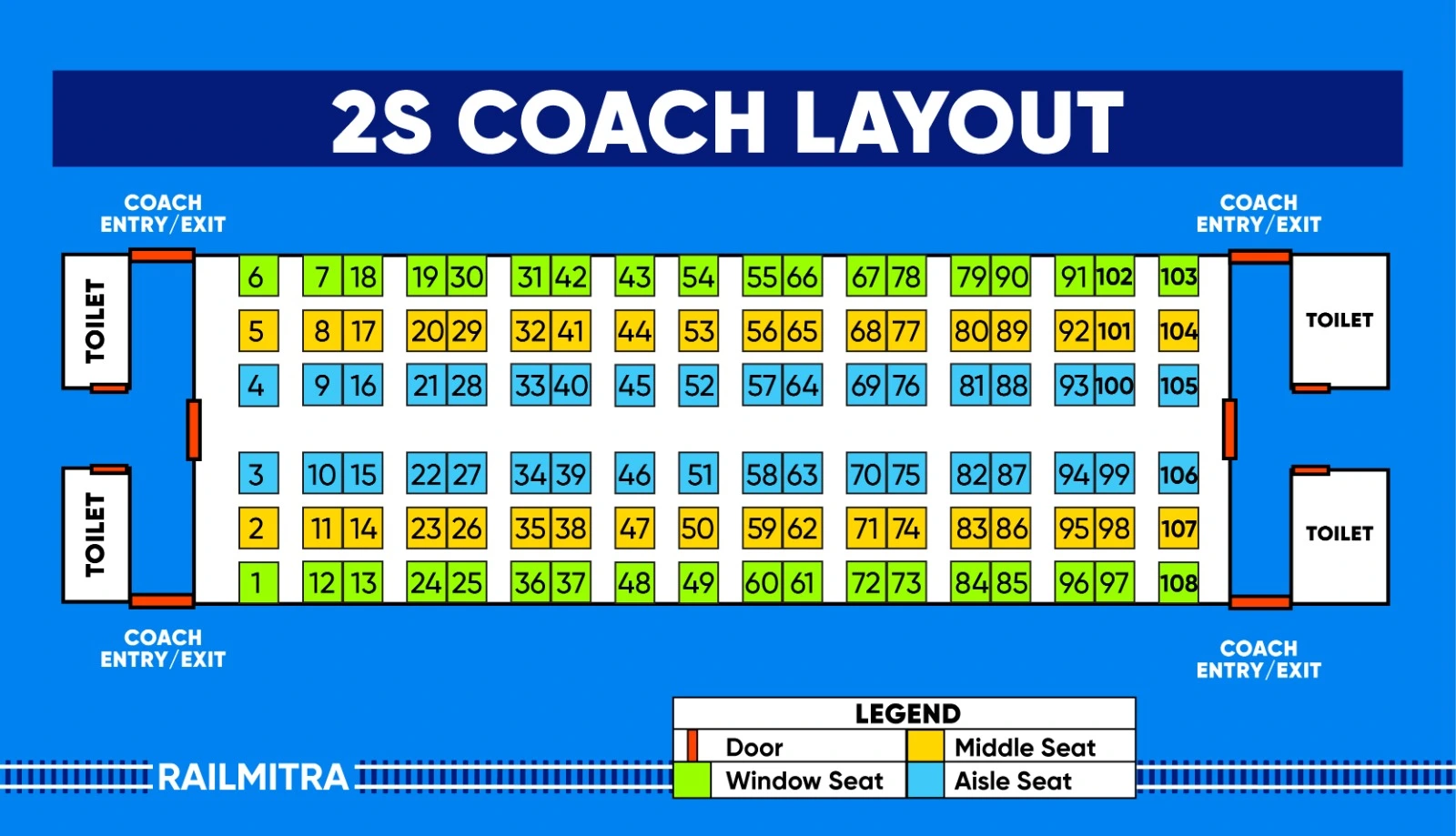
Second Sitting Coach Seat Position
Second sitting or the 2S coach in train is one of the most basic sitting classes in Indian Railways. This coach doesn’t have Air Conditioning and follows the 3×3 seat layout across the aisle seating. With 6 seats in every single row, this coach has higher seat capacity than any other AC sitting class.
The 2S Coach in train has a sitting arrangement which is a bit more compact than other sitting coaches. It has less legroom and the seats are narrower as well. Passengers can open the window for ventilation. There are ceiling fans in this coach which provide the necessary cooling during summers. This class was not built to provide comfort. It was meant to provide a budget travel option for short distance journeys.
A 2S coach can carry upwards of 100 seats depending on the train design. Because ticket prices stay extremely low, this class fills up fast on popular short routes, and live train running status becomes especially useful here since 2S heavy trains often stop at multiple intermediate stations, shifting arrival estimates along the way.
Checking PNR Status on RailMitra
Once a ticket is booked, the actual coach and seat position only gets finalized closer to the journey date, especially for waitlisted or RAC tickets. This is where PNR status becomes essential. Every ticket carries a ten digit PNR number, and checking it reveals the current booking status along with the confirmed coach and berth details.
RailMitra keeps this part simple. Type in the PNR number, wait a few seconds, and the site shows whether the ticket is confirmed, RAC, or still waitlisted, seat number included the moment it’s allotted. For anyone tracking a seat map assignment ahead of travel, this single check clears up most of the confusion in one go.
Status updates typically stabilise a day or two before departure, though final charting happens a few hours before the train leaves. The number closer to departure is the one worth trusting. Early checks often show a status that shifts again before the chart actually locks in.
Checking Train Seat Availability on RailMitra
Before booking, knowing whether seats are actually open in a particular class saves a lot of back and forth. RailMitra’s train seat availability tool exactly does that by pulling up real time seat status of various classes for any entered train and date.
Just type the train number or name, select the journey date, and the tool shows you the seat availability of Sleeper 3A 2A, 1A, and sitting classes on a single screen. It gets really handy during festival days for example when certain classes get sold off within minutes whereas others still have vacancies, thanks to an accurate display.
Dates matter more than people assume. A fully booked 3A on one date might open up completely a day earlier or later, and 2S or CC on the same route often still shows seats when the premium classes don’t. Running that check before payment saves the trouble of ending up on a waitlist nobody wanted.
Ordering Food During Your Train Journey
Long journeys eventually come down to one question: what’s actually available to eat once the train leaves the platform behind. RailMitra’s train food delivery service solves this by letting passengers order meals straight to their seat, delivered at whichever station falls next along the route.
The process stays simple. Enter the PNR number manually, the system would automatically fetch the train’s current whereabouts together with the next series of stations. Based on those pieces of information, people can choose from a list of local eateries and authorized vendors, have a look at the menus, and order food such that when the train halts, their food just arrives.
This removes the usual gamble of platform food stalls or inconsistent pantry car service. Meals arrive fresh, ordered according to personal preference rather than whatever happens to be available at a particular stop. For longer routes crossing multiple states, this also means access to regional food options that change as the journey progresses, something station vendors alone could never offer.
Final Thoughts on Train Seat Maps
A train seat map turns booking into an informed decision instead of a guess. A side lower berth in Sleeper for easy access, a cabin in 1A for privacy, or a window seat in EC on a short business trip. Each choice comes down to understanding seat position before the ticket is even confirmed.
From 1A down to 2S, every coach type runs on its own layout logic. Once that pattern is clear, reading a seat map stops feeling technical. Pair that with RailMitra’s tools for PNR status, live train running status, and seat availability. Most of the guesswork around Indian train travel just falls away.