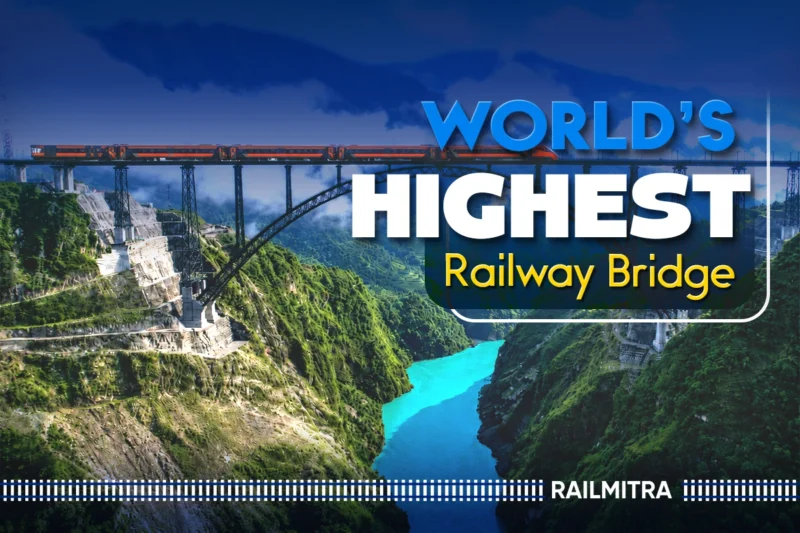
A bridge taller than the Eiffel Tower, sitting over a Himalayan gorge where a footpath was about all that existed until recently. That is the Chenab Bridge. Getting a train across took the better part of two decades, plans, redesigns, false starts, the works.

Set across the Chenab River in Jammu and Kashmir, it has changed what a rail journey into that region looks like for good. Getting a structure this tall to survive 266 km winds and an active earthquake zone took engineers years past their original timeline. What follows covers where Chenab Bridge stands, the regions it links, the trains running across it now, and what matters before booking this route.
Chenab Bridge: The World’s Highest Railway Bridge
This bridge turns up on nearly every list of Indian engineering marvels these days, and the reason comes down to one figure: 359 metres above the riverbed. Thirty five metres past the Eiffel Tower, if you need something familiar to measure against. The main arch alone runs 467 metres, the longest span on any rail bridge in the world, with the full crossing stretching 1,315 metres over 17 spans.
Two records get confused here often. The longest railway bridge belongs to the Danyang Kunshan Grand Bridge in China, over 164 kilometres of mostly flat viaduct, nothing like the climb Chenab Bridge makes. Chenab Bridge isn’t the longest rail bridge, but it is the highest rail bridge in the world. The Duge bridge in China is much higher than this bridge, however it isn’t a rail bridge but a road bridge instead.
None of this height would matter much if the bridge could not actually hold up. Reasi falls inside seismic zone V, about as high risk as earthquake classification gets in India, and wind through that valley rarely stays calm. The arch had to be designed for gusts up to 266 kilometres an hour and quakes reaching magnitude 8, figures that drove nearly every material decision on site. A 120 year design life too, in a location most contractors would have abandoned after the first site survey.
Where Is Chenab Bridge Located
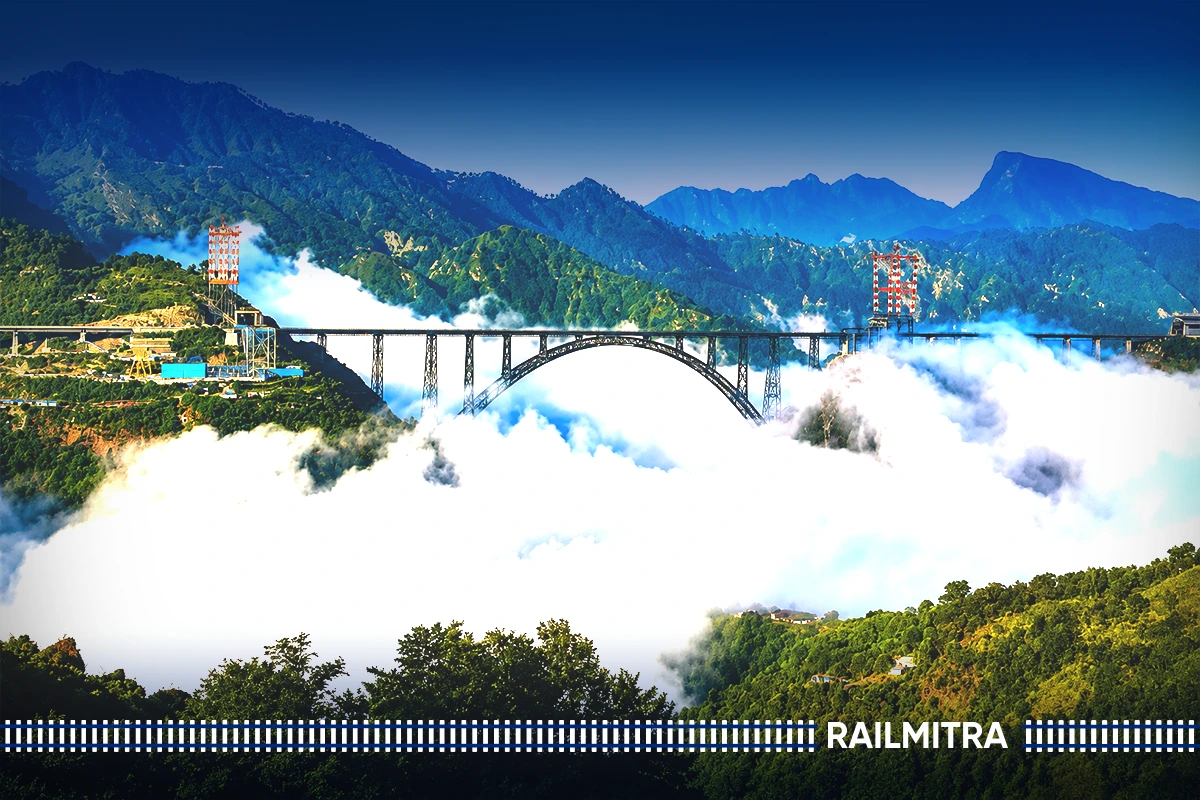
The bridge sits in Reasi district, Jammu and Kashmir, nothing more complicated than that for a location. It connects Bakkal and Kauri stations across the river gorge, forming one piece of the much larger Udhampur Srinagar Baramulla Rail Link, known to most people simply as USBRL, which Indian Railways has been building in stages for more than twenty years now.
Reasi was always going to be the difficult stretch. The rock underneath is young Himalayan geology, broken in places, inconsistent in strength from one section to the next, and the valley narrows enough that a conventional bridge design would not have fit the space available. Engineers studied a cable stayed option early on before settling on the arch, largely because of how that narrow gorge constrained everything else.
Trip through this stretch coming up? Trains between stations is worth checking before you plan around it, since halts at Reasi and along the Katra to Srinagar sector have changed more than once since the line opened in 2025, and schedules here still shift as new demand data comes in.
History of the Chenab Bridge
Talk of a rail line into the Kashmir Valley goes back further than most travelers assume. The USBRL project itself took real shape through the 1990s and into the early 2000s, and work on the Chenab crossing specifically began in the years that followed, once the alignment through Reasi was finalised.
Slow going, and not because anyone lacked ambition. Terrain would have been reason enough for delay on its own. Add funding gaps, changes to the alignment, and security concerns tied to the region, and progress stretched across years rather than months. Work even paused at one stage while engineers went back and reassessed whether the arch design could genuinely survive the seismic risk on site. Materials moved in on horses and mules before roads reached the construction area, which says something about how remote this part of the Himalayas still is.
The arch reached structural completion in 2021. August 2022 brought the formal inauguration, though no trains ran that day, not for a while actually. It was not until June 6, 2025 that passenger service actually began, with Prime Minister Narendra Modi flagging off the first Vande Bharat Express between Katra and Srinagar that day. Two decades of planning and redesign, all folded into one morning.
Engineering Behind the Bridge
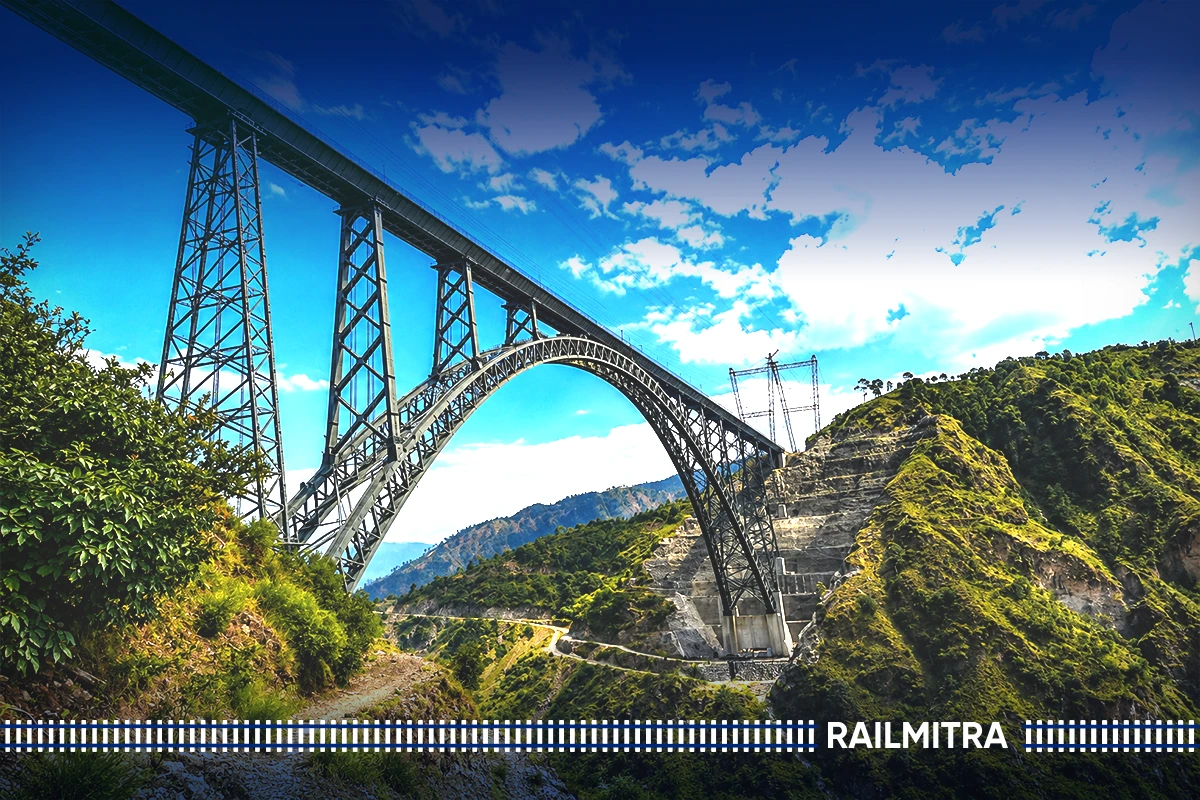
There was no existing Indian design code for a bridge at this height and span. None. So the project pulled in outside expertise from the start. WSP Finland handled early stage planning, Leonhardt Andra und Partner led the arch design itself, and the Defence Research and Development Organisation worked alongside the Indian Institute of Science on seismic and geotechnical questions the site kept raising.
Steel and concrete, with the arch built from large steel trusses specifically to cut down wind resistance. Cable cranes and derrick systems lifted material to heights where conventional cranes simply could not reach, because the gorge left no room to build ground level scaffolding across most of the site.
Afcons Infrastructure led construction, working with Ultra Construction and VSL India through the build. The total cost came to roughly 1,486 crore rupees, which covers both the tonnage of steel that went in and the years spent reworking the design each time the site turned up a new geological surprise. Around 300 civil engineers worked on it, joined by more than 1,300 labourers, plenty of them pulling round the clock shifts to stay ahead of weather windows that close fast up in the mountains.
Regions Connected by Chenab Bridge
No train had ever reached the Kashmir Valley before this bridge. Road was the only way in, through routes like the Jawahar Tunnel, and those roads shut down regularly through winter under snow and landslides. That is the gap Chenab Bridge closes, as part of the wider USBRL line linking Srinagar and the Valley to Jammu, and from there into the rest of the national rail network.
Earlier this region faced severe connection issues, especially during the winter period. Now it is connected by an all weather rail network and all year connectivity. Checking the train schedule for the Katra to Srinagar has become a common thing with the travellers, as checking the flight ticket was the norm earlier.
Trade follows connectivity, and Kashmir’s horticulture sector feels this directly. Apple growers in particular depend on getting produce out of the Valley fast, and a line that does not shut with the first heavy snowfall means fewer losses timed around uncertain road conditions. Pilgrims heading toward the Vaishno Devi shrine near Katra get something out of this too, a direct rail option where none existed in this form before.
Why the Chenab Bridge Matters Beyond the Record Books
Records make headlines. The everyday value sits somewhere else. Defence logistics get easier when troops and supplies can move by rail instead of leaning entirely on road convoys through difficult mountain passes. Tourism picks up as well, since the bridge has turned into a destination in its own right, with people travelling specifically to see it and ride across.
There is a national integration argument too, one officials have repeated often since the opening. A journey that once meant switching between road and rail now runs on a single line connecting the Valley to the rest of the country, a link that had simply not existed since independence. In a region shaped for decades by infrastructure gaps, a working rail bridge across the Chenab is not a footnote.
Important Trains Running on the Chenab Bridge
Vande Bharat Express is, for now, the only train that crosses this bridge, split into two pairs working the Katra to Srinagar sector. Trains 26401/26402 and 26403/26404 bring a journey down to under three hours, a trip that used to swallow most of a day by road.
8:10 AM out of Katra on Train 26401, quick stops at Reasi and Banihal, then Srinagar by 11:08 AM. Going back, Train 26402 pulls out of Srinagar at 2:00 PM and gets into Katra close to 4:58 PM. The other pair alternates days with this one. Built for Kashmir winters specifically, expect heated windscreens, insulated toilets, and anti freeze systems keeping these trains moving well below zero.
Live train status has become something people actually check on this route, since Himalayan weather can shift a schedule on short notice regardless of how well built the train is. An extension toward Jammu Tawi is expected once redevelopment there finishes, which would eventually put Chenab Bridge within a single ticket journey starting from Delhi.
Train Routes and Connectivity via Chenab Bridge
Right now, the operational stretch runs Katra to Srinagar, through Reasi and Banihal, home base at Shri Mata Vaishno Devi Railway Station on the Katra end. This one section alone crosses both Chenab Bridge and the Anji Khad Bridge, India’s first cable stayed rail bridge, inside a single short journey.
Longer term, both ends of this line are meant to stretch further. South of Katra, once Jammu Tawi finishes its redevelopment, a direct service is expected connecting Delhi through Jammu and Katra all the way to Srinagar. Eventually the line is meant to stretch north to Baramulla too, rounding out what officials like to call a rail link from Kashmir to Kanyakumari, though that is more a connected network than any single train running the whole distance.
Got a multi leg trip in mind? It pays to check Seat Availability separately for each sector on a trip like this, Delhi to Jammu, Jammu to Katra, Katra to Srinagar, because a confirmed seat on one leg tells you nothing about the next. Winter demand fills seats fast here, given how few real alternatives exist for reaching the Valley in that season.
Book Food in Train While Crossing Chenab Bridge
Winter through this himalayan route is brutally cold and skipping your meal is not something you would like to do. The low temperatures of this route make hot food not only a choice but a necessity. RailMitra provides food in train which can be booked ahead of the journey. The delivery arrives hot and fresh at the station of your choosing. So, you don’t have to rely on chance and can get the food you want at the place you want with RailMitra food delivery.
Works the same way here as it does on any other route on the network. Pick a stop along the way, choose from restaurant options serving that station, and the order reaches your seat around the time the train pulls in. Halts at Reasi and Banihal pass quickly, so a meal arranged ahead of time beats hunting a platform stall while you would rather be watching the gorge go by.
This route has turned into something of a scenic ride alongside being a practical one, and a warm meal that lands at the right stop changes how the whole crossing feels.
Chenab Bridge Photos and Best Viewpoints
Photographs of the bridge have spread fast since the 2025 opening. Drone shots showing the full arch against the gorge. Shots from inside a moving train as it crosses. Neither really captures the scale on its own, since height only registers with something familiar in frame, a road, a person, a vehicle, anything for comparison.
Reasi town has a viewpoint set up now for anyone who wants ground level views without boarding a train. The road into Katra from Jammu offers distant glimpses too, useful if you are travelling by car rather than rail. For train passengers, daylight crossings give the best window seat views, since the bridge stays visible for roughly as long as it takes to cross the gorge.
Winter shots, snow across the surrounding peaks, tend to get shared the most online. Though honestly, the steel arch against that valley photographs well whatever the season.
Conclusion
Chenab Bridge is not just a number sitting in a record book somewhere. It is the reason a train can cross a gorge that road travel alone was never going to solve, tying the Kashmir Valley into the rest of India in a way that holds through winter, through wind, through terrain that took engineers more than twenty years to work out. The height, the decades behind its construction, the regions it now links, the trains running across it daily, all of it adds up to one of the more significant infrastructure stories to come out of India recently. Anyone planning a trip on this route will find the bridge itself is worth as much attention as wherever the train happens to be headed.
Frequently Asked Questions
Q. How high is Chenab Bridge?
A. It stands 359 metres above the Chenab River. Nothing else in rail travel goes this high.
Q. Where is Chenab Bridge located?
A. Reasi district in Jammu and Kashmir, linking Bakkal and Kauri stations under the USBRL project.
Q. When did Chenab Bridge open for trains?
A. Passenger trains began June 6, 2025. The arch had been structurally finished back in 2021 and got its formal inauguration a year after that, in 2022.
Q. Which trains run on Chenab Bridge?
A. Just the Vande Bharat Express for now, moving between Katra and Srinagar.
Q. Is Chenab Bridge taller than the Eiffel Tower?
A. By 35 metres, yes.