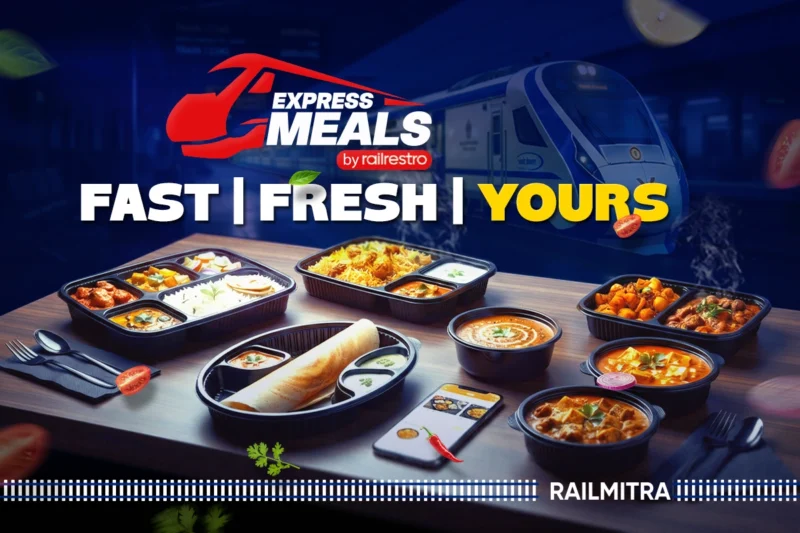
Long train journeys in India have always come with one nagging question. What do I eat once the train is running and the pantry car runs short? Express Meals answers that question directly.

It is RailMitra’s new food delivery service built specifically for passengers who want fresh, restaurant style meals delivered straight to their seat, without the guesswork that usually comes with eating on a moving train. For anyone tired of soggy sandwiches or cold rice, Express Meals changes the entire experience of eating while travelling.
What Makes Express Meals Different
Board any train and the food situation is still a bit of a lottery. One vendor at one station, a completely different one two hours later, and no way of knowing beforehand what either of them will actually have. Express Meals sidesteps that entirely. The menu stays the same whether you are somewhere near Kanpur or several states away, so you already know what you are ordering long before the train pulls out of the platform.
Then there is timing, and this is where things get interesting. Deliveries are built around the train’s actual halt schedule rather than some generic estimate, which means the food shows up while there is still time to eat it without rushing for the whistle. What happens if a delivery genuinely gets missed at a short halt? Older systems would just cancel the order and leave the passenger to figure something out. Express Meals does not do that. The order simply gets fulfilled at the next station instead.
That single detail removes a surprising amount of anxiety. Anyone who has watched a five minute halt disappear while still waiting on food knows exactly what kind of stress this solves. A Menu Built Around the Journey, Not Just the Clock
A Menu Built for Life on the Rails
Express Meals does not try to be everything to everyone. Instead, it builds its menu around what a traveller actually needs at different points in the journey. Breakfast options lean light, think bread omelette or a simple veg sandwich, food that settles well early in the morning. Come evening, the tone shifts. A travel combo meal, or an express mini thali, both built to feel like an actual sit down dinner rather than something eaten off a fold down tray table in a hurry. And for the hours in between? A paneer sandwich covers the quick bite crowd just fine.
The categories themselves are organised simply. Express Veg Meals start at a friendly 149 rupees, and there is a separate non vegetarian line for those who want it. Alongside these sit Express Bites for lighter cravings and Express Combo Meals for anyone who wants more variety in a single order. Nothing about the menu feels like an afterthought bolted onto an existing catering system. It reads like something built specifically with the train journey in mind.
How to Book Food in Train Without the Usual Hassle
Booking used to mean flagging down a vendor and hoping they had what you wanted left. That is no longer necessary. If you want to book food in train through Express Meals, the process runs entirely through the RailMitra platform. You enter your PNR, the system identifies your train and your upcoming stations automatically, and you choose from the available menu at that point in your journey.
There is no back and forth over cash, no confusion about whether the vendor has changed their stock, and no need to remember which station serves what. The moment your order is placed, it moves into a system that tracks your train’s live position, so the delivery timing adjusts to reality rather than a fixed schedule that ignores delays. If your train is running late, the system knows it. If it is running early, the system knows that too. Passengers do not need to track any of this manually.
This matters more than it sounds. A huge share of the frustration around eating on a train has nothing to do with the food itself. It comes from uncertainty. Will it arrive on time? Will it arrive at all? Express Meals removes that layer of doubt almost entirely by building the ordering process around the train’s actual movement instead of a generic timetable.
Ordering for the Whole Family or Group
Anyone who has travelled with family knows that ordering food one meal at a time gets tedious fast. Express Meals accounts for this with a group order option built directly into the platform. Instead of placing four or five separate orders and hoping they all arrive together, a group travelling in the same coach can place one combined order and have it delivered as a set.
This is particularly useful for families booked in the same compartment, or groups of friends travelling together for a wedding, a pilgrimage, or simply a long vacation. Pack based options, like combinations of four or six meals under a single payment, make the entire process faster and noticeably cheaper per head compared to ordering individually. It also means less back and forth with the delivery staff, since one person can manage the entire order for the group.
There is a practical side to this too. Coordinating separate deliveries across a group during a short halt can get chaotic, especially at stations where the train barely stops for five minutes. A single group order arriving together solves that logistical headache without anyone needing to plan around it.
Catering to Dietary Needs, Including Jain Food
Food preferences on Indian trains rarely get much attention. Vendors offer whatever they happen to have, and travellers with specific dietary requirements often just settle for whatever comes closest. Express Meals takes a different approach here. Dietary options sit inside the core menu itself, not tucked away as some rare exception someone has to ask about.
Need Jain food in train? This is where the service actually delivers on something most passengers have quietly wanted for years. No special requests, no phone calls to confirm availability. Just a straightforward selection within the same ordering flow everyone else uses, with the same delivery reliability behind it.
That says something about how the whole service was designed. Dietary needs were not bolted on as an afterthought here. They were part of the plan from day one, so passengers with specific requirements get exactly the same speed and reliability as everyone else, rather than some slower, separately handled process tucked in the back.
Pricing That Matches a Traveller’s Budget
Here is where Express Meals quietly does something smart. A Veg Meal starts at 149 rupees, and that number sits right where most travellers already expect to be spending on food during a journey anyway. This is not premium dining dressed up for a captive audience on a train. It is priced closer to a decent meal near any railway station, just delivered straight to your seat instead of requiring you to go find it.
Why does that matter? Because train food pricing has historically lived at two extremes. Either suspiciously cheap and correspondingly poor in quality, or suddenly expensive the instant a passenger has no other option left. Express Meals sidesteps both traps entirely by keeping one fixed, predictable price structure no matter which station the order actually comes from.
Combo meals and bite sized options give passengers flexibility depending on how hungry they actually are, rather than forcing an all or nothing choice between a full thali and nothing at all. For a quick breakfast, the lighter options keep costs low. For dinner, the combo and thali options offer better value per rupee than piecing together a meal from whatever a station vendor happens to have that day.
Comparing Express Meals to Traditional Pantry Car Food
Ask any regular traveller about pantry car food and you will hear the same complaints every time. Same three items, no matter the route, no matter the time of day. Express Meals grew out of exactly this frustration. Instead of one centralised kitchen trying to feed an entire train from start to finish, the model pulls fresh food in from vendors near each individual station along the way.
Take a passenger travelling from Kanpur to Patna as an example. They are not stuck eating the same three items the whole way through. Each station along that route can offer something genuinely different, so the food actually reflects where the train currently is, not where it started out hours earlier. That single shift changes how people think about eating during long journeys altogether.
Quality tells a similar story. Pantry meals often sit prepared for hours before they are reheated and served. Express Meals works with local restaurant partners near each station instead, which usually means a much shorter gap between preparation and delivery. Less time sitting around, more of it actually reaching you fresh.
Why the Train Food App Matters More Than People Realise
A lot of what makes Express Meals work sits quietly in the background, inside the train food app itself. Passengers rarely think about the technology powering a food delivery service until something goes wrong, but this is exactly where Express Meals does most of its heavy lifting. Live train tracking feeds directly into delivery timing, PNR details pull up the correct route automatically, and station level menus update without the passenger needing to search for anything manually.
One app, everything in it. Order history, delivery status, menu browsing, all sitting in a single familiar interface instead of scattered across phone calls, cash exchanges, and half remembered vendor conversations from your last trip. For frequent travellers especially, that alone removes a surprising amount of friction from a routine that used to involve constant guesswork.
There is a bigger shift happening underneath all this too. Food delivery to your home has been fast and reliable for years now. Trains were the one place that standard never quite reached. Express Meals finally closes that gap, years later than it probably should have.
Making Long Journeys More Comfortable
People rarely give food enough credit for how much it shapes a long journey. Get dinner right on an overnight train and the whole compartment settles differently, sleep included. Express Meals slides into this picture almost without announcing itself, quietly removing one of the more stressful parts of long distance travel, without asking a single passenger to change how they plan their trip.
Families travelling with children benefit particularly, since a hungry child on a delayed train is rarely a pleasant situation for anyone nearby. Business travellers benefit too, especially those who would rather spend a short halt reviewing notes than negotiating with a vendor through a train window. The service works quietly in the background for both groups, adjusting to whichever situation actually applies.
None of this requires travellers to alter their existing habits. The ordering process fits into time most passengers already spend on their phones anyway, checking train status or messaging family before arrival. Express Meals simply gives that time a more useful purpose.
Conclusion
Express Meals represents a genuine shift in how Indian train travel handles something as basic as a meal. A curated menu, delivery timing that actually adjusts to the train, group ordering for families, dietary options like jain food built in from the start, none of these are small fixes. Together they solve several long standing frustrations at once, instead of patching over just one and calling it a day. Add fair pricing and a properly built app underneath all of it, and the shift toward Express Meals starts making a lot of sense. Next time hunger strikes somewhere between two stations, this is a far more reliable answer than waiting around and hoping the pantry car has something left.