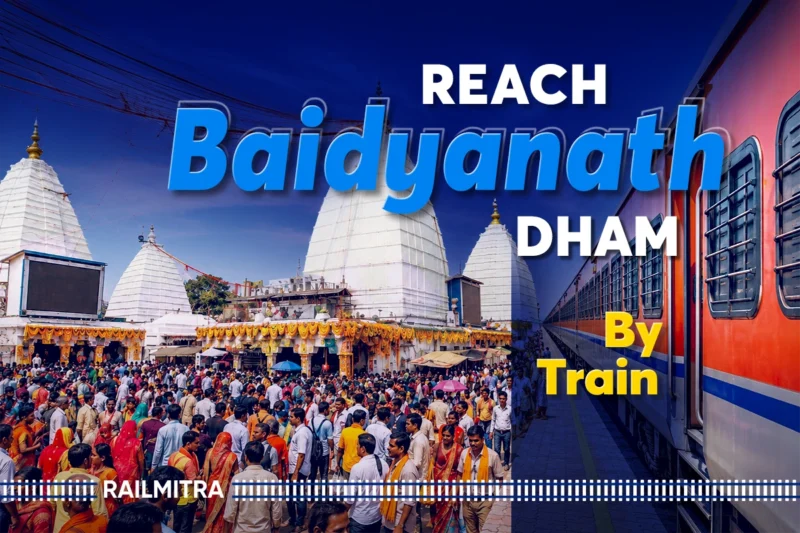
Enquiry counters fill up first. Then the WhatsApp groups start forwarding Shravani Mela schedules, and somehow Baba Baidyanath Dham turns into the one topic every devotee across eastern India wants to discuss at once. One retired schoolteacher in Patna books a full month ahead, ticket printed and filed away early. A college student in Kolkata waits till Thursday night and still walks away with a berth for Saturday. Both end up on a train headed toward Deoghar.

The temple town itself stops resembling its usual self for these few weeks. Saffron spills across every nearby platform, the chant of Bol Bam refuses to fade even at three in the morning, and stations that sit half empty most of the year suddenly cannot handle the footfall. Few pilgrimages anywhere in India lean on the railways quite this hard.
Baba Baidyanath Dham and the Sacred Sawan Month
Twelve Jyotirlingas dot the map of India. This is one. Visitors trickle in year round just because of that fact alone. Sawan changes the arithmetic completely, though. Shiva is said to hold this month closest to his heart. Mondays carry unusual weight for fasting devotees. The Ravana story still makes the rounds, roadside tea stalls, packed train compartments, told by people who’ve clearly heard it a hundred times before and tell it anyway. He was carrying the Jyotirlinga toward Lanka. Somewhere along that road, he put it down. It touched Bihar’s soil at Deoghar and refused to move again.
Why this shrine, and why Shravan specifically, rather than Chaitra or Kartik? Tradition answers half of that question. Belief fills in the rest. Offerings made here during this particular month are thought to carry a weight no other season quite matches, and generations of families have simply never questioned that logic out loud. Temples right across eastern India see a rise in footfall through the monsoon. None absorb quite the scale that Deoghar does.
Sawan and Kanwar Yatra
105 kilometres, banks of the Ganga to the doors of Baba Baidyanath Dham. That’s the walk Kanwariyas take after filling their pitchers at Sultanganj’s Ajgaivinath Temple. Some cover it in three days. Others stretch it to five. A decorated bamboo pole balances across the shoulders the whole way, and the rest stops happen whenever the body gives out, not whenever some printed schedule says they should.
Not everyone walks the whole distance. Large numbers take a train to Sultanganj or a nearby station, begin the walk from there, then lean on the railways again once the Jalabhishek is done. Others skip the walking altogether and head straight for Jasidih Junction, the railhead nearest the shrine, covering the last stretch by road instead. Anyone mapping this out ahead of time can look up exact connections through the trains between stations tool, which saves first time pilgrims a fair bit of guesswork once the mela crowds thicken.
Monsoon weather. Dense crowds. Long distances from almost every direction except Jharkhand’s own backyard. It all points toward one mode of travel. Buses and private vehicles simply cannot match what the railways carry here, not on capacity, not on cost, and certainly not on the comfort of a seat reserved weeks in advance instead of a gamble taken on the day itself.
Trains to Baba Baidyanath Dham from Every Direction
Bihar sends more devotees to Baba Baidyanath Dham each Sawan than any other state, and the reason is not complicated: the Kanwar route itself begins on Bihar soil at Sultanganj, with Patna, Bhagalpur, Munger, and Gaya all sitting close enough that rail travel is the obvious choice. That said, this pilgrimage pulls from well beyond Bihar’s borders. West Bengal sends steady numbers down from Kolkata and Howrah every year. Delhi and the wider National Capital Region send pilgrims on some of the fastest trains in the country. Jharkhand’s own towns, including Ranchi and Dhanbad sitting right next door to the shrine, add a quieter but constant stream of local traffic.
Same rake, different devotees. A Rajdhani heading down from Delhi stops at Patna, and just like that, Bihar and Delhi are sharing a train without either side quite registering it. Sorting the categories below by train type rather than state comes from exactly this overlap. Each one names whatever region it actually reaches. Jasidih Junction ties every single one together, being the nearest major station to Deoghar.
Vande Bharat Express
Ask anyone at Patna Junction which train fills first during Sawan. The answer comes back almost before you finish the question: Vande Bharat. Running the full Howrah to Patna corridor puts it on the map for Bihar and West Bengal both, and it’s the fastest way either region has of reaching Jasidih. Wait too long and seat availability closes the door, weeks before travel, once the mela rush properly sets in.
Two services run this corridor, and between them they cover the full Patna to Howrah stretch in either direction, both stopping at Jasidih on the way:
| Train (full route) | Serves | Boarding (Departure) | Alighting (Arrival) | Duration | Distance |
| 22348 Patna to Howrah Vande Bharat Express | Bihar | Patna Jn (08:00) | Jasidih Jn (10:41) | 2h 41m | 218 km |
| 22347 Howrah to Patna Vande Bharat Express | West Bengal | Howrah Jn (15:50) | Jasidih Jn (around 18:57) | around 3h 07m | 310 km |
Return journeys mirror this, similar hours, opposite direction, back to Patna or Howrah. Bakhtiyarpur Jn and Mokama Jn get a brief halt too on the way, worth knowing if either sits closer to home than Patna does.
Rajdhani Class
This Rajdhani takes the longer way round, through Patna and Jasidih, skipping the shorter Gaya route entirely. That routing quirk works heavily in favour of anyone coming from Bihar, Delhi, or anywhere along that corridor. It runs just once a week each direction though, and that catches people off guard more often than you’d expect, since most travellers assume a Rajdhani runs daily. Here’s how the Friday and Sunday services line up across the three regions it touches:
|
A Delhi passenger and a Bihar passenger, sitting three coaches apart, could complete the exact same journey without ever crossing paths.
Duronto Express
Skip the small stops, bank the hours that add up over distance, that’s the whole idea behind Duronto services. One design choice ends up serving three regions at once on this route, since the same rake runs Delhi to Howrah with Patna sitting almost bang in the middle. The schedule plays out like this:
| Train (full route) | Serves | Boarding (Departure) | Alighting (Arrival) | Duration | Distance |
| 12274 New Delhi to Howrah Duronto Express | Delhi and NCR | New Delhi (12:35) | Jasidih Jn (05:02 next day) | around 16h 27m | around 1214 km |
| 12274 New Delhi to Howrah Duronto Express | Bihar | Patna Jn (01:05) | Jasidih Jn (05:02) | 3h 57m | 221 km |
| 12273 Howrah to New Delhi Duronto Express | West Bengal | Howrah Jn (08:45) | Jasidih Jn (around 13:00) | around 4h 15m | around 310 km |
Superfast Mail Express: Poorva Express
Decades on this corridor have not dented the Poorva Express’s following, especially among pilgrims who would rather book a sleeper or general coach than pay Rajdhani style fares. Smaller towns get a fair shake on this one. The Poorva halts at more stations along the way than the Duronto or Vande Bharat bother with, so anyone boarding somewhere other than a major junction benefits directly, and somewhere in that halt heavy route, Delhi, Bihar, and West Bengal all end up connected without a gap.
| Train (full route) | Serves | Boarding (Departure) | Alighting (Arrival) | Duration | Distance |
| 12304 New Delhi to Howrah Poorva Express | Delhi and NCR | New Delhi (17:40) | Jasidih Jn (around 12:15 next day) | around 18h 35m | around 1221 km |
| 12304 New Delhi to Howrah Poorva Express | Bihar | Patna Jn (around 08:55) | Jasidih Jn (around 12:15) | around 3h 20m | around 220 km |
| 12303 Howrah to New Delhi Poorva Express | West Bengal | Howrah Jn (08:00) | Jasidih Jn (around 12:28) | around 4h 28m | around 310 km |
Humsafar and the Named Baba Baidyanath Dham Trains
Two trains on this network actually carry the deity’s name in their title, which says something about how deeply this shrine is stitched into Indian Railways’ own timetabling. Patna doesn’t feature on this one at all. Buxar and Madhupur instead, straight through to Delhi, which tells you who this train is really built for: the Capital, not Bihar. The up and down services run as follows:
| Train (full route) | Serves | Boarding (Departure) | Alighting (Arrival) | Duration | Distance |
| 22460 Anand Vihar Terminal to Madhupur Humsafar Express | Delhi and NCR | Anand Vihar Terminal (12:40) | Jasidih Jn (04:35 next day) | 15h 55m | 1207 km |
| 22459 Madhupur to Anand Vihar Terminal Humsafar Express | Delhi and NCR (return) | Jasidih Jn (around 11:45) | Anand Vihar Terminal (06:30 next day) | around 18h 45m | around 1244 km |
There’s also a second named pair on this Delhi corridor, the Baba Baidyanath Dham Deoghar Superfast Express, numbers 22465 and 22466, which offers sleeper and general class seating for anyone who finds the Humsafar fare a bit steep.
Garib Rath Express
Most guides skip over budget, but it matters. Fully air conditioned third tier travel, at a fraction of the Rajdhani or Duronto fare, is what the Garib Rath brings to this route, tying West Bengal and Bihar together on alternate days. Skip a calendar check before heading to the station and you risk a wasted trip.
| Train (full route) | Serves | Boarding (Departure) | Alighting (Arrival) | Duration | Distance |
| 12360 Ara to Kolkata Garib Rath Express (Wed, Fri, Sun) | Bihar | Patna Jn (around 20:00) | Jasidih Jn (around 23:50) | around 3h 50m | around 226 km |
| 12359 Kolkata to Ara Garib Rath Express (Tue, Thu, Sat) | West Bengal | Kolkata (20:05) | Jasidih Jn (00:25 next day) | around 4h 20m | 313 km |
Ranchi, Bokaro, and Dhanbad: One Train for Jharkhand’s Own
Ranchi to Dumka Intercity Express does something the bigger named trains don’t bother with: it links Ranchi, Bokaro Steel City, and Dhanbad to Jasidih in one single run. Devotees from Jharkhand rarely need Delhi or Kolkata bound trains once they know this exists. Board at Ranchi and this is the most direct option on the whole corridor, full stop.
| Train (full route) | Serves | Boarding (Departure) | Alighting (Arrival) | Duration | Distance |
| 13320 Ranchi to Dumka Intercity Express | Jharkhand (Ranchi, Bokaro Steel City, Dhanbad) | Ranchi Jn (12:55) | Jasidih Jn (around 21:00) | around 8h 05m | around 323 km |
| 13319 Dumka to Ranchi Intercity Express | Jharkhand (return) | Jasidih Jn (around 05:25) | Ranchi Jn (12:55) | around 7h 30m | around 323 km |
Halfway down that same line sits Dhanbad, and boarding there instead cuts the eight hour Ranchi journey down to roughly three.
Regional and Local Connectivity
08:55, Patna Junction, that’s when the Patna to Jasidih MEMU Express pulls out, no overnight berth required since it runs entirely through daylight. Jasidih Junction comes around 16:52, nearly 8 hours and 220 kilometres later, and this one runs every single day, both ways, quietly, without the fanfare the premium trains get.
Munger and Bhagalpur don’t get that same convenience. No fast train runs either straight through to Jasidih, so it’s the weekly Anga Express, one of the seasonal specials below, or a short hop to Kiul Junction to catch whatever Patna bound train happens to fit.
Gaya sits on a separate line entirely, so a direct fast train to Jasidih simply doesn’t exist. Patna first, then onward, same as everyone else. From Jasidih itself, a MEMU shuttle covers the last six kilometres into Baidyanathdham in about twenty minutes, several times a day, both directions.
Special Trains for Shravani Mela this Sawan
Indian Railways adds trains on top of the regular timetable every single year, the pilgrim numbers simply demand it, and 2026 was no different. Close to a dozen pairs of East Central Railway specials rolled out this season, reaching Deoghar and Jasidih from towns across Bihar, Jharkhand, West Bengal, and Uttar Pradesh.
06:40 each morning, Patna to Bhagalpur pulls out, one of the earliest specials running. Its return counterpart leaves Bhagalpur around 03:15 in the afternoon, and both operate daily right through peak mela weeks. West Bengal gets its own pairing too: an Asansol to Patna Special in the late afternoon on select days, matched against a Patna to Asansol departure in the early hours the next morning. Danapur side pilgrims aren’t left out either. A Danapur to Sahibganj Special runs through this same window, unreserved, no need to change trains at Patna.
2026 also introduced a new route, Ranchi to Bhagalpur via Sultanganj, departing early evening on Mondays and Fridays and arriving the following morning. Jharkhand’s interior towns haven’t had a link this direct toward the corridor in recent memory, arguably. As for the return service, no confirmed train number existed at the time of writing. Regional announcements so far have only covered the up journey, leaving the down leg unpublished. Anyone relying on this train should check Live train status closer to the date of travel, since specials of this kind sometimes get finalised only once the mela rush is already underway.
Comfort isn’t really the point on these specials. Sleeper, third AC, general class, a mix built purely to absorb the seasonal surge.
Food and Comfort for the Journey
Patience runs thin on a long train journey during Sawan, and food is usually the first thing to fall short once a train crosses into its second half. A growing number of pilgrims now order food on train through a dependable in journey delivery service instead of depending entirely on whatever the pantry car happens to be serving that day.
For devotees observing fasting rules, or simply preferring meals without onion, garlic, or anything non vegetarian, the pure veg food in train option matters more during Sawan than in any other month. Most Kanwariyas hold to a strict vegetarian diet through the entire pilgrimage, and fresh food delivered straight to the seat takes one worry off an already long journey.
Conclusion
Knowing which train actually serves your starting point, that’s really what reaching Baba Baidyanath Dham by train comes down to this Sawan. Bihar, West Bengal, Delhi, and Jharkhand turn out to be connected far more closely than most first timers expect. Vande Bharat wins on raw speed for Bihar and West Bengal. The Rajdhani and Duronto quietly move three states worth of pilgrims on a single rake without anyone really noticing. Shravani Mela specials exist for one reason: soaking up whatever the regular timetable can’t handle. Whichever state a devotee sets out from, a route exists toward Deoghar this month. Platforms will stay loud, crowds will stay thick, and Bol Bam will keep echoing down every compartment on the line, but for the millions making this trip each year, that noise is simply part of what makes the pilgrimage to Baba Baidyanath Dham worth undertaking.