Every year, somewhere around March or April, Jain families across India pack their bags. Palitana, Girnar, Shikharji, or just back home to be together for Mahavir Jayanti. And almost all of them travel by train. Here’s the thing nobody warned you about before the first time: the train food situation for Jain travelers is a mess. Not impossible, not hopeless, just messier than it needs to be. The system technically exists. The execution is variable.

If you’re about to travel on the fastest trains in India: a Rajdhani, a Vande Bharat, a Shatabdi: and you’re worried about eating right during this trip, this guide is the practical version of what you actually need to know. Not the “IRCTC has Jain options available” version. The real one.
Mahavir Jayanti and Train Food Delivery
Most folks recognize the name Mahavir Jayanti but aren’t quite sure what lies behind it. Here’s a brief look: the day celebrates the arrival of Lord Mahavira, recognized as the last of twenty-four spiritual teachers in Jain belief. Born around 599 BCE, his life began in a region known today as Bihar, more precisely, within the boundaries of modern-day Vaishali. After renouncing worldly ties, he wandered for twelve long years before reaching deep insight beneath a tree by the riverbank. Teaching followed, lasting three decades, shaping thought through quiet strength rather than forceful speech. His core teachings : nonviolence, truthfulness, non-stealing, celibacy, and detachment, still guide daily choices among those who follow Jain paths. Though centuries pass, these values remain steady anchors.
On the 13th day of the bright phase of Chaitra, usually late March or early April, the celebration takes place. How do people spend it? In towns with many Jains, parades move through streets, prayer halls fill beyond their typical numbers, giving happens quietly among neighbors, yet the mood stays subdued throughout. This occasion lacks fireworks, music, or bold displays. Without prior knowledge, someone passing by could easily miss its significance.
Moving across regions captures much of what matters. Key sites visited then include Palitana in Gujarat, perched on Shatrunjaya hill, home to 863 Jain temples, entirely built up over time. Another destination stands out: Shikharji, located in Jharkhand. Others go to Girnar; some head toward Pavapuri, known as the place where Mahavira reached moksha. Entire families take part in such journeys. Often, three or more generations set off at once, sharing the path. For elders who avoid air travel, reaching these spots involves extended train rides instead.
Which brings in the train food delivery situation. And the food situation on Indian trains, for Jain travelers, has basically always been: figure it out yourself.
The pantry car makes food for general passengers. Onion, garlic, shared vessels, the works. There’s no separation between what’s Jain and what happens to be vegetarian. You can flag it to the pantry staff. What they’ll usually do is tell you something reassuring and hand you the same food everyone else is getting, maybe minus the visible onion pieces.
E-catering platforms, IRCTC’s official one and third-party options, have made a real difference over the past several years. More vendors are listing Jain options. More stations have coverage. Whether the food is actually prepared properly varies restaurant to restaurant and honestly sometimes day to day. During Mahavir Jayanti, when Jain travel spikes, that inconsistency gets more pronounced. Bigger stations tend to hold up. Smaller ones, you’re taking your chances.
How to Order Jain Food in Train
You can easily order Jain food in train with the help of RailMitra website as well as the dedicated application. Just follow these simple and easy steps:
- Go to RailMitra.com or install the Application.
- Select Food in Train option.
- You can order by two methods: PNR Method or Train No./Name method.
- PNR Method: Enter 10-digit PNR Number and click on Order Now.
- Train No./Name method: Enter Train No./Name, Boarding Date and click on Order Now. Enter the Boarding Station.
- Select the Station where you want to Order food in train.
- Select the Restaurant of your choice, Choose your favorite Jain meals and add them to the Cart.
- Click on View Cart and Proceed.
- Enter Customer Details and Select a Payment option.
- Apply Coupon Codes.
- Hit Place Order.
You have successfully placed your order of Jain food on train.
Jain Food in Train with RailMitra
Most e-catering platforms have Jain food somewhere usually as one option in a dietary filter, sitting between “diabetic-friendly” and “low-calorie” or something similarly random. You tick it, you get whatever the system throws up, which may or may not reflect actual Jain preparation standards.
RailMitra handles it differently. It’s an urgent ecatering platform, so deliveries are coordinated with the railway system, food actually reaches you at the station you pick rather than missing the train and they’ve built a separate Jain food section rather than folding it into a general veg filter. The difference in practice: you’re choosing from restaurants that have been listed specifically for Jain food, not restaurants that added “Jain” to their profile as an afterthought.
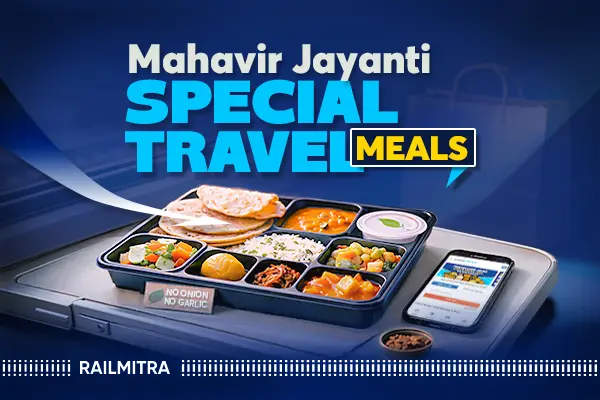
Their network covers 500+ stations and they work with 2,500+ FSSAI-certified restaurant partners. On the Jain menu, you’ll find things like Jain Thali, Jain Dal Tadka, Jain Paneer Butter Masala, Jain Pulao, Jain Chole. Actual meals, not just “rice and dal, we skipped the onion.” Delivery to your seat, no delivery charge.
Don’t order too close to the station. An hour minimum, really. If your train is pulling into Vadodara in 25 minutes and you’re placing the order now, there’s a good chance it won’t make it. For longer journeys you can order from home before you even leave, the system handles it.
If you’re traveling with family or a group, you can easily place a group order with RailMItra. Among the platforms covering train food delivery, RailMitra is the one where Jain food was clearly built in rather than added later. For a 14-hour overnight train during pilgrimage season, that’s a meaningful difference.
Stations Where You Can Actually Find Good Jain Food
Not all stations are equal. Here’s an honest breakdown:
Ahmedabad (ADI): Best station on this list for Jain travelers, by a decent margin. The Jain community is large here, local vendors mostly know the diet properly, tiffin delivery services to trains are common, and the food culture around Kalupur station reflects that. If your train stops here, use it.
Surat (ST): Similar story. Strong Jain food presence in the city. Pre-order through RailRestro or e-catering for hot food delivery. Reliable stop.
Vadodara (BRC): Solid option. Good farsan available, several e-catering vendors listed. Not as strong as Ahmedabad but dependable.
Mumbai (CSMT / BCT): Large station, more chaotic, vendor quality is inconsistent. If you’re boarding from here, picking up food from Matunga or Dadar before you board is genuinely the smarter move. Both areas have Jain restaurants that know what they’re doing.
Jaipur (JP): North India’s most useful stop for Jain food on long routes. Dal-baati-churma without onion and garlic is a real thing here and some vendors prepare it right. Ask explicitly before ordering.
Indore (INDB): The city has a real Jain food culture. Good stop if your route passes through.
If You’re Packing Your Own Food (Which Is Often the Right Call)
No vendor dependency, timing stress. No “the train is 4 hours late so now what.”
What travels well:
Thepla: still the gold standard of train food. Stays good for a full day without refrigeration, doesn’t need anything extra, and three or four of them with dry chutney is a proper meal.
Khichdi: make it a little drier than you normally would. Wet khichdi turns unpleasant after a few hours. Dry khichdi holds for most of a day.
Dry sabzi: capsicum, tindli, raw banana, cooked without gravy. Holds much longer than anything with a sauce or curry base.
Farsan: chakli, gathiya, sev. Calorie-dense, no spoilage risk, easy to eat without making a mess.
Dry fruits and mukhwas: for the stretches where you’re not hungry enough for a full meal but want something.
Avoid potato gravy for longer journeys. It turns faster than you’d expect, especially in summer. Curd is fine in winter, but in April heat on a train, it needs a proper insulated container or it won’t stay safe past a few hours.
If you’re on an overnight train especially during Mahavir Jayanti when trains run full and pantry stock gets stretched packing your own dinner removes one variable from the trip entirely.
The Things People Learn the Hard Way
Delays break the food schedule. Train is 3 hours late. The vendor you ordered from at Kota for a 2pm delivery isn’t there at 5pm. E-catering doesn’t shift your order automatically. This happens. Pack a backup regardless of what you’ve ordered online.
Satvik is not Jain. Worth saying clearly because it causes real confusion at stations. Satvik means no onion, no garlic. Jain means no root vegetables at all potato, carrot, radish, beetroot, and others. These are different diets. A satvik-marked restaurant may not be Jain-safe.
Festival period affects prices. Mahavir Jayanti is peak Jain travel. Some caterers who specifically sell Jain travel packs raise their rates. Not massively, but enough to notice if you’re comparing to what you paid two months ago.
Standard “Jain option” may not match your level of observance. If you’re in strict mode for this particular festival avoiding foods you’d normally eat outside of religious periods the train menu Jain option is probably not strict enough. In that case, packing your own food is the only reliable answer.
Conclusion
For Jain travelers boarding the fastest trains in India this Mahavir Jayanti, eating right during the journey comes down to three things: order ahead using e-catering or RailRestro, write out your exact dietary restrictions instead of just ticking “Jain”, and carry a backup tiffin because trains run late and vendors disappear.
The rail food system has gotten better. It’s workable now in a way it wasn’t ten years ago. But it’s still built around a default that isn’t yours so the planning has to come from your end.