Sleeper coaches have almost seventy two bunks accommodated in a single compartment, and simply this figure accounts for why millions of passengers choose to travel in them on a daily basis. A sleeper train seat map is not just about knowing your designated spot, it actually changes the way you plan your meals, manage your luggage, and the quality of your sleep during a long overnight journey. Indian Railways introduced this layout years ago and it is still considered as the most economic and reliable mode of long-distance travel in the country.

This blog breaks down every part of the train sleeper coach seat map, from berth positions to how the whole system keeps ticket prices within reach for ordinary travelers.
Understanding the Sleeper Train Seat Map
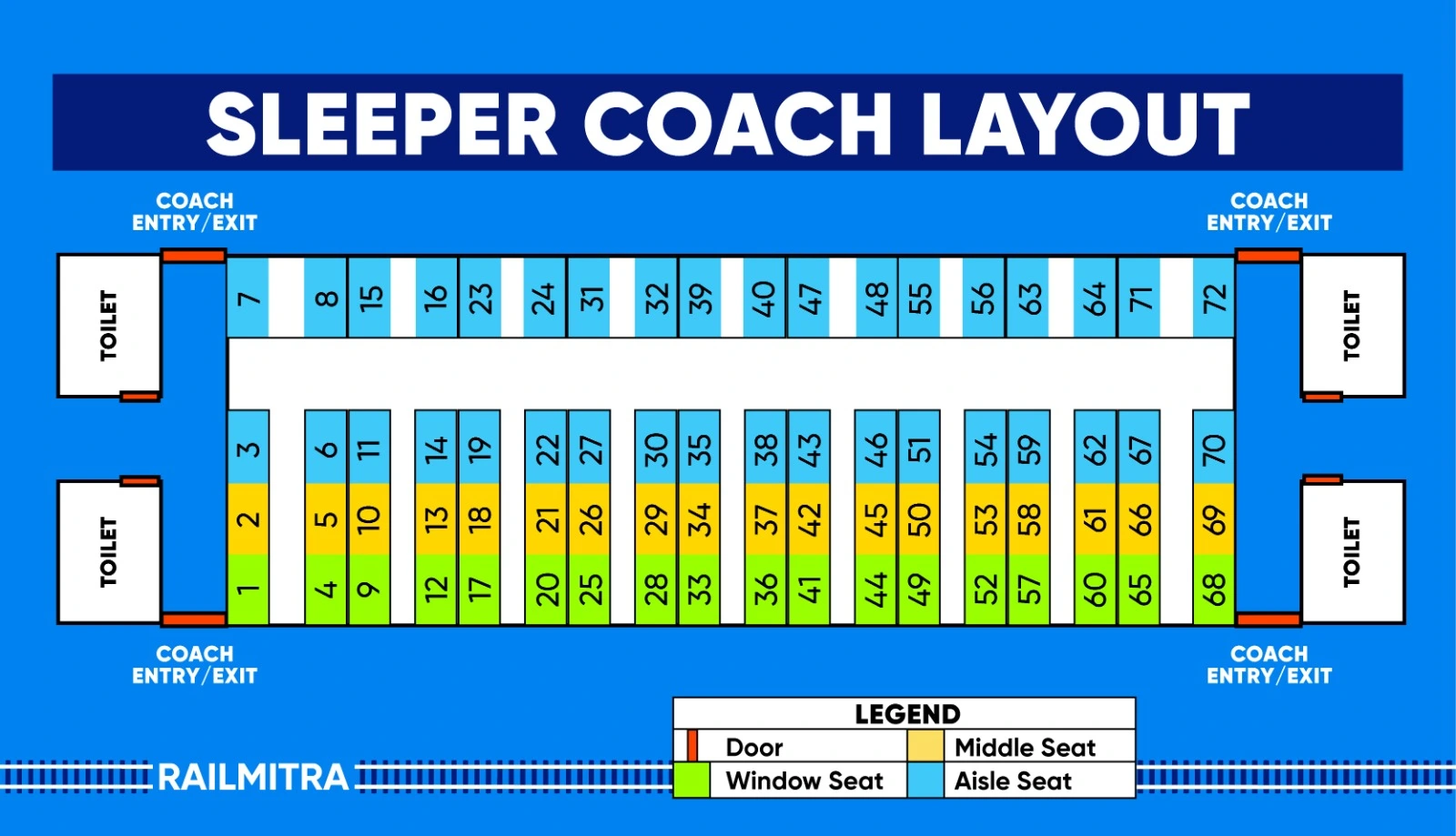
Every sleeper coach follows a fixed pattern. Eight berths make up one bay: four run along the main cabin and two more sit along the side, facing the aisle. The bay closest to the coach entrance often gets skipped by frequent travelers. This is mostly because of the noise near the doors.
Three tiers exist inside each main bay. Lower, middle, and upper. The side bay has only two, called side lower and side upper. This gives every coach a mix of six berth types in total, and each one comes with its own set of trade offs.
Why does this matter to someone booking a ticket? Because a seat map sleeper train layout isn’t random. It follows a numbering logic that repeats bay after bay, coach after coach. This means once you learn to read one sleeper class train seat map, you can read any of them across the Indian Railways network.
Passengers who travel often tend to request specific berths for specific reasons. RailMitra’s trains seat availability tool lets you check exactly which berth types remain open before your booking window closes.
Reading the Train Seat Map Sleeper Coach Numbers
Berth numbers inside a sleeper coach run sequentially from one to seventy two. Every ninth number marks the start of a new bay, since eight main berths plus… actually each bay holds eight berths together with the two side ones included.
Lower berth numbers usually end close to a pattern divisible by eight if you trace them bay by bay. Middle and upper berths sit right above, stacked in that exact order. Passengers boarding at night find these numbers printed on their chart, along with the coach code like S1, S2, or S3.
Side lower and side upper berths carry their own numbers too, positioned right where the aisle meets the window. A train seat map sleeper booking rarely goes wrong once you know this numbering flows in the same direction throughout the coach, from the first bay near the door to the last bay near the pantry end.
Lower, Middle and Upper Berth Positions Explained
The lower berth sits at the base of the bay, and it doubles as seating during the day for all three passengers assigned to that column. This makes it the most requested berth among senior citizens and families traveling with young children.
Middle berths fold down only after nine at night and fold back up by morning, according to Railways rules. Passengers assigned here often wait for the lower berth occupant to signal it’s time to convert the seating arrangement.
Upper berths remain fixed throughout the journey. They can’t be used for sitting once someone’s already lying down, which suits travelers who prefer to sleep early and skip the daytime shuffle altogether.
There’s a quieter appeal to upper berths that many first time travelers overlook: nobody disturbs you for their seating space, and your luggage stays safer tucked against the coach wall above.
Side Lower and Side Upper Berth Seat Map Details
Side berths are situated next to the corridor and look the other six or nine berths of the main deck opposite the berths. Here at the side berths, instead of a three-tier one, it is a two-tier one. That single element of design change has a big effect on how the passengers would be using the space.
Side lower feels like a private corner seat during the day. Many solo travelers prefer it over the crowded main bay, since only one other person shares the immediate space above. Window views come free too, since side lower sits directly beneath the coach window.
Side upper folds down at night just like the middle berth does, but it stays more open through the day. Fewer people crowd around it for seating. Frequent travelers on this train sleeper coach seat map often mention that side upper offers the best balance of privacy and ventilation. This is especially true on longer routes running twenty hours or more.
Both side berths sit closer to the coach’s charging points in most rakes. This matters more than people expect once phones start running low somewhere past midnight.
How Sleeper Seating Supports Budget Rail Travel
A sleeper class train seat plan is Mostly available to one reason. It accommodates more bunks within less space rather than any air-conditioned class. This space-saving feature ensures low costs so that day-laborers, students, and migrant workers can traverse between states without much financial burden.
Compare the numbers. A sleeper coach holds seventy two berths against roughly fifty four in a 3AC coach of similar length. That extra capacity spreads the coach’s operating cost across more tickets, which pulls the per passenger fare down significantly.
This isn’t a minor detail either. For a huge share of India’s population, sleeper class remains the only realistic way to travel long distances for work, family emergencies, festivals, or education. Remove that affordability and you cut off mobility for millions who depend on it.
RailMitra’s train schedule feature is a good tool if you want to decide on a train which gives you the best combination of your budget and desired compartment.
Checking Seat Availability Before You Book
Booking a sleeper berth without checking availability first often leads to waitlisted tickets. Nobody wants to start a long journey uncertain about where they’ll actually sit. RailMitra’s train seat availability service shows real time berth status across every class, sleeper included, well before you commit to a specific train.
The tool breaks down availability by quota too. General, Tatkal, and premium Tatkal all show separately, which matters since sleeper class Tatkal tickets open at a different time window than AC classes.
Searching is straightforward. Just specify a departure station, destination, and date of travel. The search results will display trains that still have sleeper berths available, along with the number of open berths. This proves to be a handy tool, particularly during festivals when passengers almost instantly book out sleeper coaches as soon as the booking window opens.
Checking early also gives you a better shot at securing your preferred berth type, whether that’s lower for comfort or side upper for privacy.
Tracking Your Journey with Live Status Tools
After confirming the ticket, people usually start worrying about arriving on time. The sleeper trains that run on long routes pass through different states. It is quite common to see delays of about one or even two hours. This is particularly common during the monsoon season or when the roads are flooded with people celebrating festivals.
The train running status function on RailMitra app is synchronized live. It shows a train’s real-time location, the extent of delay, and also the time at which the next stations of the train will get boarded or departed. These details are of great help to passengers for arriving at the station on their own. They can avoid spending hours at the station waiting based only on a train’s schedule.
Families waiting to receive someone at the destination station find this particularly useful too. They can time their arrival instead of guessing.
How to Check PNR Status on RailMitra
Every confirmed ticket carries a ten digit PNR number, and checking its status becomes essential once your booking sits in waitlist or RAC. RailMitra’s PNR Status tool is a lifesaver: you simply plug in ticket number on paper. You will immediately know the actual booking status of your train seat plus your room details on the train together with a chart preparation update.
This feature is really important for sleeper class passengers. Waitlisted tickets may get confirmed at the last minute, often before the chart preparation. This typically happens just a few hours before the train leaves. Checking status closer to that window gives the most accurate picture of whether your ticket confirmed.
The same tool also displays coach and berth number once your seat gets allotted. So you know in advance whether you’ve landed a lower, middle, upper, or one of the side berths discussed earlier in this blog.
Ordering Food During Your Sleeper Class Journey
Train trips can get a bit long sometimes, so train passengers start the search for an alternative meal midway through their journey. Since the food sold in the pantry car may neither be the preferred choice of taste nor cater to the special dietary needs of a passenger. It is only natural for RailMitra’s train food delivery service to come as the timely rescue
Through this service, a railway passenger can easily place an order from selected eateries that are on the way, near the stations. The restaurant will make sure the food packet arrives on the platform when the train gets ready to depart.
Ordering ahead also removes the uncertainty of relying on vendors who board briefly at each stop. RailMitra deliveries reach your seat directly, checked against your coach and berth number from your ticket.
This service works particularly well for sleeper class travelers, since many of these journeys run overnight or span an entire day. This makes at least one proper meal delivery a practical necessity rather than a luxury.
Conclusion
At first sight, sleeper train seat map could have appeared as just a grid of numbers with no much thought. Even so, such design is a reflection of an entire seating arrangement mechanism made first and foremost for allowing Indian railway passengers to travel affordably. It helps passengers travel from one city to another. Through the blog, you will get acquainted with how to use RailMitra to locate the exact positions of berths and availability check of seats. You will also learn about the PNR status. All the steps described will ultimately lead you towards a stress-free and well-thought-out journey. Regardless of whether it be a lower berth for added comfort or a side upper berth, having sufficient knowledge on functioning of a train sleeper coach map will give you mastery of your entire trip. This happens before you even walk onto the platform.