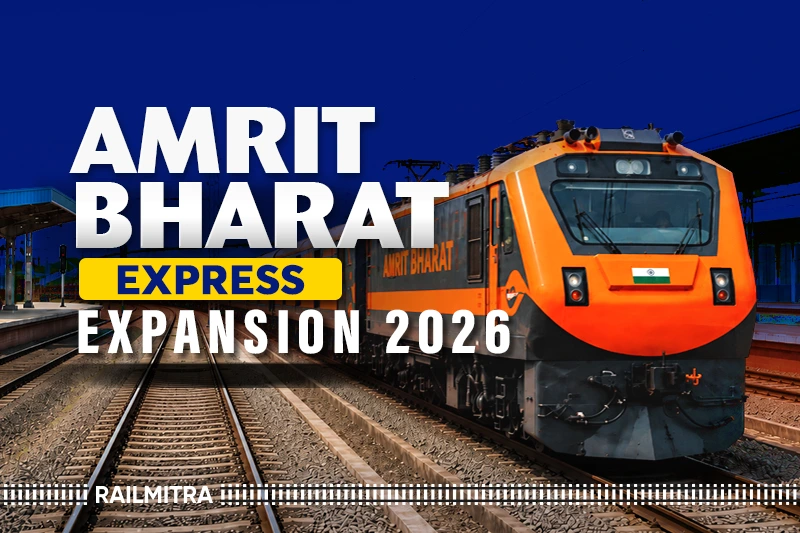
Around 13 million people travel on Indian trains, every single day. But before their trips even begin, they have to first face the Railway Stations. However, the experience of the passengers with the services available at those stations have never been good or even satisfactory. To change this attitude, Indian Railways has brought in the Amrit Bharat Station Scheme.

In December, 2022 Ministry of Indian Railways launched the Amrit Bharat Station Scheme, which aims at rebuilding more than 1300 railway stations across India. This isn’t just some upgrade. This is a systematic overhaul of the Indian stations infrastructure.
Besides experiencing upgraded facilities at the stations, passengers can upgrade their train experience with the right information as well. Track your live train status that also provides the platform number on which the train will arrive. Track your platform carefree with RailMitra and avoid shuffling through the crowded platforms at the last minute.
What Is the Amrit Bharat Station Scheme?
No uniform template. Each station gets its own master plan. Ahmedabad station takes its design from the Modhera Sun Temple. Dwarka station from the Dwarkadheesh Temple. Work gets done in phases, based on what that specific station needs and how much footfall it handles.
A small junction in Chhattisgarh and a major hub in Delhi are both in the scheme. What they get will look very different. The shared part: stations that passengers can actually use without frustration.
Key Features of the Scheme
Scope of work across the scheme includes:
- Entry and exit points
- Platform surfaces and roofing
- Toilets and waiting halls
- Parking and approach roads
- Pedestrian walkways
- Lighting and signage
- Lifts and escalators where footfall justifies them
- Free WiFi
- Digital passenger information screens
- Food courts and retail kiosks
- Kids’ play areas and executive lounges
Some stations are also getting roof plazas; 12 metre wide foot overbridges with lifts, escalators, and shops built into the bridge structure itself.
Total Budget Allocation
Total budget across the scheme: over Rs 24,470 crore. That number has grown as more stations were added.
Why the Scheme Was Needed
Spend fifteen minutes at a mid size railway station in India and the problems are obvious.
The parking area fills up fast and spills onto the approach road. The waiting hall has fifty seats and three hundred people. The cab stand and auto stand are at opposite ends and neither is marked.A person carrying a backpack climbs steps from long before their time. Stairs remain untouched through years of weather and wear. Someone with stiff legs faces what hasn’t moved in ages.
Fourth among global rail systems sits Indian Railways. Size places it here, not speed or fanfare. The stations, for years, did not reflect that scale. Most were built for a fraction of current passenger load.
Starting fresh, the plan aimed to shrink differences by turning train stops into mini downtowns instead of mere pickup zones.
A place exists where showing up sixty minutes ahead feels fine. You find a bathroom that is spotless. Food works here – no broken machines. A display tells exactly which track holds your train. Time spent waiting does not vanish into chaos.
Focus on Tourism and Local Identity
Tourism matters here too. A heritage city whose station looks neglected makes an impression before the visitor has left the platform.
Tying station architecture to local culture and heritage is part of how the scheme addresses that.
What Actually Changes for Passengers
Getting to the Station
Wider approach roads. Dedicated pedestrian walkways. Organised parking with proper marked zones. Covered porticos at the entrance so you are not standing in rain before you have even found the door.
Boards are being fixed too. Clear direction signs, multiple languages, logical placement.
Any frequent traveller who has landed at an unfamiliar station late at night and spent fifteen minutes figuring out the exit knows the value of this. It is not a glamorous infrastructure. It is necessary infrastructure.
Inside the Station Building
Waiting halls are being renovated with:
- More seating
- Better lighting
- Air conditioning at select stations
Booking and reservation offices are moving inside the main building where possible, with covered pathways connecting them to the platforms.
Passenger information screens across redeveloped stations are being replaced or upgraded; real time arrivals, departures, and platform numbers in readable display.
Pair that with Live Train Status on RailMitra and you know your train’s location before you have even moved toward the platform.
Food and Passenger Convenience
Food courts and retail kiosks are built into the new station layout.
At stations with long waits, RailMitra’s Food in Train delivery can sort your meal before you board, so you are not scrambling at the last minute.
Platform Improvements
Platforms are seeing major upgrades, including:
- Resurfaced flooring
- Extended roof cover
- Improved staircases
- Wider foot overbridges
The roof plaza conversions are the most visible upgrade; foot overbridges being widened to 12 metres with lifts and escalators integrated into the structure.
At stations where this is complete, the bags and stairs problem is largely gone.
Accessibility for Divyangjan Passengers
Ramps at entries now appear alongside restrooms designed for wheelchair access. There are dedicated parking spots reserved especially for passengers who have mobility issues. The paths have also been marked with the Brailler script so that visually challenged passengers dont lose out on their way. Seats are also set a bit apart so that all the passengers can move freely here.
The best part of these facilities is that they don’t feel like add ons. These facilities don’t appear as enforced but something totally natural. It looks like these features were in consideration since the inception of this project.
Easier Exit and Multimodal Connectivity
There are separate pick up and drop off zones in these new upgraded stations. These stations link passengers to the bus stops, auto stands and taxi areas around the city. There are proper exit signboards so that the passengers can easily navigate their way out of the station.
There are proper train layouts on these stations just like the metros. These layouts help passengers to go to the place they want without any hassles and don’t need to depend on the other fellow passengers telling which place is where.
You step off the train and the station layout tells you exactly where to go. That coordination between rail and other modes is the multimodal piece of the scheme.
If you want to check train seat availability, you can do so using the RailMitra website as well as the application. Using this service, you can find if there are any seats available on the provided train name or number. This service comes in handy when you don’t have a confirmed train ticket and are looking for available alternate travelling options.
Where the Scheme Stands Now
103 Redeveloped Stations Inaugurated
On the 22nd of May 2025, the Prime Minister Narendra Modi inaugurated the 103 new developed Railways stations virtually from the city of Bikaner in Rajasthan. These newly developed stations were not clustered at one place but were spread across 86 districts in across 18 states and union territories.
Here is the statewide number of the renovated railway stations:
- Uttar Pradesh: 19
- Gujarat: 18
- Maharashtra: 15
- Tamil Nadu: 9
- Rajasthan: 8
- Madhya Pradesh: 6
- Karnataka: 5
- Chhattisgarh: 5
Total cost for this first completed batch: over Rs 1,100 crore.
Current Completion Status
- 160 stations completed by December 2025
- 180 stations completed by March 2026
- Hundreds more under active construction
Maharashtra Station Updates
Maharashtra has been allotted 132 railway stations under this Amrit Bharat Station Scheme. Out of which 15 have been completed. Here is the list:
- Parel
- Matunga
- Devlali
- Dhule
- Chinchpokli
- Lonand Junction
- Murtizapur Junction
- Amgaon
The upgradation work has been continued in the remaining stations.
Delhi Station Redevelopment
Similarly Delhi has upgraded 13 of its Railway stations, under this scheme. Here are those:
- New Delhi
- Hazrat Nizamuddin
- Anand Vihar
- Safdarjung
- Bijwasan
- Tilak Bridge
- Delhi Cantt
- Adarsh Nagar
- Shahdara
- Narela
- Subzi Mandi
In March, 2026 the Union Railway Minister Ashwini Vaishnaw confirmed that work has been under progress across different stages for these railway stations. Passengers can experience these upgraded services very quickly as the work has been going on in full swing.
Push for Passenger Feedback
A Parliamentary Committee has advised that just upgrading the stations services won’t do, a proper evaluation of these services is also necessary. In regard to this a formal passenger satisfaction assessment should be conducted.
Railway Budget Expansion
Indian Railways has also expanded the budget from Rs 32,300 crore in FY 2014-15 to Rs 2,52,200 crore in FY 2025-26. A major part of this bulge in the budget expenditure can be attributed to the added expenditures on the Amrit Bharat Station Scheme.
Indian Railways is switching from providing quantity to giving quality experience to the passengers. Upgrading the infrastructure of the station will not only help the passengers feel better but would also add on to the earnings of the railways.
What the Scheme Does Not Cover
This Amrit Bharat Station Scheme is meant for stations only and not trains. So don’t expect train related upgrades from this scheme This scheme DOES NOT cover issues like:
- Train punctuality
- Coach cleanliness
- Seat availability
These are distinct matters and not covered under this scheme. This scheme is meant for the sole upgradation of the station.
Phased Execution Means Delays at Some Stations
Not every station gets upgraded quickly. The scheme is long term by design. Some stations will wait years for their phase to begin.
If your station is already in an active phase, the changes are visible. If not, the work is coming, but the timeline may still be a few years away.
Conclusion
1,337 stations. Rs 24,470 crore. Architecture tied to local culture instead of a one size rebuild. 180 stations completed as of March 2026, with hundreds more under construction.
Nowhere near perfect before, stations slowly match the train experience under this new push. Not quite equal yet, but closer than they’ve ever been. Through steady upgrades, platform areas begin reflecting onboard standards. With time, waiting feels less like a step down. Where trains led comfort, stations now follow without lagging far behind.
Even as the system slowly improves, features such as live train status tracking, PNR status updates, seat availability checks, and meal orders can now be found on RailMitra. Though progress takes time, these options work today. Behind the scenes, something useful waits. Right within reach: real-time details. Not everything needs fixing first. Some answers run ahead of delays.
Should you step into a newly upgraded station one day – spot clear signs, tidy seating spaces, an elevator running without issues – that moment reflects what the Amrit Bharat Station Scheme looks like when it works. Though quiet in approach, its presence shows through things simply operating as they should.