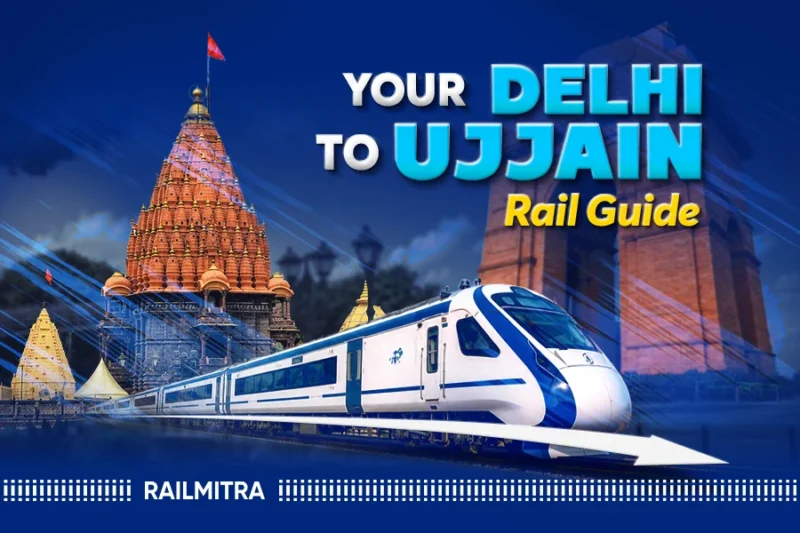
Somewhere past Kota, the fields start changing colour. Grey scrubland gives way to something darker at some point, richer too, the black cotton soil this part of Malwa is famous for. First timers on the Delhi to Ujjain route usually clock it right about here. This isn’t just another overnight train ride, not once you’ve noticed the ground itself has changed underneath you. It’s a slow handover, really, from the noise of the capital to the quieter, bell-heavy rhythm of one of India’s oldest temple towns.

People board this train for a hundred small reasons and one big one. Mahakaleshwar pulls a lot of them in. But there’s also the coaching student heading back to Kota mid route, the trader who does this run every month without fail, and the retired couple two berths down who just like trains more than they like airports. Whatever brings someone onto this train, the journey has a character all its own. It shows up long before Ujjain Junction is anywhere close.
Why This Route, and What the Journey Actually Feels Like
Ask five passengers why they picked the train instead of flying into Indore, and the answers rarely match. Some passengers travel because of the pilgrimage to the temple of Baba Mahakal and they often prefer train journeys over flight travel. Some people just don’t want that after reaching Indore by flight they had to cram into a cab for two hours. Another important reason for this journey is also the proximity of Ujjain to Indore, which also happens to be a major business and employment opportunity for the people.
What actually stays with people, though, is how the land keeps shifting outside the window. Delhi itself is flat and busy on the way out, wheat fields broken up by highways and colonies still under construction. That changes somewhere near Bharatpur and Sawai Madhopur, where Rajasthan takes over and the ground turns rocky almost without warning. Low hills, patches of scrub, and if daylight cooperates, maybe a stretch of Ranthambore’s tree line off in the distance. Kota brings the Chambal river into full view, wide and unhurried. Past that, the land rolls into Malwa’s dark soil, and by the time Ujjain is close, the whole landscape has quietly become something else entirely.
Conversations follow their own pattern too. Berth neighbours compare notes on temple timings, ask if you’ve caught the Bhasma Aarti before, argue gently over the fastest route from Ujjain Junction to Mahakaleshwar. Somewhere around dinner, food takes over the conversation, and it rarely stays theoretical. Vendors shift as the states shift too. The poha and jalebi you’d find near Kota fades out gradually, replaced by Malwa’s own version by the time Ujjain gets close. It sounds minor, but it’s genuinely one of the nicer parts of a long train ride, since the food alone tells you where you are even with the curtains drawn and the cabin lights down for the night.
Delhi to Ujjain Route: The Stations That Shape the Journey
Calling Delhi to Ujjain one continuous stretch of track undersells it a bit. It’s really a chain of stations, each with a rhythm of its own, and picking up on that rhythm changes how the whole trip lands.
Mathura Junction and Bharatpur Junction
Mathura arrives early, usually within the first couple of hours out of Delhi. Superfast trains barely pause here, often under five minutes, so this isn’t the halt for a leisurely walk on the platform. Vendors sell peda right along the train, the soft milk sweet the town is known for, and it’s a quick stop but a memorable one. Half the coach seems to mention Krishna’s birthplace out loud, every single time. Then comes Bharatpur Junction. Nothing dramatic here, just enough of a pause to top off a bottle or grab something off a passing trolley before the night stretch properly begins.
Sawai Madhopur and Kota Junction
If there’s a wildlife photographer somewhere in your coach, this is where they wake up. Ranthambore’s gateway station gets a short halt, rarely more than five to seven minutes, and it almost never turns into the kind of scramble Kota does further down the line. Kota Junction is a different animal. This halt often stretches past ten minutes, and it can get properly crowded, especially during exam season when Kota’s coaching students travel in bulk. Boarding here means arriving early on the platform, because the crowd builds fast and doesn’t wait for anyone. Food wise, Kota’s kachori and its sharp local namkeen are worth the small scramble if the halt allows it.
Nagda Junction and the Final Approach to Ujjain
Nagda Junction gets technical for the train itself. Several services reverse direction here, which means a longer halt, sometimes close to fifteen minutes. Good news for passengers, honestly, since it leaves enough time to stretch, refill bottles, or pick something up from the stalls without the usual rush. Boarding at Nagda is generally calmer than Kota, fewer last minute scrambles, an easier platform overall. From here it’s a short run into Ujjain Junction, and that’s when the mood in the coach usually shifts. Bags get packed. Seasoned pilgrims start their quiet prayers. Everyone leans toward the window, waiting for that first sign that reads Ujjain Jn.
Not sure which halts are worth a quick break and which ones to just stay seated through? Checking Live train status on RailMitra before the journey gives a realistic sense of expected halt times, since these shift depending on how much traffic the train hits further up the line.
Delhi to Ujjain Trains: Complete List by Category
A quick warning if you’re researching this online: plenty of the trains that show up under Delhi to Ujjain searches don’t actually go anywhere near Ujjain, or Delhi for that matter. Sites borrow route data from similarly named services and never bother correcting it. The Malwa Express is a good example of this mess. It gets tagged as a Delhi to Ujjain train on more than one booking platform, yet its real route runs from Mhow to Shri Mata Vaishno Devi Katra through Bhopal, hundreds of kilometres from Delhi. Then there’s the Ujjaini Express, which has a problem of its own. The name stuck around after a route change some years back, and now it ends at Lakshmibai Nagar instead of Ujjain entirely.
What follows are the trains that genuinely make this connection, grouped into small categories, and each one running as a proper return pair rather than a one way listing. Before locking in a date, it’s worth checking Trains between stations on RailMitra, since services do occasionally get rescheduled or renamed.
Category 1: Daily Superfast Express, via Indore
First up is the pair that carries most of the daily traffic on this route. LHB rakes, Sleeper through to general class, running every single day of the week.
| Train | Origin (Departure) | Destination (Arrival) | Duration | Distance |
| 12416 New Delhi to Indore Intercity SF Express | New Delhi (around 22:00) | Indore Jn (around 10:05, next day) | Approx. 12 hrs | Approx. 824 km |
| 12415 Indore to New Delhi Intercity SF Express | Indore Jn (around 17:10) | New Delhi (around 06:20, next day) | Approx. 13 hrs 10 mins | Approx. 824 km |
Ujjain Junction is a stop for both trains, right alongside Mathura, Kota and Nagda, which is really why this pair edges out the rest for anyone travelling the Delhi to Ujjain leg specifically. Book early around Mahashivratri though, since Seat Availability drops fast once the festival crowd starts moving.
Category 2: Daily Superfast Express, via Mhow
There’s a companion superfast service running almost the same path as the first pair, except this one finishes at Dr. Ambedkar Nagar near Mhow instead, with Ujjain still sitting comfortably along the route.
| Train | Origin (Departure) | Destination (Arrival) | Duration | Distance |
| 20156 New Delhi to Dr. Ambedkar Nagar SF Express | New Delhi (around 23:25) | Dr. Ambedkar Nagar, Mhow (around 12:50, next day) | Approx. 13 hrs 25 mins | Approx. 845 km |
| 20155 Dr. Ambedkar Nagar to New Delhi SF Express | Dr. Ambedkar Nagar, Mhow (around 15:30) | New Delhi (around 04:25, next day) | Approx. 12 hrs 55 mins | Approx. 845 km |
Worth keeping in your back pocket if the Indore bound options above are sold out, since this route runs almost the same course, through Mathura, Sawai Madhopur, Kota and Ujjain. A quick look at the Train Schedule for both pairs together usually makes the choice obvious.
Category 3: Weekly Superfast Express, toward Jammu
Most people have never heard of this one, but it’s a real option if the days happen to line up. From Indore, it pushes all the way through to Jammu Tawi without much of a break, passing Ujjain, Nagda and Kota early on before curving through Delhi’s Safdarjung and Shakurbasti stations on its way further north.
| Train | Origin (Departure) | Destination (Arrival) | Duration | Distance |
| 22942 Jammu Tawi to Indore Weekly SF Express | Jammu Tawi (once weekly) | Indore Jn (2nd day) | Approx. 24 hrs | Approx. 1,470 km |
| 22941 Indore to Jammu Tawi Weekly SF Express | Indore Jn (around 23:30, Monday) | Jammu Tawi (2nd day, around 20:35) | Approx. 21 hrs | Approx. 1,420 km |
Running only once a week means this pair needs a bit more planning than the daily options above. It’s worth the extra minute to check the Train Schedule closer to your travel date, since weekly services tend to see more route tweaks than daily ones.
Category 4: Biweekly Mail Express, toward Chandigarh
This one used to run all the way to Una Himachal and still gets listed that way on some sites, but its current run terminates at Chandigarh Junction. Either way, it passes through Delhi’s Hazrat Nizamuddin and Ujjain on a fixed two day a week schedule.
| Train | Origin (Departure) | Destination (Arrival) | Duration | Distance |
| 19307 Indore to Chandigarh Express | Indore Jn (around 05:30, Thu & Fri) | Chandigarh Jn (next day) | Approx. 24 hrs | Approx. 1,340 km |
| 19308 Chandigarh to Indore Express | Chandigarh Jn (evening, Fri & Sat) | Indore Jn (following day) | Approx. 24 hrs | Approx. 1,340 km |
At Ujjain, this pair typically gets a longer than usual halt, close to fifteen minutes, since it’s still a fair way from either end of its journey at that point. Worth remembering if you’re boarding here and want a few extra minutes on the platform.
Category 5: Seasonal Special Trains
When summer hits or a big festival rolls around and the regular daily trains are booked solid weeks out, Indian Railways puts an extra special on this same stretch to handle the overflow.
| Train | Origin (Departure) | Destination (Arrival) | Duration | Distance |
| 09310 Hazrat Nizamuddin to Indore Special | Hazrat Nizamuddin (around 08:20) | Indore Jn (around 21:00, same day) | Approx. 12 hrs 40 mins | Approx. 820 km |
| 09309 Indore to Hazrat Nizamuddin Special | Indore Jn (evening) | Hazrat Nizamuddin (following morning) | Approx. 12 hrs 40 mins | Approx. 820 km |
Special trains like this one don’t run year round, so it’s genuinely worth checking the Train Schedule a few weeks before travel dates like Mahashivratri or the summer break, rather than assuming the service will simply be there.
A Quick Note on Premium and High Speed Options
Quick flag before you go looking: Delhi and Ujjain aren’t connected by any Rajdhani, Shatabdi or Vande Bharat right now, direct or otherwise. Speed focused travellers tend to ride one of those as far as Bhopal or Indore, then finish the journey by road or a shorter train. It’s an extra leg, yes, but it can work out faster overall for some. New premium routes do surface occasionally, so it’s worth glancing at RailMitra now and then if speed matters to you.
Food on the Delhi to Ujjain Route
Food on this route tells its own story. The first few hours out of Delhi bring the usual mix, samosas, chai, packaged snacks from vendors who board and get off within a station or two. Things shift around Mathura and Bharatpur, where peda and other milk based sweets take over the platform stalls. By Kota, it’s kachori and the region’s sharp namkeen pulling people to the windows, wallets already out before the train has even stopped rolling.
Ratlam slips behind, Ujjain gets closer, and the food changes with it, tilting toward what Malwa does best. Sev heaped generously over poha, jalebi pulled straight from hot oil, chai that comes thicker and more milky than anything Delhi pours. Even the passengers who swear by home cooked tiffins tend to try it at least once.
For those who’d rather not deal with the platform rush at all, food in train through RailMitra brings a hot meal straight to the seat, timed to land around the train’s arrival at bigger stations. No frantic dash during a two minute halt, and it’s especially handy for families or anyone with kids who won’t wait patiently for the right stall to show up.
Final Thoughts on the Delhi to Ujjain Train Experience
Ujjain Junction comes into view eventually, and most passengers have already worked out by then what this whole journey actually was. Part pilgrimage, part slow lesson in geography, and somewhere in there, a shared table with strangers who don’t feel like strangers anymore by the time Kota is behind you. The stations along the way, the food that kept changing, the land itself shifting colour outside the window: none of it is something a flight could give you. Whether it’s Mahakaleshwar pulling you forward or just a preference for watching India go by from a train window, this route rewards anyone willing to take their time with it.