Your railway ticket is full of signs and symbols that might seem a little strange to first time train passengers. However, these signs carry important information about the train journey and understanding them is important if you don’t want unnecessary surprises in your journey. One of such signs and symbols passengers encounter is CAN/MOD in Railway.

Most passengers are confused when they see this on their printed or digital ticket. Not anymore. In this blog we will delve deep into what this means in Indian Railways. We will also explain what is the next course of action for the passengers if they see this on their tickets.
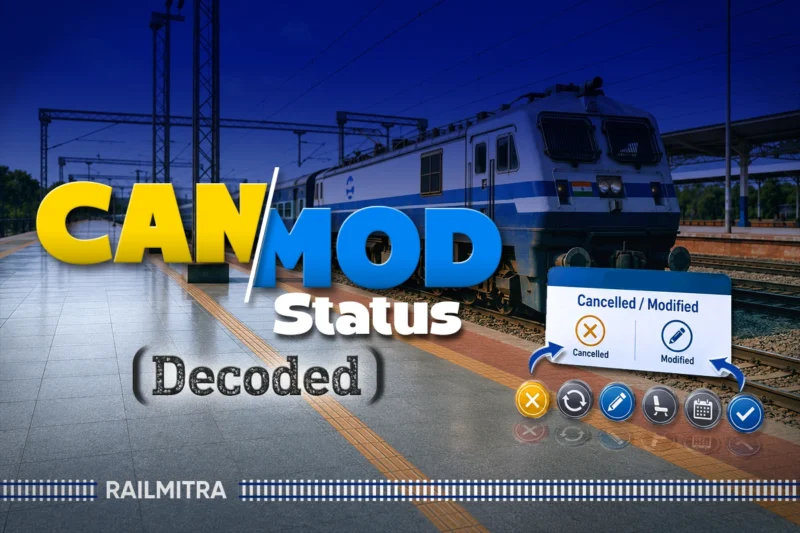
CAN/MOD in Railway
What Does CAN Mean in Railway?
CAN is short for Cancelled. Simple as that, though the implications run a little deeper. When Indian Railways marks a PNR as CAN, it means that particular ticket, or in some cases a specific passenger within a group booking, has been withdrawn from the reservation. That PNR number does not get handed off to someone else later. It just sits there, cancelled, until the system eventually clears it out.
Passengers searching for CAN full form in railway usually land here first, wanting the straightforward definition before anything else. And the answer really is that plain. Cancellation can happen because you initiated it yourself through IRCTC, or because a co-passenger on the same PNR dropped out while the rest of the group kept their seats.
Sometimes, Railway officials also cancel a berth if they find some discrepancies or if something just doesn’t add up. However, passengers should not assume that the whole ticket is void if the sign appears once against any of the passenger’s names. If the sign appears against one name in a ticket consisting of five people, this means the cancellation for only one person. The rest of the four people are free to continue their journey according to the status provided against their names.
What Does MOD Mean in Railway
MOD mean in railway is simple, it means modified. The PNR Status appears on your ticket if you have made some changes in your booking. Suppose you booked the ticket in a hurry and misspelled your name or made some other errors in booking. If you modify these changes a MOD sign will appear against your name in your ticket. This sign is there to tell the railway officials that there have been changes or modifications in the original booking.
This change can be anything. It can be a name correction, a change in the class of the train berth or the boarding station. Any of these can trigger this status code against your ticket. Unlike CAN, the MOD symbol means that your details have changed and not cancelled altogether.
Read More: How to Change Passenger Details After Booking a Train Ticket
CAN/MOD Meaning in Railway: How It Appears on PNR Status
When you check your PNR Status and see CAN/MOD sitting where a berth number should be, it is worth pausing before assuming the worst. The system is telling you that either a cancellation or a modification touched this booking since it was first confirmed.
This is also where can mod pnr status searches spike the most, since people want to know if they can still board the train. In most cases involving MOD, yes, you travel as usual, just with updated details on record. With CAN, the specific berth or passenger flagged will not be travelling, though others on the same PNR often can.
Why Does CAN/MOD in IRCTC Show Up on Your Ticket?
Anyone booking through the portal eventually runs into can mod in irctc, usually after making a last minute edit themselves. The platform logs every change against your PNR, and that history reflects in the status you see later. Can in irctc specifically points to the cancellation side, whether self initiated or system driven during chart finalization.
A quirky detail here. Sometimes a MOD tag appears simply because railway staff corrected a typo in your name during verification, nothing dramatic at all. Checking your train schedule alongside your ticket status the day before travel usually clears up any lingering doubt about what actually changed.
What Are CAN/MOD Statuses Good For?
You might be wondering how a CAN/MOD status could be good for anything. Well for once, CAN/MOD makes some changes in the existing booking allocations. These cancellations and modifications make several seats open for booking. These bookings are utilised through the confirmation of Waiting List passengers or the assigning of RAC statuses. The CAN/MOD code makes sure the seat allocation system is able to understand which seats have been recently reallocated. These vacant seats could then be easily transferred to the more needful.
This was from the perspectives of others. However, these codes are helpful for the passengers themselves. Suppose a group of passengers travelling in a group of five. If one passenger backs out of the travel plan at the last moment (as it happens most of the time). Now if he/she cancels the ticket and there is no CAN/MOD status code then it would be very difficult to distinguish which passenger has cancelled the ticket. Also, this could be unnecessarily troublesome for passengers who are going to travel. The CAN/MOD code on the ticket settles the commotion once and for all.
There is a transparency angle too, one people rarely think about until they need it. Railway staff checking your ticket onboard can immediately tell whether a change was authorized through official channels or not. That matters more than most passengers realize, especially during disputes over berth allocation.
Benefits of Knowing This Beforehand
Most people only learn what CAN/MOD means the hard way, staring at their phone at the station wondering if they still have a seat. Knowing it in advance changes that entire experience.
- You can relax and prevent unnecessary worries that this code will affect your train plans
- You can clearly distinguish if the code applies to you or your co-passenger
- Passengers would be able to differentiate when it is time to call the railway help line and when to ignore your friend pointing over it again and again.
- You prevent yourself from unnecessarily booking your tickets again. Yes, many people have done that after seeing CAN/MOD in railway tickets.
The last point in the list is the most crucial one. This status code does create a certain kind of panic on the passengers which leads to them booking the ticket again although they shouldn’t have. This blog is meant to inform the passengers and prevent them from doing something like this.
Drawbacks and How Passengers Should Handle Them
The obvious downside is confusion, and railways have not done a great job explaining these codes anywhere visible on the ticket itself. A CAN tag against a shared PNR can look, at a glance, like the entire booking failed, even when four out of five travellers are perfectly fine.
There is also a timing risk worth mentioning. If a MOD change was made too close to departure, sometimes the updated details do not sync properly with the chart before it prints. This is rare, but it does happen, particularly with last minute class changes.
So what should you actually do when you spot CAN/MOD on your PNR? Do not cancel a working ticket out of confusion, first of all. Read the individual passenger names carefully rather than the summary status. If anything still looks unclear, a quick call to the railway helpline or a check on your live train running status closer to departure day usually resolves it without drama.
Checking Live Train Running Status on RailMitra
Once you know your ticket stands, the next natural question is timing. RailMitra makes this easy. Head to the live running status section, enter your train number or name, and you get real time updates on where the train currently is, expected delays, and platform information at your boarding station.
This becomes especially useful after a MOD change to your boarding point. Knowing exactly when the train is expected to hit your new station saves you from either rushing unnecessarily or, worse, missing it by minutes because you assumed the original schedule still applied.
Exploring Alternatives with Trains Between Stations
Sometimes CAN status on your PNR means you genuinely need another way to travel, not just a corrected booking. This is where the trains between stations tool on RailMitra earns its keep. Punch in your source and destination, and it pulls up every available train option running that route, along with timing and class availability.
For passengers whose berth got cancelled during chart preparation with no waitlist movement in sight, this feature turns a frustrating dead end into a workable backup plan within a couple of minutes.
Food Booking While You Wait It Out
Long waits at the station while sorting out a CAN/MOD confusion are never fun, especially on an empty stomach. RailMitra’s train food booking service lets you order meals straight to your seat or to your boarding station, timed around your actual arrival. Whether you are waiting out a modification confirmation or just settled in after boarding, hot food delivered without leaving your coach makes the whole journey a little less stressful. No need to rely on uncertain pantry car timings or rush a platform vendor before the train pulls away.
Conclusion
At the end of it, can/mod means in railway nothing more sinister than a change log attached to your ticket. CAN tells you something was withdrawn, MOD tells you something was edited, and that together they simply keep a log of the journeys your booking took before it appeared on your screen. Once you got past these initial warnings and checked your PNR, verified your live status, and had RailMitra’s tools ready to use whenever the need arose, it wasn’t much of an issue.