Ever spotted a coach right behind the engine with no windows, no passengers peeking out, just a low constant hum coming from inside? That’s usually your first brush with an EOG coach in train setups, and most travellers walk past it a hundred times without knowing what it actually does. EOG coach in train terminology refers to a power generating car that keeps the lights on, the fans running, and the AC working through your journey.

It sits quietly at one end of the rake, doing a job passengers rarely think about until something goes wrong with it. This blog breaks down what EOG means, where you’ll find it, and why it matters more to your comfort than you’d expect. Planning ahead helps too, and checking the train schedule before you travel gives you a sense of which trains on your route are more likely to run with this setup.
What Does EOG Coach in Train Mean?
So what is the EOG coach in train really about? The term stands for something fairly mechanical, but the effect on your journey is anything but boring. In simple words, EOG coach in train means a compartment fitted with power generating equipment, usually diesel generators, that supply electricity to the rest of the train. Older rakes especially depend on this setup because the locomotive alone doesn’t always provide enough power for lighting, fans, charging points, and air conditioning across a full rake of coaches.
Two power systems run side by side on Indian Railways. One lets the locomotive itself generate and supply power, called HOG, or Head On Generation. The other leans on separate generator cars to do that job, and that’s the system EOG belongs to. Plenty of zones haven’t upgraded their older rakes yet, so EOG stays common on quite a few routes even now, not some rare exception you’d only spot once in a while.
That quieter locomotive at the front, the low hum coming from somewhere near one end of the rake, occasionally a faint whiff of diesel while the train’s parked at a platform. Small details, but they’re usually what makes someone type “EOG coach in train means” into a search bar in the first place, trying to place a difference they can’t quite explain otherwise.
EOG Full Form in Train Explained
End On Generation. That’s the EOG full form in train usage, and it’s fairly literal once you unpack it. Power gets generated from a unit placed at one end of the train, rather than through the locomotive.
Power supply isn’t uniform across the Indian Railways network, and that inconsistency is exactly why this distinction matters. Certain routes have moved entirely to HOG, chasing better fuel efficiency and lower running costs. Others still carry EOG coaches bolted to the rear or front of the rake, sometimes because of the locomotive type in use, sometimes because the route itself hasn’t been electrified enough to support HOG. Zonal railways decide this on a rake by rake basis, which is why two trains on a similar route can end up running completely different power setups.
Coach composition charts occasionally list power cars apart from passenger coaches, using this exact term. Understanding the EOG full form in train notifications makes those charts a lot less confusing when you’re trying to figure out your coach position before boarding.
Where is the EOG Compartment Located in a Train?
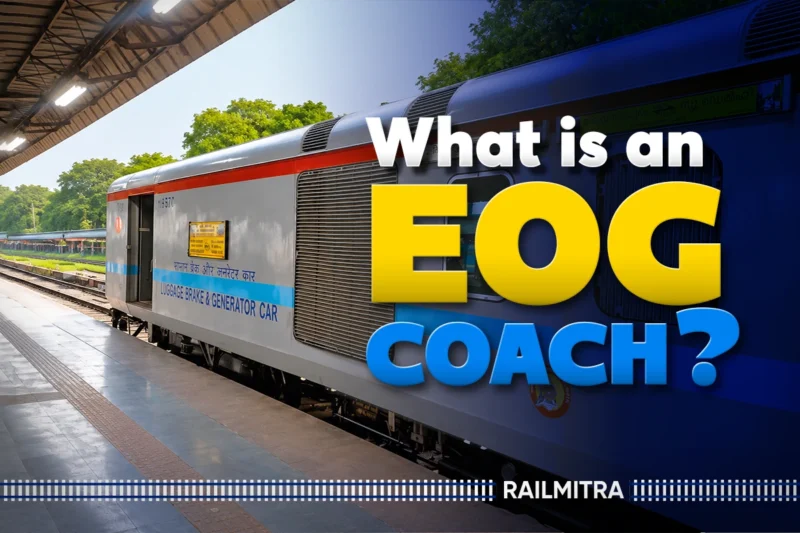
Look toward either end of the train, and that’s usually where you’ll find it. The EOG compartment in train formations is almost always positioned right after the locomotive, or occasionally at the very rear of the rake, depending on how the train has been marshalled for that particular route.
You won’t be able to enter it. It’s sealed off from passenger access for safety reasons, given the diesel generators and electrical systems running inside. From the platform, it’s fairly easy to identify: no windows in the usual sense, sometimes a slightly different paint marking, and often positioned adjacent to the SLR (Seating cum Luggage Rake) coach.
Coach composition charts displayed near the platform or available through railway apps typically mark this position clearly, so if you’re curious before boarding, that’s worth a quick glance.
What Do EOG Coaches in Trains Actually Do?
Their job sounds simple on paper: generate electricity, distribute it across the rake. In practice, this single function touches almost everything a passenger experiences once onboard.
Lighting throughout every coach draws from this power source. So does the air conditioning in AC coaches, which pulls considerably more load than lighting alone. Charging points at your seat, the fans in sleeper class, even the announcement systems in some rakes trace back to power coming from these generator cars.
EOG in trains basically function as the electrical backbone of the entire rake. Without them working properly, you’d notice within minutes: dimmer lights, AC units struggling to maintain temperature, charging ports going dead. Railway staff monitor these systems closely because a malfunction here doesn’t just inconvenience one coach, it can affect the whole train depending on how the power distribution has been wired.
How EOG Coaches Affect Your Travel Experience
Most passengers never consciously register the presence of an EOG coach in train travel until it fails or underperforms. Working fans, a charging port that actually holds up till morning, none of it feels special until one night it just doesn’t work. That’s usually when people start asking questions.
June and July nights tend to expose it first. AC coaches near the far end of a long rake sometimes get weaker cooling than the ones closer to the generator car, and travellers who’ve done the same route more than once tend to pick up on it fast.
There’s a noise factor too, worth flagging before you book. Coaches sitting closest to the EOG unit occasionally pick up a low mechanical hum, more noticeable once the train quietens down at night. Not loud enough to wake most people, but light sleepers in coaches near the power car have brought it up often enough in reviews that it seems worth a mention here.
Checking Live Train Running Status Before You Travel
Rake substitutions happen. Maintenance windows shift schedules. And coach configuration, EOG or HOG, sometimes plays a quiet role in both. Which is why checking live train running status through RailMitra before you leave home is worth the thirty seconds it takes.
Real time positioning, expected delays, platform numbers, all pulled straight from railway data feeds. No standing around guessing. Fog rolls in across North India most winters, and older EOG rakes tend to go through a bit more safety checking before they’re cleared to leave, something worth factoring in if you’re travelling that stretch between December and February.
Delays still sneak up on people even now, despite punctuality improving over the years on paper. Nobody wants to find that out standing on an empty platform. Checking status before leaving home avoids exactly that.
Looking for Alternatives? Trains Between Stations
The train you were counting on gets pushed back, or maybe you’re just weighing what else runs that route before you commit to a booking. Either way works. The trains between stations feature on RailMitra handles it. Punch in your source and destination, and every train running that route shows up, complete with timings, class availability, and roughly how long each one takes.
Useful if you’re trying to dodge a rake known for older EOG coaches. Useful too if you’d rather book something on the newer HOG system, where AC coaches tend to run marginally quieter. A preference some travellers build up over time, once they’ve sat through enough journeys to notice the difference between the two setups firsthand.
Booking gets easier when your dates aren’t fixed in stone. Lining up two or three trains side by side and picking whichever lands you at your destination sooner beats grabbing the first option that pops up.
Food Delivery in Train: Convenience Without Leaving Your Seat
Long journeys stop feeling long once you’re not stuck depending on pantry car food or whoever happens to be selling something at the next station. RailMitra’s food delivery in train service pulls from local restaurants near your upcoming stops, and the order lands at your seat based on your PNR and coach details, no scrambling required.
Routes that run smoothly on EOG coaches through the night tend to keep that food fresher too, sitting in a properly cooled coach rather than a warm, poorly ventilated one. Order ahead, track it as it comes, and skip the gamble of station food stalls entirely.
Small things, maybe. But anyone who’s bought a soggy vada pav through a train window at 2 AM knows exactly why it matters.
Wrapping Up on EOG Coaches
EOG coach in train systems might not be something you think about while booking a ticket, but now you know what’s actually keeping your coach lit, cooled, and functional through the journey. The EOG meaning in train context, where the compartment actually sits inside the rake, none of it stays a mystery anymore once you’ve read this far.
PNR status, running position, alternatives through the trains between stations tool if the timing looks off, all of it takes a few minutes at most. Pair that with knowing how an EOG coach in train setup actually functions, and the whole journey stops feeling like something happening to you and starts feeling like something you’re steering.