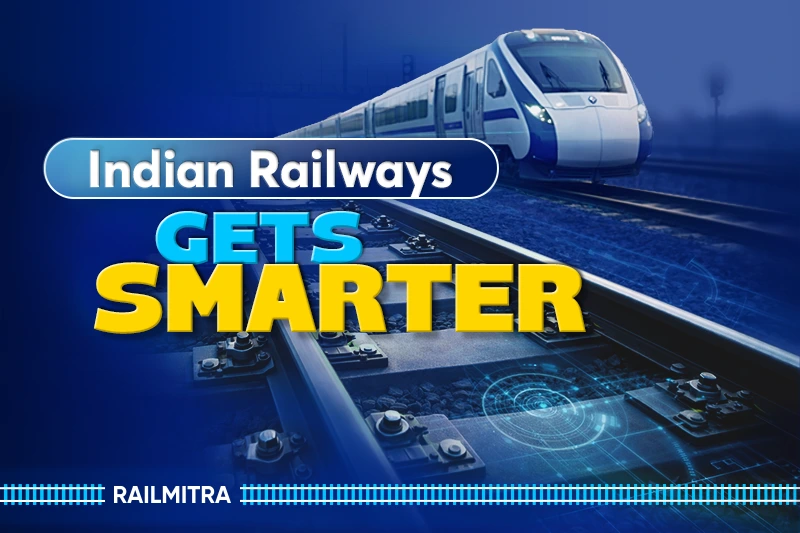
The Indian Railways has never really been shy about announcements. But what came out of the Ministry of Railways this week is a bit different; this one is about the actual physical track under your train, and the technology watching over it.

Two sets of upgrades were announced. One deals with the material used to hold railway tracks in place. The other is about how Railways will now monitor those tracks using AI. Together, they address something passengers rarely think about until something goes wrong: the condition of the track itself.
What Are Composite Rail Ties and Why Does It Matter?
Most people have no idea what keeps two rails from drifting apart. That job belongs to sleepers or what Railways is now calling composite rail ties in newer installations. These are the cross-pieces laid perpendicular to the rails, bearing the weight of passing trains and keeping the gauge consistent.
For decades, Indian Railways used concrete and iron sleepers.Heavy they might be, yet these systems function, just cost a lot to fix. Tricky spots such as bridge entries or tight turns at switches often resist their fit. Most rail passengers have felt it: that abrupt sideways shake when shifting tracks, or the distinct thud rolling over a span.
Heavy steel and concrete railroad ties now face a different kind of rival, lighter ones built from blended substances. These fresh versions weigh much less yet hold up just as well under pressure. More importantly, they can withstand loads of up to 700 kg per square centimetre, which is higher than what most existing sleepers handle. They also offer better cushioning, which directly reduces the jolt passengers feel at bridges and junctions.
What is genuinely useful about these ties is that they can be designed for specific locations. A bridge approach has different stress requirements than a flat stretch of track. Earlier, Railways had to use the same standardized sleeper everywhere. Now the tie can be engineered for exactly where it is going to sit.
The Ministry also noted that these composite ties are easier to lay and repair. Repairs wrapping up quicker helps keep trains moving. With more than 68,000 route kilometres under its care, the Railway system relies on speed when fixing tracks. Less downtime adds up to smoother operations across the network.
If your trip suddenly seems calmer crossing a bridge or weaving through traffic, that could be the reason. Curious whether the train will actually show up when it should? RailMitra shares live train status so you know right away.
AI-Assisted Track Monitoring: Ground Penetrating Radar in Inspection Vehicles
The second part of this announcement is about how Railways checks whether tracks are in good condition and this part is genuinely interesting.
Currently, track inspection is done through a mix of manual checks and mechanical measurement cars. It works, but it has limitations. Visual inspection can miss sub-surface problems. Cracks forming inside a rail or the ground shifting below a sleeper are not things you can catch just by looking.
Railways is now equipping inspection vehicles with Ground Penetrating Radar (GPR) devices tied to an AI-based analysis system. GPR sends radar pulses into the ground below the track and reads the reflected signal. The AI then interprets that data to assess track condition identifying voids, settlement issues, or subsurface defects before they become visible problems.
This moves track monitoring from reactive to something closer to predictive. Instead of finding a problem after it causes a delay, or worse, an incident, the system can flag sections that are deteriorating before they become dangerous.
A separate measure announced alongside this is Magnetic Particle Testing for welded joints. Bent rails snap under pressure because joints bear the brunt of strain across segments. Where pieces meet, flaws hide until revealed through invisible forces that pull tiny metal bits into cracked patterns. A defect disrupts the magnetic field and the particles cluster around it, revealing the problem. It is a standard industrial NDT (non-destructive testing) method that Railways is now formally adopting for quality checks on track welds.
AI Surveillance and Station-Level Tech: What Else Is Happening
Now rolling out across 1,405 stations, automatic train announcements rely on real-time updates instead of fixed schedules. This shift ties into the National Train Enquiry System, syncing display boards and audio alerts seamlessly. Live data flows directly, replacing older scripted formats entirely. Alongside track upgrades, fresh details emerged about Railways’ wider push into AI and telecom by 2025–26. If your train is late, the announcement updates accordingly.
AI-enabled video surveillance is deployed at 1,874 stations. These systems do not just record, they actively flag suspicious activity like intrusion or loitering, and facial recognition is part of the setup. It is a significant infrastructure push, though the facial recognition component will likely attract its own conversation over time.
Inside long rail tunnels like those on the Udhampur-Srinagar-Baramulla route, special comms gear is going up where regular signals fail. When workers are deep underground, messages still move between them and command hubs above ground – this link matters most when things go wrong. Because of these setups, help can respond faster if an issue strikes mid-build or once trains run.
What This Means If You Are Travelling Soon
None of these changes are visible from a passenger seat. You will not see the composite rail tie under your train or the GPR device in the inspection vehicle ahead of it. But the effects of smoother passage over bridges, fewer sudden lateral jolts at junctions, fewer track-related delays. All will be felt over time as these upgrades roll out across the network.
If you are planning a trip, you can checkPNR Status to confirm your booking details, and if you want to order a meal ahead of your journey, food in train lets you get hot food delivered to your seat at the station of your choice.
The infrastructure work is long-term. But at least this time, the announcement comes with specific materials, specific technology, and specific locations, which is more than most railway upgrades tell you.