If you have ever booked a sleeper or AC coach ticket and got a middle berth in train, you probably had a moment of “okay, what exactly do I do with this.” Most passengers treat it like the worst draw in the lottery. But that reaction usually comes from not knowing how it actually works. Once you do, the seat starts making more sense.

This blog covers what the middle berth is, the railway rules around it, who it is good for, and how you can check or change your berth before the journey.
What Is the Middle Berth in Train?
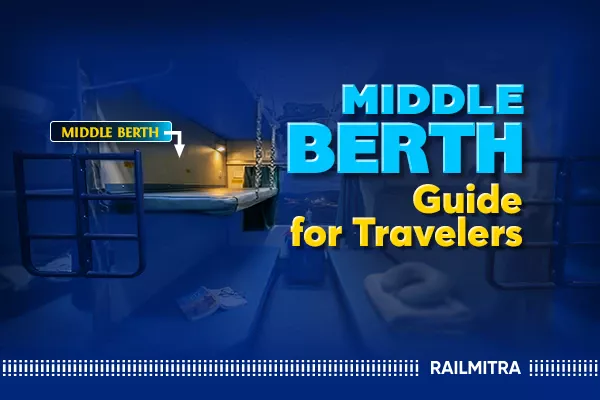
Take a side bay in any Sleeper or 3AC coach. Pick any side bay in a Sleeper or 3AC coach. Lower berth at the bottom, upper berth at the top, and one more in between. That middle one is what this blog is about.
Daytime, it stays folded flat against the wall. The lower berth passenger gets the space as a seat. The upper berth just sits there above everyone. Come 10 PM, the middle berth gets unfolded and whoever has that ticket finally has somewhere to lie down.
This is one of the most important distinctions of the middle berth in train. This train seat can be used for sleeping in the day as for that the consent of the lower berth passenger needs to be taken. This is because when the middle berth is lowered then the lower berth person cannot sit and would be forced to sleep or sit in an awkward position.
Middle Berth Rule: What Indian Railways Says
The middle berth rule set by Indian Railways is straightforward. The middle berth can only be unfolded between 10 PM and 6 AM. Outside these hours, it stays folded. This gives lower berth passengers their daytime sitting space and sets a clear expectation for everyone in the bay.
The railway rules for middle berth also touch on who has authority here: the lower berth passenger does not need to agree to fold the middle berth down before 10 PM. If the middle berth passenger tries to lie down during the day, the lower berth occupant is within rights to ask them to fold it back.
This specific railway rule for middle berth applies to Sleeper, 3AC, and 2AC classes. In 2AC, there is no stacking: only upper and lower exist. So the middle berth is specific to SL and 3AC.
Ticket examiners can intervene if a conflict comes up, and the 10 PM to 6 AM rule is what they fall back on.
Middle Berth Seat in Train: What It Actually Looks Like
The middle berth seat in train looks like a flat padded plank that folds out from the side wall. During the day it is vertical. At night it is horizontal, roughly at shoulder height when you are sitting on the lower berth.
Getting up onto it requires some effort: you use the side ladder rungs. It is not as high as the upper berth, so that part is a little easier. But the headroom above the middle berth is more limited than the lower berth. You cannot sit upright once you are lying there. Some taller passengers find it uncomfortable for that reason.
The sleeping surface itself is the same width as upper and lower berths. The padding is identical. From a pure “flat surface to sleep on” standpoint, it is no worse than the others.
You can check your exact seat number and berth type any time using PNR Status on RailMitra. Once the chart is prepared, it tells you your coach, berth number, and position (upper, middle, or lower).
Benefits of the Middle Berth That Most Passengers Miss
Nobody asks for the middle berth. But it has a few things going for it that you only appreciate once you are actually on the train.
Start with temperature. The upper berth gets stuffy because heat rises. The lower berth, depending on which side of the coach, sits next to a window that often has gaps. The middle berth avoids both problems. Not dramatically, but enough that you notice it on a long overnight run.
Second, think about the lower berth during daytime. It is shared seating for everyone in the bay. Bags land on it, kids sit on it, co-passengers use it through the whole journey. If you have a lower berth ticket, that berth is a public space until 10 PM. The middle berth passenger skips all of that: nobody sits on a folded vertical plank. At night there is also a bit more enclosure, with berths on either side. Third, the aisle brushes against lower berth passengers constantly. Vendors, other passengers, the TTE. The middle berth is just above that zone.
Before the journey, you can check the live train running status on RailMitra to track where the train is and plan when to get settled in.
The Honest Downsides of the Middle Berth
No berth is without issues, and the middle berth has real ones.
Headroom is the real issue. Lie down on the middle berth and the underside of the upper berth is maybe two feet above your face. You cannot sit up properly. Propped on one elbow is about as upright as it gets.
The ladder is shorter than the upper berth climb, so that part is manageable. What catches people is the nighttime trip to the washroom. Moving train, dark coach, trying to find the rung quietly. Most passengers work it out after the first attempt.
The bigger practical issue is daytime. You do not have a berth to sit on during the day. You have to sit on the lower berth alongside its assigned passenger. That arrangement can feel awkward for a long journey, especially if you and the lower berth passenger have different ideas about personal space.
Who Is the Middle Berth Good For?
Honestly, it is a reasonable berth for solo travelers on overnight journeys where most of the travel happens at night. If you board at 9 PM and arrive at 7 AM, the day restriction is barely relevant.
Younger passengers who board late and travel overnight tend to have no complaints. The ladder is easy, the daytime restriction barely applies, and they sleep through most of the journey anyway.
Elderly passengers or anyone with knee problems will find it a bad fit. Climbing down even a short ladder with stiff joints on a moving train is not a situation worth getting into. Same goes for daytime journeys: if your train runs mostly during the day, you are spending hours sitting on someone else’s berth. For those cases, checking for a lower berth using Train Seat Availability on RailMitra before booking is worth doing.
Can You Change Your Berth from Middle to Lower?
Three ways to go about it, none guaranteed.
Before the journey, pull up Train Seat Availability on RailMitra and see what is open on your train. Lower berth available? Head to the reservation counter at the station with your PNR and ask for a reallocation.
If you are on the train, you can contact the TTE directly once the train chart has been prepared. If a lower berth in train would be available you would be provided the seat. However, there is no guarantee for this and you can often end up disappointed here as well.
Direct swap is also worth trying. Some lower berth passengers genuinely prefer the upper, or are fine with a trade on short routes. Ask around before assuming nobody will agree.
One thing to be clear about: there is no rule that gives you a lower berth just because you asked. Railway policy on preferential lower berth allotment covers senior citizens and passengers with disabilities at the time of booking, not upgrades on request.
How to Check Your Berth Using PNR Status
Once you have booked your ticket, your berth type may show as “GNWL” or “RAC” until the chart is prepared. After chart preparation (usually 4 hours before departure), your seat gets confirmed with a coach and berth number.
To check this:
Head to PNR Status on RailMitra and enter your 10 digit PNR. Once the chart gets prepared, the status page shows your coach, berth number, and whether you got lower, middle, or upper. That is the cleaner way to find out rather than hunting for your name on the printed chart at the station.
Separately, train schedule on RailMitra shows all station stops and timings along the route. Useful for figuring out roughly what time you will want to settle in for the night.
Train Food Delivery for Middle Berth
Did you know you can now easily get food on the train? Not only that, the food would be delivered right on your train seat. You can use train food delivery apps like RailMitra which will provide food from restaurants and bring tasty delicacies at your seat number. RailMitra is present in more than 500 stations and has partnered with more than 2,500 FSSAI approved vendors making tasty and hygienic food available across most of the stations in the country.
Just enter your PNR number and the system will detect your train, journey date and boarding station. If you don’t have the PNR number you can also use the Train Name and Number method. You just have to manually enter your boarding date and station in this method. Select the station where you want to get your delivery, choose from available restaurants and add your favorite meals to the cart. Proceed for payment and the order would be brought to you by one of our delivery partners.
Conclusion
The middle berth in train is not the most glamorous draw, but it is far from unusable. Knowing the railway rules for middle berth, the 10 PM to 6 AM unfolding window, and your options if you want to switch berths puts you in a much better position than most passengers who just accept whatever they got. If you want to plan around your berth type, check PNR Status and Train Seat Availability on RailMitra before your journey. That five minutes of prep saves a lot of on-board friction.
FAQs for Middle Berth in Train
Q: Is the middle berth compulsory to use at night?
A: No, there is no compulsion for this. However, if the lower berth passenger insists, you have to. It all depends on the consent of the lower berth passenger.
Q: Can passengers keep the middle berth open during the day?
A: No. The Indian Railway has mandated that from 6 AM to 10 PM the middle berth in train should be folded. You can open it but only when the lower berth passenger has consented to it or is empty. If there is a passenger in the lower and he does not want the middle berth open, you would have to fold it.
Q: Can I request a change from middle berth to lower berth?
A: Yes. Check Train Seat Availability on RailMitra first. If a lower berth shows open on your train, go to the reservation counter with your PNR before departure and ask for it. On board, the TTE handles it if something is unoccupied after chart preparation. Nothing guaranteed either way, but both are worth trying.
Q: What should I do if someone forces me to open the middle berth early?
A: Hold your ground. The middle berth rule gives you the right to keep it folded until 10 PM. You are not obligated to open it earlier because another passenger wants more lying space. If the pressure continues, call the TTE. That is what they are there for.
Q: Can I sit on the lower berth if I have a middle berth ticket?
A: Yes. Daytime seating in a bay is shared. The lower berths are where everyone sits from morning until 10 PM, regardless of which berth their ticket says. Middle berth passengers are no exception.