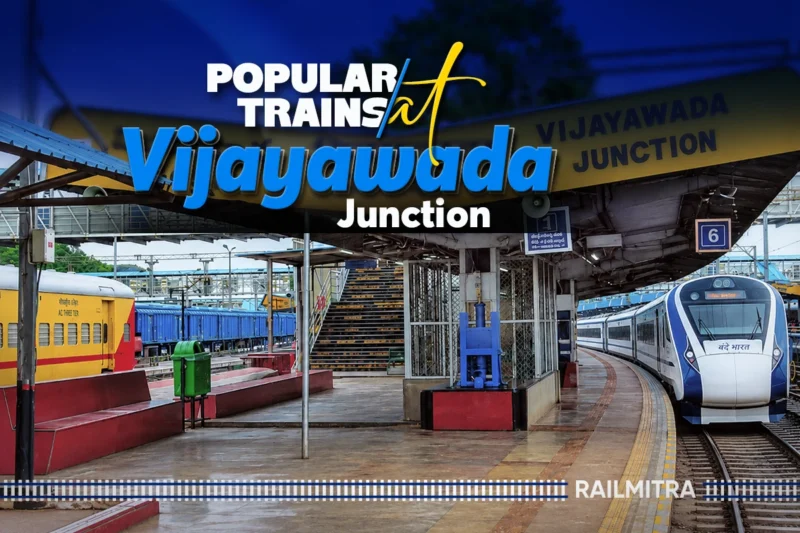
Ask a local which platform to wait in and the first thing they’ll ask you is, which direction are you going. Vijayawada junction is one of the busiest railway junctions in the Indian Railways network. A meeting point of the Chennai to Delhi and Chennai to Kolkata lines, the station sees twenty two tracks and ten platforms go by in steady traffic. The station is unique in that it serves traffic in four directions at once, and newbies often take a while to get their bearings.

Why Vijayawada Junction Sees So Much Rail Traffic
A track climbs north from here toward Nagpur and eventually Delhi. East is a different story, curving up through Vizianagaram and Bhubaneswar before it finally reaches Howrah. South, the line proceeds straight on to Chennai and, beyond that, into Kerala and Tamil Nadu. Throw in the branches to Machilipatnam, Gudivada, and Guntur, and you have a system in which these are by no means the only lines, carrying capacity, and traffic.
Almost 250 trains pass through it on an average day. Count local passenger services and freight alongside the express traffic, and that number climbs further still. There’s a reason South Central Railway ranks Vijayawada among its busiest stations, and it isn’t a close call.
What that scale means in practice is simple. Nearly any South India journey has a decent chance of routing through Vijayawada, even one that never mentions the station by name in a search. Trains between stations on RailMitra is worth checking before booking, since it often turns up connections a single train name search would never surface.
Vande Bharat Trains That Run Through Vijayawada
Three Vande Bharat services touch this junction, and each solves a different problem.
20677 and 20678, that’s the Chennai to Narasapur Vande Bharat, and it wasn’t always this long. It started life as a shorter Chennai to Vijayawada service before someone decided to stretch it further down the coast. Vijayawada kept its halt regardless, and that stop alone cuts real time off what the old express trains used to take.
20833 and 20834 run the Visakhapatnam to Secunderabad leg instead, slicing through Vijayawada on the way between the port city and Hyderabad. Before this train started, anyone on that route was stuck choosing between a packed superfast or waiting around for something faster.
A Bengaluru link joined the roster more recently, and it runs early, out at dawn, through Tenali, Ongole, Nellore, Tirupati, Chittoor, and Katpadi before reaching SMVT Bengaluru around early afternoon. What existed before this was a thrice weekly express, nothing more, so the gap it filled was a real one.
These seats don’t sit empty for long. It is worth checking seat availability in train through RailMitra before a trip, especially anywhere near festival season, rather than finding out at the counter.
Rajdhani and Duronto Trains Passing Through the Junction
Skip stops, run fast, that’s basically the whole design philosophy behind Rajdhani and Duronto services. That’s why a Rajdhani stopping here is a big deal . The Swarna Jayanti Rajdhani from Vishakhapatnam to New Delhi via Warangal, Nagpur and Bhopal runs only one stop at Vijayawada on the route. So if ever the passenger misses the chance , it would be too late to catch the train .
Duronto services follow the same logic even more strictly. Yesvantpur to Howrah Duronto runs through Vijayawada on its way from one end of the peninsula to the other, and only has enough time to stop there briefly. A Secunderabad to Visakhapatnam Duronto similarly runs on the same broad corridor, serving Vijayawada on its way too, for those looking to save time on longer distance trains.
The tradeoff with all of this speed is fragility. A delay picked up three states away has a way of showing up right here too, sometimes without much warning. Not a bad idea to check live train running status on RailMitra before leaving for the station either, schedules this tight don’t leave much room for guessing.
Chennai to Delhi Trains Through Vijayawada Junction
This north south corridor had its heavyweights long before Vande Bharat entered the picture. The Tamil Nadu Express has linked Chennai and New Delhi for decades now, and somehow it still fills up most days it runs. Nagpur and Bhopal show up again on the Grand Trunk Express route, an old name on Indian Railways that has simply refused to fade.
Hyderabad gets its own pair on this same corridor. The Andhra Pradesh Express and the Telangana Express both start there instead of Chennai, but end up on Delhi through more or less the same broad route.
Families travelling here often stick with these older services for one reason above all others, the fare gap compared to newer premium trains stays real even when the ride runs longer.
There is nothing modern about the coaches on these trains, no rotating chairs, no built in entertainment screens. What has kept them relevant for so long is a simpler thing, decades of arriving close enough to on time.
Trains Linking Vijayawada Junction With Kolkata and the East Coast
One train dominates this stretch of coast, and coastal Andhra Pradesh knows it by name before anything else, the Coromandel Express. It has run from Chennai to Howahh along the Bay of Bengal for so many generations that it has become totally unremarkable to most regular travelers
Secunderabad to Howrah is a Falaknuma Express service via Vijayawada, heading north through Vizianagaram and Bhubaneswar; meanwhile, more leisurely travelers may prefer the Howrah Chennai Mail, which more or less follows the same track, but with sleeper accommodation for those wishing to take their time and enjoy the views.
An alternative inland service, the East Coast Express, runs between Bhubaneswar and Hyderabad with a call at Vijayawada, providing connection for passengers due to travel from Odisha through the northern most extremity of Andhra Pradesh, and on into Telangana.
Long routes mean long stop lists, and this stretch drifts off schedule more than most, monsoon weather further up the coast usually the culprit. Pulling up the train schedule on RailMitra before finalising plans is worth the minute, especially with a connection waiting soon after Vijayawada.
Trains Between Vijayawada and Hyderabad or Secunderabad
Traffic to Hyderabad outpaces nearly every other regional corridor here. The Satavahana Express handles the bulk of it, leaving early morning and reaching Secunderabad by evening while picking up students and daily commuters at nearly every stop along the way.
Two more options run this same broad path. The Golconda Express is heading towards Hyderabad while the Krishna Express is making it’s way further south towards Chennai via Vijayawada and Guntur both. Each seems to have a different set of passengers but are running close enough to allow for one to catch the other, at least not every corridor on this list has such a choice
The Amaravati Express is perhaps more interesting as it serves as a kind of side trip from Hyderabad towards Tirupati via Vijayawada also carrying pilgrims in addition to everyday travelers on most days it’s in service
A journey that only takes a few hours rather than a day to complete seems to be the main difference between this route and the much larger north-south ones covered previously. That short duration is exactly why so many passengers treat these trains as weekend options rather than something reserved for occasional long trips.
Trains From Vijayawada Junction Toward Kerala and Tamil Nadu
Few trains elsewhere have run for as long as the Kerala Express, which runs between Thiruvananthapuram and Nizamuddin in Delhi, with a stop in Vijayawada on the way. It has never been especially quick, nor does it especially seek to be. Nevertheless, people still keep booking it for the sheer reliability it affords.
Kollam is connected to Vijayawada, Guntur via the Sabari Express, while there is no need to change trains in Chennai. Nightjars running between Chennai and Vijayawada tend to prefer the Pinakini Express, which regulars regard as a good option. And the Circar Express, running Chennai to Visakhapatnam with a Vijayawada stop along the way, keeps drawing anyone who would rather pay less and travel slower than book the Vande Bharat covering similar ground.
Daytime has its own answer here too. The Jan Shatabdi Express gets from Chennai to Vijayawada in a little over seven hours, a timing it has held for years without much fuss. Together, these services give South India a genuinely dense set of choices, all funnelled through this one junction.
Trains Connecting Vijayawada Junction With Mumbai and Western India
Options thin out fast once you head west from Vijayawada. But what does run this direction covers serious distance, the Konark Express being the clearest example, linking Bhubaneswar and Mumbai through Vijayawada, Secunderabad, Solapur, and Pune. Probably the longest single journey touching this station.
This is not a trip booked casually. Given the distance and duration involved, sleeper passengers on this one tend to plan around an entire week, not just an overnight stretch, given how far it actually goes.
Festival season brings out a few special and seasonal trains on the Vijayawada to Mumbai stretch as well, mostly for Andhra Pradesh workers in Maharashtra heading home for the holidays. None of these run year round though, so it’s worth checking closer to the travel date instead of assuming the same train will show up on the schedule again.
Delays on a route this long tend to compound rather than fade. Something minor near Warangal can turn into a real setback by the time the train reaches Pune, so building in buffer time on either end is worth the small effort.
Local and Regional Trains Around Vijayawada Junction
Not every important train through Vijayawada gets written about, and the Machilipatnam Dharmavaram Express is a good example. It links the coastal town of Machilipatnam with Dharmavaram, crawling through more than twenty stops that the superfast trains skip right past.
Then there’s the MEMU and DMU network running all day between Vijayawada, Guntur, Gudivada, and Machilipatnam, carrying commuters, students, and traders who move between these towns like clockwork. No AC coaches here, no pantry car, sometimes not even a guaranteed seat. Yet put them all together and they probably move more people than any single long distance express mentioned so far.
The Vijayawada to Guntur passenger service in particular fills up every morning and evening almost like clockwork, timed closely around office and college hours in a way long distance trains rarely manage.
Travellers new to the region are often surprised these shorter services exist even when the real plan involves a longer journey. A brief MEMU ride into Vijayawada from a nearby town, followed by a superfast or Vande Bharat for the rest of the way, usually works out cheaper and calmer than arranging a cab.
Food and Train Food Delivery Options at Vijayawada Junction
The smell reaches the platform before the food itself does, fresh idli and filter coffee drifting out from the stalls near platform one. Regular travellers rate Vijayawada Junction’s food highly, and not because it’s fancy. Reliably fresh is more the point, and with so many trains stopping here specifically for a meal break, that reputation gets tested daily.
Catering stalls stick to the expected lineup, South Indian breakfast items, packed meals, bottled water, and a longer halt usually leaves just enough time to grab something before the whistle goes again. During a longer stop, some passengers step outside the station entirely for a proper meal at a nearby shop instead.
For a train that barely pauses, or for anyone who would rather not risk missing it while stuck in a queue, ordering through train food delivery on RailMitra removes that risk completely. Food arrives right at the seat or berth, timed to the train’s arrival, no gambling on a five minute stop.
Late night trains, particularly those headed toward Howrah or Delhi, tend to find fewer stalls open. Pre ordering matters even more when the journey through here falls well after midnight.
Conclusion
A Vande Bharat pulls out toward Chennai. Somewhere else on the platform, a Duronto is already racing for Howrah. A MEMU slips quietly off toward Guntur, barely noticed. Vijayawada Junction holds its rhythm through all of it, and none of that happened by accident. It comes from decades of planning around a station that sits exactly where South India’s rail network folds into itself.
Next time a route runs through Vijayawada Junction, a minute on the platform is worth taking, just to watch how many directions those trains are actually headed. Not many places in the country make the scale of Indian Railways feel quite this real.