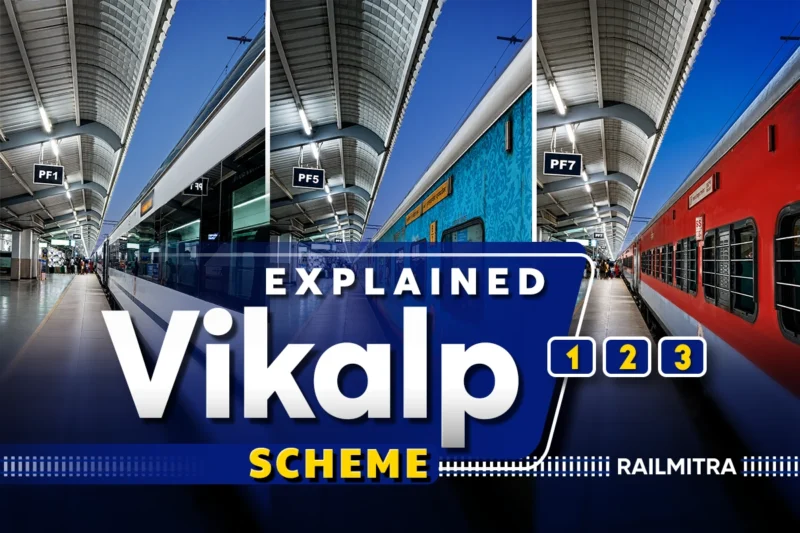
Waitlisted ticket, travel date approaching fast, and IRCTC quietly offering something called Vikalp during booking. Most passengers click past it without reading, then wonder later what they missed. The Vikalp Train scheme is one of Indian Railways’ lesser understood but genuinely useful tools for waitlisted passengers who want a real shot at travelling on their intended date, even if that means a different train altogether.

This blog breaks down what Vikalp actually means, how the option works at the time of booking, how to track its status, and what actually improves your chances of confirmation. Before booking, checking the train schedule on RailMitra gives a sense of which trains run on your route and when, which matters once you start thinking about alternate options.
What Does Vikalp Mean in IRCTC
Vikalp is a Hindi word meaning alternative or option, in fact, the scheme gives just that. Indian Railways officially launched the scheme as the Alternate Train Accommodation Scheme. The railways introduced it to make better use of vacant berths on trains running along overlapping routes with similar timings. What does Vikalp mean in IRCTC? It means your waitlisted PNR becomes eligible to move to another train with confirmed seats instead of remaining in the waitlist queue and hoping for a miracle during chart preparation.
Vikalp in IRCTC works only for passengers who are still on the waitlist at the time of chart preparation. RAC and confirmed tickets are not eligible. The scheme exists purely to help those who would otherwise travel on a waitlisted ticket or not travel at all. Whenever there are empty berths available on trains going between the same pair of stations that the original train was going to use, and which operate within a certain time interval, the system finds these out. The interval is usually just a couple of hours before or after the actual departure time of the first train. It then gives these reserved compartments to the waitlisted travelers. Preference is based on their reservation date.
Opt Vikalp Train: What This Really Means for Passengers
When people search for Vikalp train means, they are usually trying to figure out if choosing this option costs anything extra or locks them into something irreversible. It does not. Opting in simply widens the pool of trains your ticket can be confirmed on, without any additional fare or separate transaction.
The opt Vikalp train choice appears as a checkbox during the booking process itself, right after you select your travel class and before payment. If your ticket remains on the waitlist after booking, the system automatically considers you for alternate trains only if you ticked this box during the booking process. Skipping it at the time of booking means you cannot add it later, so it is worth ticking almost by default whenever there is a real chance of ending up on the waitlist.
There is a common misconception that opting in guarantees a seat somewhere. It does not guarantee anything, it only makes you eligible for consideration when vacant berths open up elsewhere. Passengers travelling with family or in a group should also know that Vikalp only works when the railways can accommodate the entire group together on an alternate train. Otherwise, the railways do not shift any member of the group.
How the Vikalp Option in Train Works
The Vikalp option in train bookings kicks in only after Indian Railways prepares the reservation chart, roughly four hours before departure for most trains. Until that point, your ticket behaves like any regular waitlisted ticket, and there is nothing extra to track.
Once Indian Railways finalises the chart, the system scans other trains departing from the same origin station or nearby stations within the defined time band, usually up to twelve hours in either direction, depending on the route. If it finds vacant berths on any of those trains, the system automatically shifts waitlisted passengers who opted for the Vikalp scheme according to their original waitlist position. After passengers choose the Vikalp option during booking, they cannot manually select an alternate train.
Another twist that passengers often do not anticipate is that the replacement train may depart from a different but nearby railway station in the same city or arrive at a station close to the one they originally expected. Whenever the train number changes, IRCTC sends an SMS and email with the updated PNR and train details. To avoid missing these updates, you should keep your mobile phone notifications turned on, especially during the week of your journey.
Who Should Consider the Vikalp Train Option
Not every waitlisted passenger benefits equally from this scheme, so it helps to think about whether your situation fits.
Passengers travelling on high demand routes during festival season or peak summer holidays tend to see the most value here, since multiple trains usually run close together on those corridors. Someone travelling between Delhi and Patna, for instance, has several train options within a few hours of each other, which raises the odds of a vacant berth turning up somewhere.
Indian Railways usually shifts solo travellers and small families of two or three more easily than large groups because it can accommodate smaller groups together on a single alternate train. Choosing a flexible arrival time is usually a minor point provided one arrives at the destination before planned. Vikalp train then can be a very good option for such a journey almost every time without much worry.
Picking Vikalp would need more careful consideration if the passenger is a business traveller with fixed meeting hours or a journey with no waiting time for the passenger after reaching the station. The reasons include Truth is the arrival time of the alternate train might vary several hours from the planned departure.
Checking Seat Availability Before You Opt Vikalp Train
A little planning before booking often reduces the chances of ending up on the waitlist in the first place. Railmitra trains’ seat availability tool allows passengers to verify the real time berth status across different classes of train. This can be done before the booking window even opens. A few clicks with the train number or route and journey date give passengers a clear picture. It shows how many seats are left in sleeper, AC, or general categories.
When the preferred train is already giving indication of its waitlist being long, looking up trains between stations through Railmitra offers passengers a complete picture. It is better than going for the first train that is available and hoping for luck. The tool lists all the trains running between two stations with timings and seat status. This enables passengers to compare two or three trains. They can select the one with the highest chances of confirmation. Combining this early research with the Vikalp option in train bookings essentially doubles the safety net. You are both choosing a train with better odds and keeping the door open for an automatic shift later.
How to Check Vikalp Status After Booking
Vikalp status is not something that shows up instantly after ticking the checkbox. Nothing changes on the PNR until chart preparation happens, so checking status too early usually just shows the regular waitlist number with no additional information.
Once your chart is prepared, the PNR Status tool immediately shows any change in your Vikalp status. It displays the new train number, coach, and berth. If the railways shift a passenger to another train under the Vikalp scheme, the PNR Status tool reflects the updated train details. This includes the new train number, coach, and berth. But if the railways do not shift the passenger, the tool confirms that the passenger remains on the original waitlisted train. If the railways cannot find a vacant berth on any alternate train, the passenger continues on the original waitlisted booking. This happens without any Vikalp allocation.
Plus SMS and email notifications, IRCTC also informs passengers immediately when they get rescheduled. Yet, it is a bit of a quicker service and not reliant on delay of messages if you directly check the PNR status. For those traveling from smaller stations with a weak or patchy mobile network connection, it is better to manually check the status a few days nearer to departure. This is better than waiting for notifications to turn up.
Vikalp Confirmation Chances: What Actually Improves Them
The probability of confirming a train ticket booked through Vikalp depends largely on the travel destination and the time of the year. There is no set percentage that covers the entire scenario. Routes that have a larger volume of trains, like from Delhi to Mumbai and Chennai to Bangalore, normally display higher changeover rates. This is because more alternate trains are available. This happens because more trains are available from which passengers can switch trains.
Booking early in the reservation cycle also helps indirectly. An earlier booking usually means a better waitlist position, and better waitlist position translates to higher priority when the system starts allocating vacant berths under Vikalp. Travelling during off peak months, avoiding major festival windows where every train runs full, naturally improves the odds as well.
Group size matters too, as mentioned earlier. A party of six waiting for six vacant berths together on one alternate train faces steeper odds. This is compared to a solo traveller waiting for just one seat. Checking seat availability across two or three trains on the route beforehand is one of the most practical ways to stack the odds in your favour. It is better than booking blind on a single heavily booked train. This helps before Vikalp even comes into play.
Train Food Delivery for Vikalp Passengers
If the railways shift you to an alternate train at the last moment, your travel plans often change in small but inconvenient ways. Meal arrangements are one of them. RailMitra’s train food delivery service works regardless of which train a passenger ends up travelling on. Passengers place their orders against the PNR. RailMitra matches those orders to the coach and berth the passenger occupies at the time of travel.
A Vikalp shift happens if a passenger is shifted to a different train due to an unexpected closure or change of running. Mostly just before the departure time. Still, passengers can place a food order for the new train once the updated PNR displays the change. During the travel to several stations, the meals arrive at their seat. This includes not only the various kinds of local thalis but also lighter choices of snacks. It is based on availability at each halt. This convenience takes care of one less thing to worry about when your travel plans change at the last minute. Passengers do not have to search for food at unfamiliar stations or on a train they were not originally booked to travel on.
Conclusion
The Vikalp Train policy has done a quiet yet impressive job of solving a long-standing issue. Indian Railways travelers had been frustrated over the flat rejection of waitlisted tickets. Vikalp simply helps the situation by giving people whose tickets are on waitlist another possible option for travel. It lets them travel by the same date that they were originally planning to travel. Knowing what Vikalp means, choosing the scheme during booking, and checking your status later can help you travel with more confidence. It is better than simply hoping your waitlisted ticket gets cleared. It’s also very advisable to carry out preliminary work by checking available coach space. Compare different trains using a service like RailMitra. This will give you an even greater advantage. The next time a booking shows a long waitlist, ticking that Vikalp Train checkbox costs nothing. It might just be the difference between reaching your destination on time and rebooking from scratch.