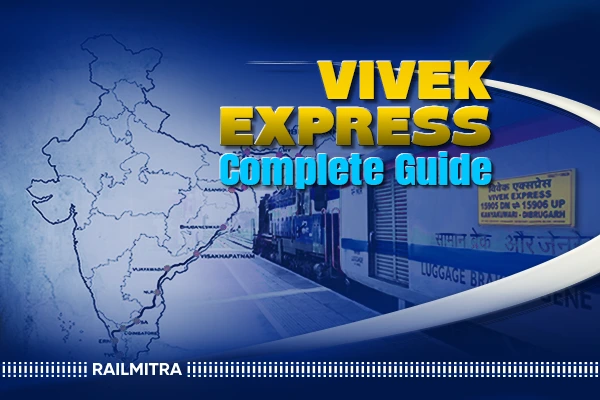
Getting on the Vivek Express at Dibrugarh and getting off at Kanyakumari means 4,154 kilometres across four calendar days, no change of train anywhere in between. Indian Railways has no longer route than this, and Vivek Express is the train with the longest travel duration. The window covers flooded tea gardens in Upper Assam on Day 1, the Brahmaputra flood plains, the Siliguri Corridor pressed between Bhutan and Bangladesh, the Bay of Bengal coast through Andhra Pradesh, the Deccan plateau, the Western Ghats, and rubber tree groves with coastal salt air by Day 4.

What 75 hours of that window does to your sense of the country is difficult to summarise, but this guide covers the practical and the less practical sides of both. In this blog we will try to give you a taste of this train by providing information about the stops on this train as well as the </s
pan>
Why the Vivek Express Was Started
Railway Budget, then-Minister Mamata Banerjee. Four trains were introduced together, all named from Vivekananda’s legacy, the 150th year since his birth being the occasion. Vivek carries a meaning somewhere between wisdom and conscience in Sanskrit. The trains were commemorative in intent. Most launched on that basis go quiet within a decade.
The demand behind this one had been building for years. Migration from Assam, Nagaland, and the nearby hill states toward the south is not a recent phenomenon. Tamil Nadu has the tea estates and textile mills that absorb a lot of that labour. Kerala draws heavily from the northeast for hotel and resort work. Andhra Pradesh has manufacturing and security contracts spread across southern cities. Two or three tickets was the old way to make the Dibrugarh-to-Coimbatore journey: one to Howrah or Chennai, then a long wait, then another booking. A worker from Dimapur could lose 18 to 20 hours just managing those two junctions. One direct train removed that. The route filled up quickly and has stayed that way.
India’s Longest Train Route: The Numbers
Train 15906, departure Dibrugarh 19:00 Day 1, arrival Kanyakumari 22:00 Day 5. Work out the gap and it comes to 74 hours and 35 minutes over 4,154 km, averaging about 56 km per hour. Frequent stops and East Coast Corridor congestion pull that average down considerably.
On a European map, 4,154 km comes out wider than the continent east to west. Rail enthusiasts who compile long-distance journey rankings place the Vivek Express alongside the Trans-Siberian in terms of raw distance. Coach composition is 11 Sleeper, 4 Third AC, and general class, with no Second AC or First AC on most runs. Sleeper and 3AC berths fill weeks ahead. Check Train Seat Availability at the 60-day mark, not the week before travel.
The Feel of a 75-Hour Journey
The first night is easy in the way any overnight train is easy. Luggage arranged, phone plugged in, trying to figure out which side of the berth gets a breeze through the window grille. Assam outside is mostly dark, the occasional lit-up platform sliding past, diesel smell at crossings, the sound of frogs near the track at some halt between Mariani and Furkating.
Morning of Day 2 and the coach has its own rhythm already. Someone is selling chai at the door. A man near the window has set up a small card game with people from the next compartment. The family from Dimapur who boarded in the middle of the night has unpacked a tiffin of steamed rice and fish. Nobody asked them to share. They did anyway.
The stretch from Hour 30 through Hour 50 is the one that drains most passengers. Odisha goes by, then northern Andhra Pradesh. The Bay of Bengal is off to the left but scrubland covers it more often than not. Pantry menu has already repeated. Sleep has been happening at odd angles. The phone battery starts feeling urgent around Hour 36 even with a power bank.
Around Palakkad something in the air through the window changes. Wet stone is part of it. Coconut husk. Something green that does not have an obvious name. Whatever the Deccan landscape was doing for the last several hours, it is no longer doing it. Past the Palakkad Gap the window is dark wet green all the way. Berth-flat passengers start sitting up. The compartment gets noisier. By Hour 65 or so it is the most talkative the coach has been since Day 1 morning.
Complete Station Guide: All 59 Stops with Timings
The full timetable for Train 15906 is laid out below. The station notes after it cover which halts are actually worth planning around and what to do at each one.
Assam
| S.No | Station | Arrives | Departs | Halt | Day |
| 1 | Dibrugarh (DBRG) | Start | 19:00 | Origin | 1 |
| 2 | New Tinsukia Jn (NTSK) | 19:50 | 20:00 | 10 min | 1 |
| 3 | Naharkatiya (NHK) | 20:28 | 20:30 | 2 min | 1 |
| 4 | Simaluguri Jn (SLGR) | 21:30 | 21:32 | 2 min | 1 |
| 5 | Mariani Jn (MXN) | 22:20 | 22:30 | 10 min | 1 |
| 6 | Furkating Jn (FKG) | 23:48 | 23:50 | 2 min | 1 |
| 7 | Hojai (HJI) | 03:48 | 03:50 | 2 min | 2 |
| 8 | Jagi Road (JID) | 04:48 | 04:50 | 2 min | 2 |
| 9 | Guwahati (GHY) | 06:45 | 07:00 | 15 min | 2 |
| 10 | Goalpara Town (GLPT) | 09:00 | 09:02 | 2 min | 2 |
| 11 | Abhayapuri (AYU) | 09:30 | 09:32 | 2 min | 2 |
| 12 | New Bongaigaon Jn (NBQ) | 10:10 | 10:20 | 10 min | 2 |
Nagaland
| S.No | Station | Arrives | Departs | Halt | Day |
| 13 | Dimapur (DMV) | 01:35 | 01:42 | 7 min | 2 |
Assam (Return Section Before Entering Nagaland)
| S.No | Station | Arrives | Departs | Halt | Day |
| 14 | Diphu (DPU) | 02:14 | 02:16 | 2 min | 2 |
| 15 | Lumding Jn (LMG) | 02:55 | 03:05 | 10 min | 2 |
Assam (Bodoland Region)
| S.No | Station | Arrives | Departs | Halt | Day |
| 16 | Kokrajhar (KOJ) | 10:53 | 10:55 | 2 min | 2 |
West Bengal
| S.No | Station | Arrives | Departs | Halt | Day |
| 17 | New Alipurduar (NOQ) | 12:00 | 12:05 | 5 min | 2 |
| 18 | New Cooch Behar (NCB) | 12:25 | 12:35 | 10 min | 2 |
| 19 | Mathabhanga (MHBA) | 12:58 | 13:00 | 2 min | 2 |
| 20 | Jalpaiguri Road (JPE) | 14:03 | 14:05 | 2 min | 2 |
| 21 | New Jalpaiguri Jn (NJP) | 15:35 | 15:45 | 10 min | 2 |
| 22 | Rampurhat Jn (RPH) | 22:15 | 22:25 | 10 min | 2 |
| 23 | Barddhaman Jn (BWN) | 00:11 | 00:13 | 2 min | 3 |
| 24 | Dankuni Jn (DKAE) | 01:15 | 01:20 | 5 min | 3 |
| 25 | Kharagpur Jn (KGP) | 03:55 | 04:05 | 10 min | 3 |
Bihar
| S.No | Station | Arrives | Departs | Halt | Day |
| 26 | Kishanganj (KNE) | 17:10 | 17:12 | 2 min | 2 |
West Bengal (Malda Division)
| S.No | Station | Arrives | Departs | Halt | Day |
| 27 | Malda Town (MLDT) | 20:20 | 20:30 | 10 min | 2 |
Odisha
| S.No | Station | Arrives | Departs | Halt | Day |
| 28 | Baleshwar (BLS) | 05:23 | 05:25 | 2 min | 3 |
| 29 | Bhadrak (BHC) | 06:30 | 06:32 | 2 min | 3 |
| 30 | Cuttack Jn (CTC) | 07:55 | 08:00 | 5 min | 3 |
| 31 | Bhubaneswar (BBS) | 08:49 | 08:54 | 5 min | 3 |
| 32 | Khurda Road Jn (KUR) | 09:20 | 09:40 | 20 min | 3 |
| 33 | Brahmapur (BAM) | 11:10 | 11:15 | 5 min | 3 |
Andhra Pradesh
| S.No | Station | Arrives | Departs | Halt | Day |
| 34 | Palasa (PSA) | 12:31 | 12:33 | 2 min | 3 |
| 35 | Srikakulam Road (CHE) | 13:28 | 13:30 | 2 min | 3 |
| 36 | Vizianagaram Jn (VZM) | 14:20 | 14:25 | 5 min | 3 |
| 37 | Visakhapatnam Jn (VSKP) | 15:30 | 15:50 | 20 min | 3 |
| 38 | Duvvada (DVD) | 16:23 | 16:25 | 2 min | 3 |
| 39 | Samalkot Jn (SLO) | 17:49 | 17:50 | 1 min | 3 |
| 40 | Rajahmundry (RJY) | 18:43 | 18:45 | 2 min | 3 |
| 41 | Eluru (EE) | 19:59 | 20:00 | 1 min | 3 |
| 42 | Vijayawada Jn (BZA) | 21:10 | 21:20 | 10 min | 3 |
| 43 | Ongole (OGL) | 23:02 | 23:05 | 3 min | 3 |
| 44 | Nellore (NLR) | 00:45 | 00:47 | 2 min | 4 |
Andhra Pradesh / Tamil Nadu Border Region
| S.No | Station | Arrives | Departs | Halt | Day |
| 45 | Renigunta Jn (RU) | 02:45 | 02:50 | 5 min | 4 |
Tamil Nadu
| S.No | Station | Arrives | Departs | Halt | Day |
| 46 | Katpadi Jn (KPD) | 04:55 | 05:00 | 5 min | 4 |
| 47 | Salem Jn (SA) | 07:10 | 07:20 | 10 min | 4 |
| 48 | Erode Jn (ED) | 08:52 | 08:55 | 3 min | 4 |
| 49 | Tiruppur (TUP) | 09:32 | 09:35 | 3 min | 4 |
| 50 | Coimbatore Jn (CBE) | 10:20 | 10:30 | 10 min | 4 |
Kerala
| S.No | Station | Arrives | Departs | Halt | Day |
| 51 | Palakkad Jn (PGT) | 11:30 | 11:40 | 10 min | 4 |
| 52 | Thrissur (TCR) | 13:10 | 13:15 | 5 min | 4 |
| 53 | Aluva (AWY) | 14:05 | 14:07 | 2 min | 4 |
| 54 | Ernakulam Town (ERN) | 14:40 | 14:45 | 5 min | 4 |
| 55 | Kottayam (KTYM) | 16:00 | 16:03 | 3 min | 4 |
| 56 | Kollam Jn (QLN) | 18:10 | 18:15 | 5 min | 4 |
| 57 | Thiruvananthapuram (TVC) | 19:30 | 19:35 | 5 min | 4 |
Tamil Nadu (Final Section)
| S.No | Station | Arrives | Departs | Halt | Day |
| 58 | Nagercoil Jn (NCJ) | 21:00 | 21:05 | 5 min | 4 |
| 59 | Kanyakumari (CAPE) | 22:00 | Terminus | Destination | 5 |
Note: Timings are indicative. Always verify via live train running status before boarding at intermediate stations.
Key Stops: What to Do, What to Eat, What to Buy
Most halts on the Vivek Express are two to five minutes. Stepping off at a two-minute stop and getting back on is a real risk. The stations worth planning around are the 10 and 20-minute ones. At those, a vendor visit, a platform walk, and boarding all happen at a normal pace.
Dibrugarh: Origin (Day 1, 19:00 Departure)
Board early. The first few hours after Dibrugarh have almost no vendor access: small stations, short halts, late evenings. Get bottled water and dry snacks sorted before the train moves. The station vendors here sell Assam orthodox tea leaves in small cloth packets, the authenticated kind with no flavouring added. Last reasonable place to pick any up on the route.
New Tinsukia Junction: 10 Minutes (Day 1, 19:50)
Oil and coal country, Upper Assam. New Tinsukia is the commercial centre for that belt. The halt is 10 minutes and platform vendors are basic: packaged biscuits, water, a chai stall. Not a food stop worth planning around, but useful for restocking before Mariani.
Mariani Junction: 10 Minutes (Day 1, 22:20)
Night stop, so the food options are fried snacks and not much else. Mariani sits in tea estate country. Pitha occasionally appears here: flat rice cakes with a slight sweetness that hold well through the next stretch of travel.
Lumding Junction: 10 Minutes (Day 2, 02:55)
3 am. Most passengers are on their berths and that is unlikely to change for a 10-minute stop. Lumding is one of the Northeast’s major division-level junctions where crew and loco changes happen, but at this hour the platform has chai and glucose biscuits and not much else. The train is 376 km from Dibrugarh.
Guwahati: 15 Minutes (Day 2, 06:45)
06:45 arrival means the platform is already set up for breakfast. Hot chai, Kachori, seasonal fruit. Magazine sellers are out here, and so are blanket vendors who get far more business in January than in June. The halt tends to run the full 15 minutes at Guwahati. A useful stop to book food in train through RailMitra for stations further south, with your PNR as the reference.
New Bongaigaon Junction: 10 Minutes (Day 2, 10:10)
The Siliguri Corridor starts after this station, so the landscape outside changes noticeably once the train leaves. Platform vendors here carry chai, bhujiya, packaged snacks. The junction handles loco changes. Useful for a brief stop, not much more than that.
New Cooch Behar: 10 Minutes (Day 2, 12:25)
Around 30 km of usable width in the Siliguri Corridor here, with international borders on both sides. The train moves through it carefully. Cooch Behar station is quieter than the Assam junctions from earlier in the morning. Roshogolla in sealed packets and jhal muri in newspaper cones both appear on the platform. They tend to go fast.
New Jalpaiguri Junction: 10 Minutes (Day 2, 15:35)
On clear days the Darjeeling foothills show to the north from this platform. The momos here are steamed fresh and served with a dark chili chutney that is not the same thing as the bottled variety. Darjeeling tea is sold by the cup at reasonable prices. Ten minutes is enough to eat and get back on board.
Malda Town: 10 Minutes (Day 2, 20:20)
Deep into West Bengal now. In summer, Fazli mango season means vendors sell them in small bags, very ripe and sticky. Year-round, Aamsotto (thick dried mango leather) is available and travels well in a berth pocket for the following day.
Rampurhat Junction: 10 Minutes (Day 2, 22:25)
Late evening in Bengal. The platform here has Mishti Doi in small clay pots, the kind with a caramelised surface and a firm set. Not the packaged variety. Worth getting off for if there is any appetite left at this hour.
Kharagpur Junction: 10 Minutes (Day 3, 03:55)
4 am halt and most passengers stay on their berths. The platform here runs over a kilometre from end to end, something that becomes apparent if you do step off. Aloo Chop vendors are set up at this hour. Bengal ends at this station; Odisha begins.
Bhubaneswar: 5 Minutes (Day 3, 08:49)
A short halt in Odisha’s capital. Vendors here know the train schedule and everything moves through the window because five minutes does not allow for anything else. Chhena Poda is what to ask for: baked cottage cheese with a caramelised crust that is specific to Odisha and does not appear anywhere on the pantry car menu. Window purchase only.
Khurda Road Junction: 20 Minutes (Day 3, 09:20)
The loco crew changes here. That is why the halt is 20 minutes, the longest on the entire 4,154 km route. The stall nearest the main exit sells Puri with Dalma: thick puri and a lentil-and-vegetable stew that holds you for several hours. Get off, eat at the stall, walk the platform, board without pressure. No other Odisha stop gives anything close to this time.
Visakhapatnam Junction: 20 Minutes (Day 3, 15:30)
20 minutes at Vizag on Day 3 mid-afternoon. The platform has boiled groundnuts in newspaper cones, Mirchi Bajji with filling, cold drinks. Wide concourse. Getting off, eating at a stall, and boarding without rushing is workable here.
Vijayawada Junction: 10 Minutes (Day 3, 21:10)
Night halt and the platforms are crowded. BZA adds a significant number of passengers to the 15906 mid-route. People who started at Dibrugarh now share coaches with people who joined here. If new passengers are supposed to join your coach, check your PNR Status before arrival. Gongura pickle packets and Mirchi Bajji are at the window stalls and both travel well.
Renigunta Junction: 5 Minutes (Day 4, 02:45)
About 30 km from Tirupati, and that proximity shows even at 2:45 am. White-clad pilgrims with temple bags on the platform. Families coming down from Tirumala. Vendors selling Pulihora in leaf packets, the tamarind rice version distributed as prasadam at the shrine. Five minutes only, but nothing about this platform behaves like a 3 am stop.
Coimbatore Junction: 10 Minutes (Day 4, 10:20)
Salem and Erode are behind you, both brief stops. Coimbatore has a properly stocked platform by mid-morning. Filter coffee in steel tumblers, soft idli with coconut chutney, banana chips in small bags. The halt runs 10 minutes reliably. If you want to order ahead for the Kerala stations through RailMitra’s book food in train service, this is a reasonable point before the halts get shorter.
Palakkad Junction: 10 Minutes (Day 4, 11:30)
The Palakkad Gap cuts through the Western Ghats and that is the route the train uses to cross into Kerala. The dry flatness of Tamil Nadu does not last long after the pass. Banana chips fried in coconut oil at the platform, Pazham Pori, coconut water. Noticeably cooler than Coimbatore was an hour earlier.
Ernakulam Town: 5 Minutes (Day 4, 14:40)
Five minutes at the commercial centre of Kerala. Kerala Parotta with egg curry is the window purchase here. The flaky layered flatbread with a coconut-based gravy is something the pantry car menu does not approximate. Buy through the window: the halt does not allow for anything else.
Kollam Junction: 5 Minutes (Day 4, 18:10)
The backwaters are close and the Kerala coast at 6 pm has a particular quality of light that is hard to describe plainly. Tapioca chips and coconut-based snacks on the platform. Window purchases only at this halt.
Thiruvananthapuram: 5 Minutes (Day 4, 19:30)
Last major stop before Kanyakumari, and the platform gets busy as new passengers board for that final leg. Some stalls carry Neyyappam, a fried rice-and-jaggery sweet cooked in ghee, small and dense. Worth picking up if the stall happens to be near where your coach stops.
Kanyakumari (CAPE): Terminus (Day 5, 22:00)
The engine cuts. 74 hours and 35 minutes since Dibrugarh. The forecourt outside faces the tip of the subcontinent, where you can see the water on three sides simultaneously: east, west, and directly south, three different seas at the same point. Most passengers stay on their berths for a moment before starting to pull luggage down. Fish fry stalls near the beach open early for anyone spending the night.
Food on the Vivek Express: Pantry, Platform, and Delivery
The pantry car runs a fixed menu that repeats. By Day 3 the options feel familiar in an unwelcome way. Platform food is genuinely better, and the station guide above is structured around that fact. The practical constraint: a two-minute halt is not enough to negotiate with a vendor, pay, and get back on board. Always check the live train running status before a food stop to know whether the train is running on schedule or sitting 45 minutes late somewhere behind you.
RailMitra Food Delivery: Which Stops Work Best
RailMitra’s book food in train service works by entering your 10-digit PNR and selecting the delivery station. The delivery network covers 36 stations on the 15906 route, including Guwahati, New Jalpaiguri, Kharagpur, Bhubaneswar, Visakhapatnam, Vijayawada, Renigunta, Coimbatore, Palakkad, Ernakulam, Kottayam, Kollam, and Thiruvananthapuram.
What RailMitra gives you that the pantry car does not is specificity. You can order Andhra Biryani for delivery at Vijayawada, or Kerala fish curry at Ernakulam, rather than taking whatever the window vendor has available when the train pulls in. For passengers on restricted diets, Jain meals or low-oil options or plain curd rice, ordering ahead removes the uncertainty entirely. By Day 3 on the pantry car menu, most people wish they had planned their food stops more carefully.
Planning Your Journey: A Few Practical Notes
Sleeper and 3AC berths on this route fill fast. This is not a tourist train. It is a working route with real commuter demand, and seats in the lower classes go weeks in advance. Check train Seat Availability as soon as you have a date, ideally at the 60-day mark when the reservation window opens.
Delays happen regularly on this route. The East Coast Corridor carries heavy freight traffic, and any disruption adds hours to an already long schedule. Always monitor live train running status starting the day before you travel. At major junctions like Vijayawada or Visakhapatnam, the platforms are crowded. Know your coach number before you arrive.
Carry your PNR Status on your phone from the day of booking. At intermediate stations, the chart is posted, but checking on the app is faster when the platform is busy and the train is about to leave.
One practical thing worth knowing: on a train this long, your coach can stop quite far from the station building. If you are boarding at an intermediate point such as Guwahati or Vijayawada rather than at Dibrugarh, check the train schedule for your coach position. Ask at the station inquiry counter the evening before. Running 400 metres down the platform with luggage at night is avoidable with some preparation.
Conclusion: What the Vivek Express Actually Proves
74 hours on the Vivek Express is not comfortable travel. The berths are standard Indian Railways Sleeper. The pantry menu runs out of variety by Day 3. Delays happen. The middle stretch through Odisha and northern Andhra Pradesh tests your patience with the journey.
None of that changes what the trip actually is. Around the 60-hour mark, somewhere in Kerala, the air through the window changes and someone in the next berth asks if you want a piece of homemade murukku. That person boarded in Assam 60 hours ago and has been reading the same newspaper since Bhubaneswar. You do not share a language. You take the murukku.
The Vivek Express covers 4,154 km from Dibrugarh to Kanyakumari and no other train in India does that. But what it actually does, in the hours between the origin and the terminus, is put the whole country in one long moving room and let the occupants sort themselves out. That part cannot be replicated by any faster option.