Prayagraj Junction Railway Station (PRYJ) has been there for a long period of time. The station was started in 1859, which makes it one of the oldest institutions, not only in UP, but all of India. However, this age doesn’t mean that the station lacks infrastructure, but rather its popularity. Even after such a long time, this station has been as active and popular as it had bee since inception.

Prayagraj Junction stands on the corridor connecting Howrah to Delhi main line as well as the Delhi to Prayagraj to Mumbai lane. Trains from all around the country either pass through this station or originate from it.
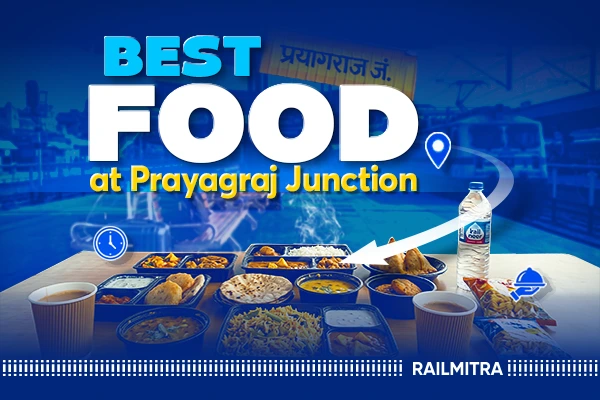
Prayagraj Junction Railway Station handles over 300 trains everyday. That is on a normal day. When the time of Kumbh Mela arrives, this station becomes a literal sea for the passengers. However, one question that confuses passengers on this station is what are the food options and how can we get it? This blog will answer all your doubts and queries.
Prayagraj Junction Railway Station: Station That Has Never Been Quiet
A steam engine pulled into Kanpur from Prayagraj back in 1859. By 1864, rail travel between Howrah and Delhi began, though river crossings still relied on boats – no bridge stood over the Yamuna at the time. Only once the Old Naini Bridge rose, during 1865 and 1866, did trips settle into a steady rhythm. For decades it carried the name Allahabad Junction until early 2020 remade it as Prayagraj Junction.
Start here, if you are passing through now. That past means PRYJ runs the whole North Central Railway zone – way more than most top-tier stations get. Not counting platforms yet, mind. There are ten. Around three hundred ten trains stop each day. When festivals fill Triveni Sangam, crowds jump into the lakhs. Then comes Kumbh Mela, where railways add hundreds of extra services just to keep up. Most weekdays though? It stays within reach. Land here during a festival date or peak pilgrimage season and the food situation changes entirely, not because the stalls disappear but because 200 people have the same idea at the same time.
The platforms have digital boards and the waiting rooms are decent. None of that solves the real problem, which is time. Transit passengers catching connecting trains do not have the luxury of browsing. If you want to use RailMitra’s train food app before your journey, the reason becomes obvious the moment your train pulls into PRYJ and the platform is already three-deep with people.
What Food Actually Looks Like at the Station
Platform food at Prayagraj Junction is not bad, but calling it reliable would be generous.
Tea is probably the safest bet on any platform here. The chai is strong, milky, and made the UP way, which means it is genuinely good at 6 AM when you are half-asleep and the train is cold. Alongside the tea stalls come kachoris, filled with spiced lentils and served with aloo sabzi. Morning is when these are freshest. By mid-afternoon the sabzi thickens and the kachoris get oilier. Worth knowing before you order.
In Prayagraj, chaat isn’t new – it’s deep-rooted, taken seriously by folks who’ve known it for generations. Near the train station gates, you’ll spot vendors lining up their trays with familiar bites: aloo tikki here, samosas there, papdi chaat tossed in between. Variety? Never an issue. What wobbles is how reliably good any given bite turns out. One day golden crisp, next time limp and off. That’s where the real snag hides. Some stalls are fine. Others you take one look at and keep walking. For a short trip where a dodgy stomach is just uncomfortable, that calculus is different from a 14-hour journey where it becomes a real problem.
The Civil Lines exit and the City Side entry both have dhabas and thali counters within a few minutes on foot. North Indian thalis, mostly, ranging from roadside-basic to slightly more organised sit-down places. If your train stops for 20 minutes or more, this is a real option. For most express trains at PRYJ, it is not.
Packaged items, biscuits, namkeen, chips, bottled water, are available at several stalls across the platforms. Predictable and unremarkable. The kind of thing you reach for when nothing else is working.
Families with children tend to find the platform food situation harder than solo travellers, partly because coordinating multiple people’s preferences in a moving crowd is genuinely stressful, and partly because dietary restrictions narrow the already-variable options down further. For anyone travelling as a group order becomes the option that actually makes sense, rather than a convenience upgrade.
Ordering Food in Train: The Cleaner Choice at PRYJ
Prayagraj Junction is one of those stations where the argument for ordering ahead makes itself. The platform is busy, the halt is short, and the quality varies enough that you cannot really plan around it.
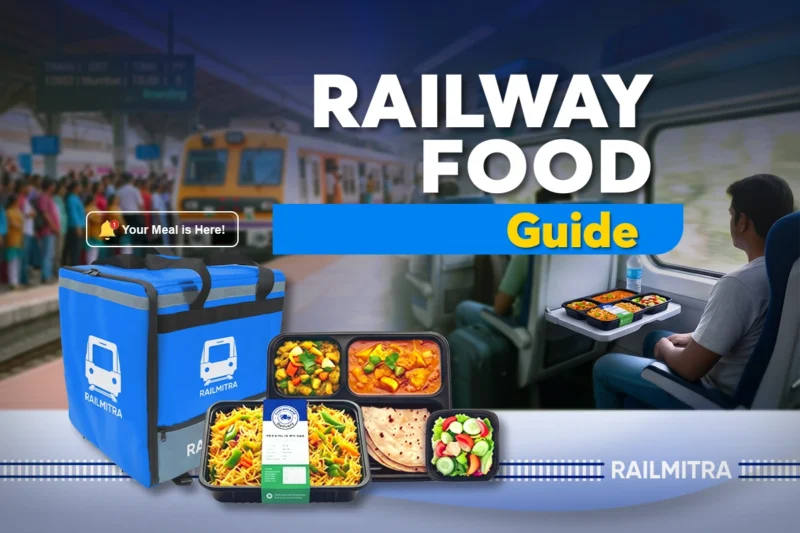
RailMitra covers PRYJ for train food delivery, and the way it works is simple enough. Enter your PNR, select PRYJ as your delivery station, browse the menus, place your order. Food reaches your seat when the train halts at the station. No queue involved, no reading a stall from a moving window trying to figure out whether it looks clean.
For passengers travelling with families or any kind of group, RailMitra’s group order option handles the bulk booking in one step. This matters at a junction this large because a large portion of PRYJ traffic is exactly this: families on religious trips, students moving between cities, large groups where everyone wants something slightly different and nobody wants to solve that problem on a crowded platform.
The menu variety covers North Indian thalis, biryani, breakfast options depending on what time your train passes through, and snack items for shorter trips. Prayagraj’s food culture leans vegetarian, especially around pilgrimage traffic, and RailMitra’s pure veg food in train filter lets you see only vegetarian options without scrolling past everything else. For a station where a large share of passengers are visiting for religious reasons, that filter gets used more here than at most other stops.
RailMitra Train Food Delivery at Prayagraj Junction
Ordering through RailMitra at PRYJ does not require anything complicated. PNR goes in, station gets selected, food gets ordered. The delivery happens at your seat when the train is at the station, and for passengers boarding at PRYJ itself, you can place an order for delivery at a later station down the route instead.
Most times, you’ll find North Indian plates here – think lentils with veggies and flatbread, steamed rice bowls, or layered biryanis that come either plant-based or meat-filled. Breakfast staples appear too, depending on the hour. Which places are live for your journey decides what ends up listed. Peek before you expect something. Surprise visits rarely help.
For group travellers, bulk ordering is handled through the same platform. Group order works particularly well at PRYJ because the station’s crowd conditions make it genuinely difficult to manage 6 or 8 people’s food individually on a short halt. One order, one delivery window, everyone sorted before the train moves.
Vegetarian and Jain travellers will find the filtering options useful. PRYJ’s pilgrimage footfall means there is genuine demand for this, and the restaurants listed for the station tend to reflect that. The pure veg food in train feature works across this station for most trains with a scheduled halt of reasonable length.
If you are still setting up before boarding, downloading a train food app while your connection is stable, at home or at the station concourse, is a better idea than trying to navigate it on the platform after boarding. Mobile networks at large junctions like PRYJ get crowded at peak hours.
Local Food Worth Knowing About
Older than the train station, Prayagraj’s food scene carries habits shaped over generations. When visitors pause here, certain details make the stop more meaningful.
Later in the day, Tehri – cooked in mustard oil with whole spices – starts tasting even better. Not like biryani at all; it skips the perfume, goes straight to something grounded. What sets kachori-sabzi apart here? A tangier edge. That comes from tamarind, used only around these parts, unlike versions found in Delhi or Lucknow. The morning version, fresh out of the oil, is probably the best platform-adjacent food argument for arriving early.
Lassi in Prayagraj comes thick and cold. Baati-chokha starts showing up around this belt, wheat balls roasted over fire with mashed spiced vegetables on the side, the kind of food that does not travel well to a train seat but is worth sitting down for if the city allows it. The lanes near Chowk and parts of Civil Lines have places that have been running the same menu for a long time. Not a destination for transit passengers but worth the detour for anyone staying a night.
Before You Board at PRYJ
Check your train’s scheduled halt at PRYJ before deciding anything about platform food. Rajdhani trains often stop for under 10 minutes. Slower trains sometimes give you 20 to 30, which changes what is realistic. Getting out of the station and back in during a short halt on a crowded platform is a risk that usually is not worth it.
If you are arriving at PRYJ to catch a connecting train, platform 1 has waiting room access and some food options nearby. Average quality but genuinely convenient compared to hunting for something outside.
Check PNR status before your journey to PRYJ, particularly during pilgrimage seasons when trains frequently run delayed into this station and schedules shift without much warning.
Conclusion
Prayagraj Junction Railway Station is one of the busier, older, and more historically loaded stations in northern India, and that combination produces a food situation that rewards a little planning. Platform food exists and some of it is genuinely good, the chai especially, the morning kachori-sabzi if you catch it fresh. For anything more reliable, ordering ahead through RailMitra before your train reaches Prayagraj Junction Railway Station is the option that removes most of the uncertainty. The station will be crowded. What you eat on that journey does not have to depend on how the queue looks from the train door.