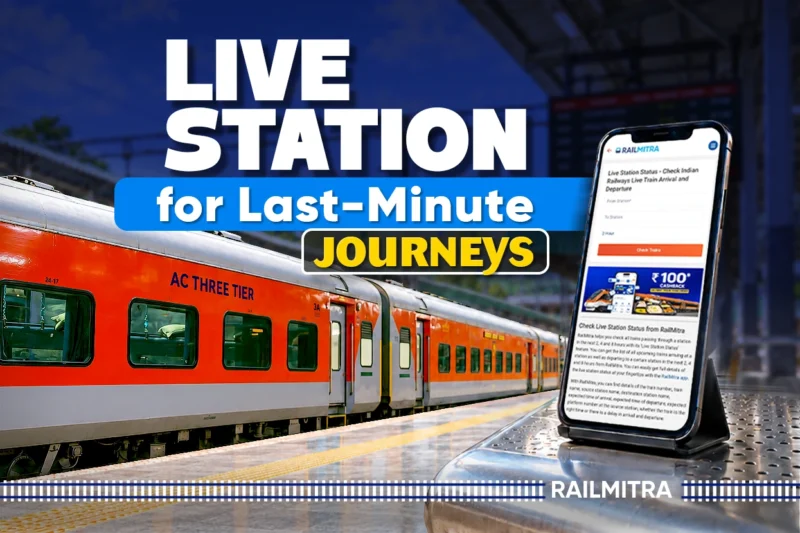
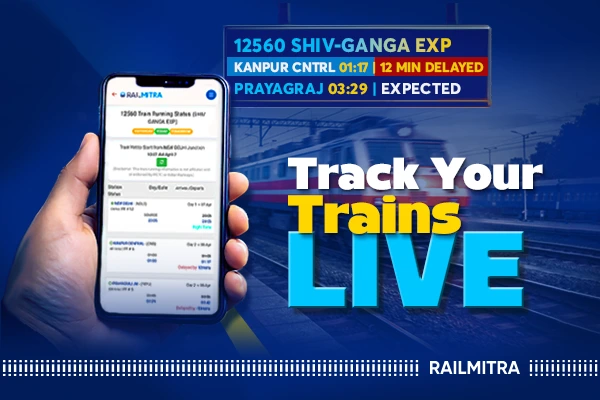
To check live train running status in 2026, enter your 5-digit train number on RailMitra. You get the current location, delay in minutes, expected arrival time at your station, and platform number, which are updated every 30 seconds from GPS data. This service can be of immense use to you in making your train well planned and problem-free.
Live train running status is a service for the Indian Railways that lets you track your train in real. time. You must have faced calls from your parents or relatives enquiring about where your train is. If they are using this service, they wont have to call as they can check your train’s present location with just a few clicks.
Table of Contents
- The platform waiting problem
- What live running status shows you
- How to check on RailMitra
- How accurate is it
- NTES vs RailMitra
- Diversions and rescheduling
- Before journey day
- FAQ
The Platform Waiting Problem
There’s a specific kind of frustration that every regular train traveller in India has felt. The indicator board says your train arrives in 8 minutes. You haul your bags to the platform, squeeze past the chai stalls, find your approximate coach position, and stand there. Eight minutes pass. Then twelve. Now the display glitches, showing a wait of thirty-one minutes before arrival.
It wasn’t a lie. What makes it odd is that fact itself. Information on station displays comes from the National Train Enquiry System. That system relies on reports sent by earlier stops along a train’s route. Because of these delays between locations, the 8-minute prediction shown had been based on details already outdated, possibly by 10 or even 15 minutes. Though helpful at first glance, such numbers trail real time. The train was further away than that data suggested. By the time the system caught up, the gap had grown.
This is why checking live train running status on your phone, before you leave home, is not a luxury. It should honestly be the first thing you do on the morning of any long journey, along with checking yourPNR Status to confirm your seat. Once you get in the habit of it, going back to relying on platform boards feels a bit silly.
What Live Running Status Shows You
Most people open it to check one thing: late or not late. That’s fair. But the page actually gives you quite a bit more.
Current location. The last station the train departed from, and sometimes the specific block section between stations. A delay figure alone gives little insight if the journey path remains unknown. Yet knowing the approximate route reveals far more about arrival times. Consider a train departing Kanpur twenty minutes prior – its schedule differs sharply from one leaving Lucknow at the same time. Each progresses toward its destination under distinct conditions. Arrival depends heavily on the starting point, not just elapsed minutes.
ETA. (Expected Time of Arrival) Later arrivals shift everything – timing updates rely on live data, not printed plans. What shows now comes from where things are, plus how fast they move at this instant. When delays hit, real-time estimates take over; timetables fade in relevance. The forecasted moment replaces the original promise once disruption appears.
Intermediate station timings. The full list of stops with updated arrival and departure times. If you’re boarding from somewhere in the middle of a long route, this lets you watch the train work its way toward you through stations you recognise.
Coach position and platform number. Not always available, but when it is especially at busy junction stations, it’s worth checking. Starting at the far edge of a train platform in New Delhi or Howrah, hauling bags, means heat and hassle – yet it does not have to be that way.
Expecting delays? Look up the train schedule before leaving home. During review, pay attention to travel duration between stations. Starting early means knowing arrival times at every destination. One benefit? Knowing whether arrival fits into a reasonable part of the day. This step supports smoother transfers between services too. Timing matters most if another ride waits on your train’s arrival. A quick look can prevent waiting around longer than needed.
How to Check on RailMitra
Open RailMitra’s Live Train Status page on any browser. You don’t need an account.
Type your train’s 5-digit number. If you only know the names such as Poorva Express, Tejas, Humsafar, whatever, type that and pick from the list that appears. Select the date of travel. Search.
That’s genuinely it. What comes back is current location, delay, ETA at your station, and platform details where the system has them. The whole thing takes under a minute.
It helps to remember that legacy schedules often list trains using four digits. Starting in 2010, the move toward five-digit codes changed older numbers, take 2301, which could appear today as 12301. Though small, such shifts affect how past records align with current formats. When searches fail, testing with a leading 1 could bring up the correct service. Numbers on earlier tickets may not match today’s format.
How Accurate Is It?
Truth is, it depends. Moving across major hubs like Delhi to Mumbai or journeys starting in Howrah bound for Chennai, tend to have consistent GPS updates streaming real-time position details. Approaching destinations such as Bangalore bound for Delhi, travelers notice arrival estimates shaped by steady tracking inputs. Updates flow without long gaps, making predictions more accurate over time. Arrival timing adjusts smoothly thanks to consistent signal delivery across these busy corridors.
On branch lines, in hilly terrain, or through some stretches in the Northeast, data connection can be little shaky. The “current location” you see may be from several minutes ago rather than this very second.
The ETA isn’t just a simple calculation from current position divided by average speed. Although both trains may show identical delays, their outcomes often diverge sharply. Trains behave differently based on routine patterns along fixed corridors. One might regain lost minutes steadily, another continues losing ground. Congestion zones vary by service type and timing. Performance also shifts depending on the weekday. A fast Rajdhani delayed near Mathura carries different implications than a regional express lagging there. Historical movement shapes what happens next. Routes reveal tendencies only long observation exposes.The predictions account for that.
What can throw it off: the train has stopped at an unscheduled point and the GPS data hasn’t updated yet. You’ll see the last confirmed location repeated while the train is stationary. If this happens, wait 4-5 minutes and refresh.Most times, it eventually moves forward. Twenty minutes without motion often means a blockage, faulty signaling, an open crossing, or debris down the track. Progress halts when systems pause. It does happen.
Closer to your station, the accuracy improves considerably. The last 45 minutes of tracking before a train reaches you tends to be the most reliable window.
NTES vs RailMitra
| Feature | NTES | RailMitra |
| Update frequency | Every 2–5 minutes | Every 30 seconds |
| ETA calculation | Timetable-based | Current position + delay history |
| Platform number | Limited | Available where data exists |
| Coach position | Not available | Available on select trains |
| Train schedule | Basic | Full timetable, all stops |
| Food ordering | No | Yes, meals delivered to your seat |
| Mobile interface | Desktop-first | Mobile as well as desktop optimised |
To be clear: both NTES and RailMitra draw from the same underlying GPS and signal data that Indian Railways generates. What differs is refresh rate, processing, and what’s layered on top.
Diversions and Rescheduling
Often confused, these two differ clearly. Despite appearances, one does not equal the other.
Departure times might shift slightly, though the journey follows the exact path listed. Even if the schedule changes, each stop stays unchanged along the way. Timing adjusts – everything else remains fixed. The trip unfolds just like before, only earlier or later by design. Your ETA moves accordingly, but your boarding station is still on the route.
A diversion is different and more disruptive. It means the train is physically running on a different line, different intermediate stations, some original stops dropped, possibly some new ones added. This happens when there’s track work, flooding, or an infrastructure problem on the scheduled route.
If your boarding station happens to be one that got dropped from the diverted route, the train will not stop there. You won’t get a berth warning or an automatic cancellation, the ticket stays valid, the train just doesn’t come. This has happened to people. The live status page flags diversions and shows the updated stop list; check it the night before travel if you’re boarding from anywhere that isn’t the origin station.
Rescheduling announcements also sometimes come late, 6 hours before departure is not unusual. Another reason to check the morning of.
Before Journey Day
Evening checks often reveal what morning ones miss. When changes appear the prior day, learning at nine that tomorrow’s six o’clock service now leaves at ten beats discovering it at half past five on a platform. Timing matters – late updates still beat last-minute surprises.
Early on departure day, take another look roughly ninety minutes prior to your intended start time. Instead of waiting until twenty, go ahead an hour and a half earlier. Should delays hit – say, three-hour setbacks – it’s better knowing while still indoors having breakfast. That detail matters most before stepping out, certainly not when already parked on a station seat beside bags.
The “Last Reported Station” field is worth watching. If it isn’t updating, resist the urge to assume the worst immediately. Data feed gaps are common, especially in the early morning hours. Refresh a couple of times. If 20 minutes pass with no movement, the train may be stationary at a signal or waiting to cross another service, call 139 at that point if you need confirmation.
TDR note for the detail-oriented: if your train runs more than 3 hours late at a major station and you decide not to travel, you’re eligible to file a TDR for a refund. The timestamp data visible on live status can support this if questioned later.
If the status shows a long delay and your journey has a stretch with no major station stops, the kind where no food will be available for hours, RailMitra’s food ordering service delivers meals to your seat at upcoming stations. If the train is crawling and you can see which station it’ll reach next, you can plan the order to arrive there.
FAQs for Live Train Running Status
Q: Does checking live status cost anything?
A: No. Free, no account needed, works on any browser.
Q: What’s the difference between live running status and PNR Status?
A: Completely different things. PNR Status is about your booking: confirmed, waitlisted, RAC. Live running status is about where the train physically is right now. You want both on journey day.
Q: My train number isn’t working in the search.
A: A digit 1 at the start might help when the number has four figures – many older codes gained an extra numeral back in 2010, either a 1 or 2 up front. When that fails, looking up the train by its name could bring better results. Freshly launched services sometimes need several days before showing up on NTES.
Q: The ETA jumped by an hour suddenly. What happened?
A: The train probably stopped at an unscheduled point, signals, a crossing wait, something blocking the line. The system recalculated when it got the updated position data. It can also happen if there’s a confirmed delay further down the track that the system just factored in.
Q: Can I track a train that hasn’t started yet?
A: Yes. Before departure, you’ll see the scheduled origin time and starting station. Live tracking begins once the train moves.
Q: The train shows diverted. Does that affect me?
A: Depends on your boarding station. Open the updated stop list on the status page and check whether your station is still on the diverted route. If it is, you’re fine. If it’s been removed, you’ll need to look at alternatives as the train genuinely won’t stop there.