Most passengers know what a lower, middle and upper berth in train is. Some also know what a side berth in train is. However, very few would respond when someone brings up the aisle seat in train.

Aisle seat is not a designated railway term, but is rather a placeholder for a number of seat or berth types in the Indian Railways. In this blog, we will take a deep dive into this berth type and closely look into its meaning, immportnce, benefits, drawbacks and how can you increase the chances of getting this particular berth at the time of train booking.
What Aisle Seat in Train Actually Means
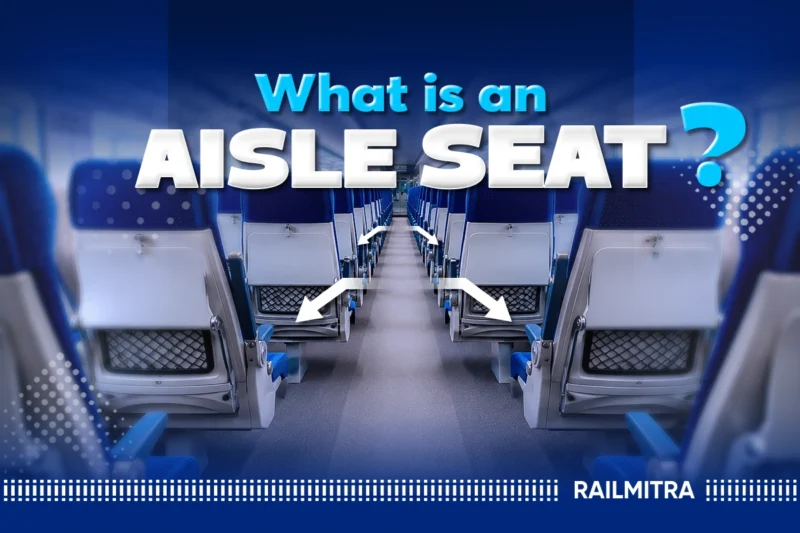
Picture the walking passage running down the middle of a coach. Any seat sitting right against that passage, rather than tucked near the window, falls into this category. In sleeper and AC coaches specifically, that usually points to the side lower berth in train or side upper berth in train, since both run parallel to the corridor instead of facing inward the way main berths do.
Also, there is the upper berth in train. While during the night time, the passenger goes on to sleep in their designated berth. During the day time they sit on the lower berth in train. The upper berth person’s designated seat is one the isle side of the lower berth during the day time, i.e., between 6 AM to 10 PM.
Ask around and you will find plenty of confusion over aisle seat meaning in train bookings. Half the passengers assume it means something close to a window seat. Wrong assumption, and one that only becomes obvious once someone’s shoulder bumps into yours for the third time in an hour. Pantry staff walking through, someone heading to the washroom, another passenger just stretching cramped legs, all of it passes right by if you are sitting here. That single detail shapes almost the entire trip. Whether it is good or bad, it depends completely or the kind of passenger you are and what you want.
Chair Cars have a slightly different definition of aisle seat in train. The seats bordering the middle pathway are the designated aisle seat for this coach. Depending upon the coach there can be 1 or 2 seats in between the aisle seat and the train window. There are many trains like Shatabdi and Vande Bharat which has chair cars as well as executive chair cars in them.
What People Actually Get Wrong About This Seat
When you search for the seat layouts of an aisle seat in the train it will probably give you a figure or the image of the coach describing the position and numbers of the different seats. However, these diagrams seldom reveal the living reality of the seats. For example, these diagrams don’t cover how it feels when the middle pathway is filled with passengers and vendors both shouting like there is a prize on the other side.
The most affected by these passing by commotions is the person sitting on the aisle seat. Even when the train starts moving and everyone is on their seats, then also an aisle seat passenger might get frequent passerbies looking to access the toilet or move to a relative at the other end of the coach. Privacy is something that is something that will be compromised in this seat unless you travel in air conditioned classes that have curtains.
However, if you are someone who likes interacting with people and also enjoys the freedom of movement then this seat is for you. Like all the things in the world, the aisle seat has them too. What matters is what kind of things you like. If you are a people friendly extrovert, then this seat is exactly for you.
Advantages You Only Understand After Actually Sitting There
Legroom is the part nobody mentions until you have experienced it firsthand. Side lower and side upper berths run along the length of the coach rather than facing another berth, so your feet are not boxed in by a stranger’s knees the way they would be in a regular facing setup. Need the washroom at three in the morning? You can easily reach there without even disturbing any other passengers.
Some passengers prefer this train seat over other seats as it provides an unmatched freedom of movement inside the coach. Most of the train is visible from your seat, making the vendors and amenities like the wash basin and toilet vastly accessible. Passengers who want this train seat can check the seat availability service at RailMitra. This service gives you the real time availability data and helps you choose the right train for booking.
Newer coach designs also tend to place charging points closer to aisle rows, small detail, but one that matters on a long journey when your phone is sitting at eleven percent.
And if you are someone who steps out at a station for a quick snacks or grabs food from a platform vendor mid route, doing that without disturbing two sleeping co-passengers counts for more than people admit before their first overnight trip.
The Drawbacks Nobody Mentions Upfront
The biggest challenge comes when you have to sleep in these seats. Since there is a continuous motion of passengers, trolley, ticket checkers at odd hours, the sleep can get affected. What makes the disturbance even more compounding is that all of this will happen inches away from where you are sleeping. Moreover, during the day the lower berth acts as a sitting place as well. Therefore, aisle seat in train with the lower berth can’t even guarantee you a sleeping seat in the daytime, i.e., 6 AM to 10 PM..
Then there is the light. Corridor bulbs stay lit through most of the night in Indian coaches, and sitting near the aisle means catching more of that glow than someone tucked against the window ever would. Noise follows the same pattern, only worse in a way. Door side conversations, station announcements crackling over the speaker, general shuffle of people moving through, none of it stays contained to the corridor. It reaches your berth first, before it reaches anyone else’s.
Families travelling together run into a different issue altogether. Aisle positions are not adjacent to window berths within the same bay, so booking as a group often means someone ends up separated from the rest, sometimes by a surprising distance for what is technically the same coach.
How Passengers Actually Get This Seat While Booking
Passengers get the option of selecting the preferred seat while booking. Other third party applications and even the counter booking allows you to seat a preference. However, this doesn’t mean you are guaranteed to get the seat. Railways allot the seat according to the seat availability and different quota restrictions. However, if you select this choice and there are seats available, you will get the seat.
Tatkal bookings are always tricky. Picking your favorite aisle seat in train with tatkal is even trickier. Most passengers accept whatever is given at the tatkal booking. But, passengers do get the chance to select their berth preference at the time of the booking. This works the same as the general booking works. This means, you get seats of your choice if they are available.
RAC and waitlisted tickets complicate things further. Seat allocation for these categories often finalizes closer to departure, sometimes confirmed only hours before the train actually pulls out of the origin station, which leaves little room for planning around a specific preference.
Checking Your Confirmed Seat Through PNR Status
Once the booking is done, running a PNR Status check tells you exactly what you landed. Punch in your ten digit PNR number and the result shows coach number, berth number, and berth type without any ambiguity, side lower, side upper, or something else entirely.
Why does this matter so much? Because seat preference requests do not always go through the way passengers expect. Someone requesting an aisle seat in train booking might still walk in to find a middle berth waiting, simply because availability shifted between the time of booking and chart preparation. Checking PNR Status a day before departure, right after the reservation chart gets prepared, gives the accurate final picture rather than the tentative status shown right after payment. No account needed either, RailMitra runs this in seconds, which helps when you are checking from the platform minutes before boarding.
How to Check Aisle Seat Availability Before You Book
A few dates, a few trains, compare them side by side before locking anything in. That is really all checking Train Seat Availability comes down to, and it shows exactly which services still have side lower or side upper berths open. Festival season changes the math though. These preferred categories vanish faster than middle or upper berths during that stretch, simply because more passengers are actively hunting for the same thing you are.
Results usually break down by class and quota. One glance tells you which trains still carry generous inventory in sleeper or AC three tier, and which ones are already running close to full. Checking a few days ahead, rather than the morning of travel, leaves room to switch trains if your first choice comes up empty in the seat type you actually want.
Live Train Running Status is worth a look too, particularly for anyone with a connecting journey. Knowing whether your train is running late changes how much buffer time you actually have at the transfer station, sometimes that gap is the only thing standing between catching a connection and missing it.
Food Ordering for Aisle Seat Passengers
Sitting near the aisle works in your favour when meal time comes around. Pantry staff and vendors walking the coach reach aisle positions first, purely because the walking path runs directly past these berths before anywhere else.
Using RailMitra’s train food booking service to order ahead means deliveries come straight to your seat, and that handover tends to go faster when you are already positioned near the passage the delivery staff are walking through anyway. Ordering in advance also skips the usual scramble of trying to flag down a vendor during a two minute station halt, meals get booked for a specific station, prepared fresh, and handed over right at the seat.
Overnight journeys benefit from this setup even more. No stepping over sleeping passengers to collect your own food, something window seat travellers often have to manage far more awkwardly.
Final Thoughts on Choosing an Aisle Seat in Train
It comes down to priorities, really. That is the honest answer to whether an aisle seat in train suits a particular journey or not. Solo travellers chasing convenience over uninterrupted sleep tend to like it, legroom and easier movement and quicker food access all working in their favour. Families wanting to stay together in one bay probably will not, and light sleepers who notice every creak of corridor noise are better off with a window or middle berth instead.
Either way, the decision does not have to be a gamble. Checking PNR Status after booking, comparing Train Seat Availability before it, both put the choice back where it belongs, in your hands rather than left to chance. Indian Railways carries enough berth variety that getting what actually suits your travel style is mostly a matter of planning a little ahead. Not luck.