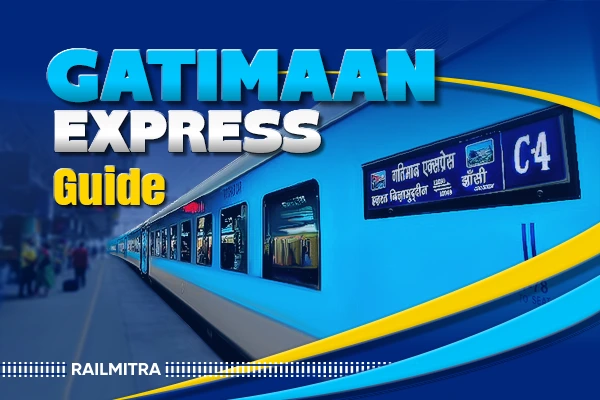
403 km in 4 hours 25 minutes, that is the Gatimaan Express on the Delhi to Jhansi corridor, and before April 2016 that timing simply was not on offer from Indian rail. A passenger train at 160 km/h had been an announcement for years before it became an actual service.

The Northern Railways cleared over 80 obstacle points from the route, tilted tracks at curves, dealt with level crossings one stretch at a time on a mainline most people assumed had already reached its ceiling. Friday is the weekly off for this train, so check the train schedule on RailMitra before locking in your travel date.
Why Was the Gatimaan Express Launched?
Most travelers heading to Agra pass through Delhi first. For years, the Shatabdi covered that stretch fast, about two hours door to door. That timing works fine unless you’re hoping to squeeze in more sightseeing later. Heavy crowds have long made this train line among India’s busiest tourist routes. That was the case until the Gatimaan Express arrived on the scene.
That morning of April 5, 2016 began with Suresh Prabhu launching the inaugural run of Gatimaan Express from Hazrat Nizamuddin. Built on a tight rhythm departing Delhi early, hitting Agra within one hundred minutes. Sightseeing unfolded around the Taj Mahal, then moved toward Agra Fort afterward. Evening brought the trip back, rolling into the city well ahead of eight. It worked because someone had actually done the timing math. The route ran only to Agra Cantt initially. Gwalior joined in February 2018 and Jhansi in April of the same year, both because passengers and tourism operators between those cities pushed for the extension.
None of the speed was possible without serious groundwork. The Tughlakabad to Agra stretch required Northern Railway to clear curves, address level crossings, and tilt sections of track. The locomotive got the credit publicly. Without that track preparation, 160 km/h in commercial service was not happening.
Gatimaan Express Route and Stations
Leaving Hazrat Nizamuddin at 08:10, Train 12050 pulls into Jhansi by 12:35. From the opposite end, 12049 rolls out of Jhansi at 15:05, reaching Delhi later that evening at 19:30. Running six days straight, then pausing – Friday stays open, untouched.
Hazrat Nizamuddin (NZM):
Surprising how many first-timers head straight to New Delhi Railway Station as for this train, this is the wrong place altogether. Not even close, really. NZM lies down south in Delhi, hooked into the metro lines. Feels calmer than NDLS, somehow. Coming from Noida? Or maybe Faridabad? Could be smoother that way. Travelers based in South Delhi often find it simpler without all the rush.
Agra Cantt (AGC):
Out by 09:55, after arriving at 09:50 for the morning run. Back again at 17:30, already leaving by 17:35 as the timing closes. Five minutes on the platform gives just enough room, especially when aiming for Petha from stall vendors near the gate. This sweet treat in Agra shows up in many types, most of them found right there. Day travelers reach here early, then come back to the same station at around 17:50 for their train home.
Gwalior Junction (GWL):
Eleven thirteen arrival with the train leaving again at eleven fifteen. Though tea sellers linger nearby, there is hardly time to look around. Three kilometers separate the train stop from Gwalior Fort, too far to reach and back in such little time. This platform serves one purpose only: step on, step off. What happens here stays brief.
Virangana Lakshmibai of Jhansi
Queen’s name ties to a fortress just two kilometers off. Exit the station, find small eateries nearby. Those bound for Orchha or Khajuraho stop through here instead of going straight. Rides continue from spots beyond the entrance.
Schedule and Train Numbers
One route, two train numbers going opposite directions.
| Train No. | Direction | Departs | Arrives |
| 12050 | Hazrat Nizamuddin to Jhansi | 08:10 | 12:35 |
| 12049 | Jhansi to Hazrat Nizamuddin | 15:05 | 19:30 |
Gatimaan Express operates on all days of the week except Fridays. Passengers can leave Hazrat Nizamuddin at 08:10, reach Agra Cantt around 09:50. Once you have traveled across Agra, you can ride the sam train by 17:50 and reach Delhi just before 19:30. The time period is understandably not long enough to cover the grandeur of Agra. However, for a quick visit on weekends, this train is a suitable option.
You can visit the Taj Mahal and then head on to the Agra Fort.No need to rush too hard if things move smoothly. Seats vanish quickly, especially weekends both ways. Look up train status on RailMitra ahead of deciding days. Surprises happen less when you check early.
Speed, Coaches and What the Train Carries
LHB coaches from Rail Coach Factory in Kapurthala. That is the hardware underneath the Gatimaan Express and it is what separates the ride quality from older rolling stock. Balanced draft gear couplers between coaches absorb the lateral jolt that ICF coaches used to pass straight into the seat. At speed the cabin stays steady enough that reading is comfortable.
Design maximum is 160 km/h on the Tughlakabad to Agra corridor. Since June 2024 that has been walked back to 130 km/h, pending the Kavach automatic train protection system going live on this stretch. Average across the full 403 km comes out to about 91 km/h once you factor in the slower approach through stations and outer yard speed limits.
Coach breakdown: E1 and E2 are Executive Class AC Chair Cars, C1 through C8 are AC Chair Cars, and two EOG vans sit at either end handling power. No pantry car attached. Catering staff move through with trolleys, one male and one female host per coach, three cabin managers across the full rake.
Seatback LCD screens, free Wi-Fi, automatic sliding inter-car doors, GPS passenger information displays, bio-toilets. The welcome flowers and chocolate that the host delivers within the first few minutes of departure get mentioned every time someone describes their first ride, which says something about how unexpected it feels on an Indian train.
Ticket Fares for Both Classes
“`html id=”tnkdl26″
| Class | General Fare | Tatkal Fare | Child Fare |
| AC Chair Car (CC) | Rs. 860 to Rs. 1,105 | Rs. 1,340 | Rs. 1,100 |
| Executive Class (EC) | Rs. 1,695 to Rs. 2,260 | Rs. 2,785 | Rs. 2,260 |
Fares land about 25% above Shatabdi on this corridor. The catering is already in the price, meaning whatever the trolley brings to your seat is paid for. If you would rather opt out, that can be done at booking and the catering component is deducted.
Senior citizen concessions: women 58 and above get 50% off, men 60 and above get 40%. These apply on the base fare.
Executive Class is roughly double Chair Car in price. Wider seat, more recline, different menu. Across 4.5 hours to Jhansi the extra space is worth considering. On the 100-minute Delhi to Agra leg, less so. After booking, PNR Status on RailMitra is where waitlist movement shows up and where the confirmed berth and coach appear once the chart is out.
Travelling on the Gatimaan Express: What the Journey Is Like
The Gatimaan Express does not come out of Hazrat Nizamuddin fast. Through South Delhi the pace is unremarkable and nothing outside the window suggests this is a different class of train. Past Tughlakabad the speed climbs and the farmland starts moving at a different rate entirely.
Breakfast lands early on the morning service. What actually shows up: mini dosa, whole wheat upma, fruit salad, Spanish white egg omelette, aloo kulcha, chicken roll for non-veg passengers, walnut cake with dry fruits at the end. Tea and coffee run ahead of the food. The bone china crockery gets mentioned almost every time someone describes their first trip on this train, which is not nothing given that it arrives on a regular passenger train.
Two-by-two in Chair Car, aircraft seating configuration. Window versus aisle is selectable when you book. Legroom clears the bar for most adults without being generous. The automatic inter-car doors are one of those things you do not notice until you have wrestled a bag through a manual train door and suddenly do not have to.
Afternoon departures from Jhansi run into low light over the farmland on the way back. The dusk stretch between Agra and Delhi has good window views if you are on the right side. People coming back from Agra day trips tend to find the return leg more relaxed than the outward one, probably because the plan is already done.
Who Travels on the Gatimaan Express and Why
Agra accounts for the bulk of bookings. The Taj Mahal and Agra Fort are not new discoveries for anyone, but a same-day trip from Delhi with comfortable timings at both ends genuinely was not available on Indian rail before this train. International tour groups, school excursions, families doing a weekend out from Delhi: the 08:10 departure is usually a full coach and the Agra platform in the evening fills up the same way.
Gwalior attracts a different kind of traveller. Business visitors, government department employees, and students travelling between Delhi and Gwalior use the Gatimaan because it is faster than most alternatives on the corridor. The city has an industrial base and administrative significance that generates steady weekday movement.
Jhansi is part heritage stop and part transit node. The fort is the main draw but a good share of passengers are actually in transit, heading to Orchha 15 km away or starting the longer trip to Khajuraho. Photography groups come through, as do travellers specifically tracing the 1857 uprising route. It is a specific kind of demand and it is consistent. Weekend seats on this train close earlier than most people plan for. Use live train running status on RailMitra on the travel day to follow the train’s location and flag any delays before they affect onward plans.
Food on the Gatimaan Express
Onboard meals are included in the ticket price and served by train staff from trolleys. Both vegetarian and non-vegetarian options are on the menu, prepared to airline-style catering standards. The quality lands noticeably above what most Indian train food delivers and this was a deliberate part of the train’s original positioning.
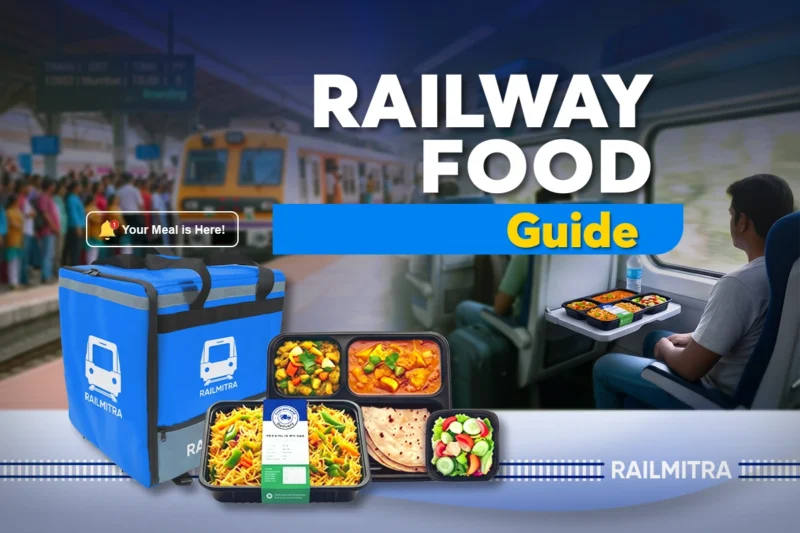
Not every passenger wants the fixed menu. RailMitra’s meals on wheels service lets you order from restaurants at stations along the route, delivered to your seat while the train is at the platform. Agra Cantt has the widest selection of delivery options on this corridor given the tourist volumes passing through. Browse and order on RailMitra before boarding and the food arrives coordinated to your coach. Passengers joining at Gwalior or Agra rather than Delhi sometimes find the fixed onboard meal timing does not match when they are actually hungry, and ordering through the food delivery service in advance is the cleaner solution.
Booking, PNR Status and Train Updates
Tatkal for the Gatimaan Express opens the day before departure. Regular quota on weekends and long weekends is usually gone days in advance, which leaves Tatkal as the practical option for anyone booking late. Chair Car Tatkal adds roughly Rs. 230 to Rs. 250 to the base fare.
Train 12049’s final chart comes out 3 to 4 hours before the 15:05 Jhansi departure. That is when waitlisted tickets either confirm or do not. Check PNR Status on RailMitra once the chart is prepared for your coach and seat details.
Punctuality on this train is better than the network average. Delays when they happen tend to be short. If someone is picking you up at the destination, live train running status on RailMitra tells you where the train actually is so the pickup timing is not a guess.
Conclusion
The gap the Gatimaan Express closed was a practical one: visiting Agra from Delhi in a day without the itinerary feeling rushed. That was not really achievable by rail before 2016. There were trains, but the timing did not quite work. The train took most of those off the table. At 160 km/h design speed with LHB coaches, catering included, and departure times that match how tourists actually plan, it runs at a different level from most of what operates on this network. Train schedule, Train Seat Availability, and live train running status for the Gatimaan Express are on RailMitra.