Most people who travel on trains don’t know the TDR full form. It’s not even strange as it is only in desperate circumstances that one looks for this service. It is generally a waitlisted ticket booked at the counter or a missed train for which one needs a refund.

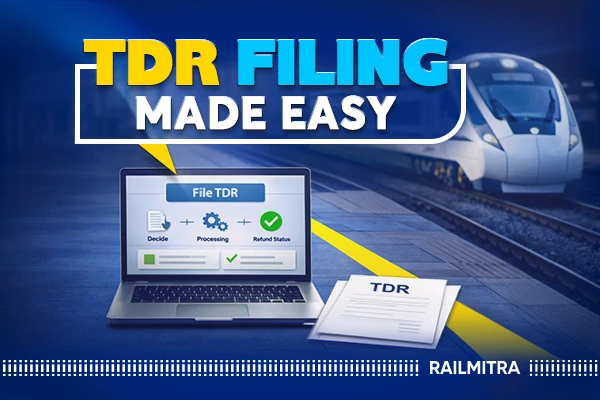
TDR full form is Ticket Deposit Receipt and is a method introduced by the Indian Railways for claiming refund on the ticket when all the other conventional methods of refunds have been exhausted. With the recent changes and remarks introduced by the Union Minister for Railways Ashwini Vaishanv, the TDR rules are going to be transformed.
What is the TDR Full form and how does it help users, what are the recent changes and how would this “Reform Express” by the Railways ministry change the way people book tickets and claim their refunds? This blog will explain all of these doubts.
TDR Full Form and Meaning in Railways
As mentioned before TDR full form is Ticket Deposit Receipt. This is the Indian Railways mechanism for providing refunds for tickets when the passenger is unable to board a booked ticket. The name of this service is so because earlier an actual receipt was provided if you deposited your ticket. That receipt was the proof that you have claimed a refund request for your ticket.
Indian Railways has shifted the TDR process for e-tickets completely online. Now TDR filing is required for tickets booked offline at the counters. But the name TDR stuck around even after the process went digital.
The situation where TDR becomes necessary is when the reservation chart has been prepared. Once the chart is prepared, the normal online cancellation option closes. So if after chart preparation your train gets cancelled, runs very late, or you are unable to board due to some reason, you cannot cancel the ticket the usual way. TDR was the only option left for getting a refund in such cases.
The key thing to understand about TDR is that it is not a cancellation. It is a claim. You are essentially telling Indian Railways that something went wrong and you want your money back. Railways then checks their internal records and decides whether to approve or reject it. It was not automatic, it was not fast, and it could be rejected for reasons as simple as selecting the wrong reason from a dropdown menu.
The Reform Express Announcement: What Vaishnaw Said
Indian Railways Minister Ashwini explained about the changes under the Reform Express initiative which are aimed at making the train travel easier and a smooth experience. The newly introduced reforms cover a broad range of changes such as Aadhar verification for Tatkal, faster trains, changes in chart preparation and cancellation windows as well as the TDR process.
On TDR specifically, Vaishnaw announced that the requirement of filing a Ticket Deposit Receipt for e-tickets has been done away with. Refunds for e-tickets will now be processed automatically upon cancellation. This is the single most significant change for the majority of passengers who book online. Passengers can also upgrade their travel class up to 30 minutes before the time of departure. Earlier such changes were permitted only before the train chart was prepared.
The Biggest Change: TDR for E-Tickets Is Getting Phased Out
Passengers who have tried filing the TDR process know how difficult is the waiting period staring at your Claim Refund (CR) Registered to change into Chief Commercial Manager (CCM) approved.
This whole process could take anywhere from 60 to 90 days and even after all that wait there was no guarantee that the refund would be approved. Many passengers have had their TDR rejected simply because they selected the wrong reason from the dropdown menu or missed the filing deadline by a few hours.
With the new system, all of this is no longer a concern for e-ticket holders. The refund is now triggered automatically when a cancellation-eligible situation arises. There is no form to fill, no reason to select, no zonal railway approval to wait for.
To give an example, if your train gets cancelled by Railways and you have an e-ticket, the refund will be processed on its own. You do not need to log into IRCTC and navigate to the TDR filing section at all.
For passengers who had already filed a TDR before these reforms came into effect, the old process still applies to those claims. Status labels like CR Registered, Admin Approved, CCM Approved and GGM Approved are still relevant until those pending refunds are fully resolved.
What Still Requires Physical TDR: Counter Tickets
TDR has been stopped but only for e-tickets. If you have booked the ticket at the counter or booked a ticket online that was delivered physically, still requires filing TDR manually.
For these tickets, the process remains:
Surrender the original ticket at any railway station counter within 3 days of the journey date. Under the new reforms, counter tickets can now be cancelled at any railway station across the country; the earlier restriction requiring cancellation only at the originating station has been removed.
After surrender, a physical Ticket Deposit Receipt is issued. This, along with a written refund application, must be mailed to:
GGM(IT), Indian Railway Catering and Tourism Corporation Ltd., 1st Floor, Internet Ticketing Centre, IRCA Building, State Entry Road, New Delhi – 110055.
For claims involving AC failure, the original TTE certificate, either an Extra Fare Ticket or Guard Certificate issued on the train must be included in the same envelope.
New Cancellation Windows: The 72 / 24 / 8 Hour Structure
The TDR changes are the only ones introduced by the minister. Passengers would also need to know the new ticket cancellation windows. This has been shifted from the earlier pattern of 48-12-4 hours pattern to the new 72-24-8 hours pattern.
Here is how refunds now work under the new rules:
More than 72 hours before departure: Only a flat minimal cancellation charge per passenger is deducted. Maximum refund is returned. This window has been extended from the previous 48-hour threshold, making early cancellation slightly more forgiving.
72 to 24 hours before departure: 25% of the fare is deducted, subject to the minimum class-wise charge.
24 to 8 hours before departure: 50% of the fare is deducted. This mid-range penalty tier is new, there was no equivalent deduction at this level under the old rules.
Less than 8 hours before departure: Now it takes twice as long to get a refund denied. Eight hours out, money stays put. Before that change, travelers lost refunds just four hours prior. Waiting longer means less cash back when plans shift suddenly.
What’s really happening here? A tighter booking window means fewer rushed bets on available spots. Scalpers get less room to maneuver. When someone cancels, those waiting have a better shot at grabbing that seat before plans fall apart. Time shifts slightly in favor of real travelers.
Before deciding to cancel near departure time, it might help to look up your train’s current status. Sometimes delays shift quickly, leaving a chance for things to improve. Checking right away gives a clearer picture than guessing. A last-minute update could change everything. Waiting too long risks missing new information.. You can track real-time train movement onRailMitra’s live train status, particularly useful if you are deciding whether to travel based on a delay situation.
Chart Preparation Is Now Earlier Too
Train Chart Preparation Time has also been updated. Earlier the train chart was 4 hours before the departure which was too short for non-confirmed passengers to look for other alternative train options. The new reforms have shifted the train chart preparation time to 9-12 hours before the time of trains’ departure.
This change directly benefits waitlisted passengers. Previously, a passenger with a WL ticket had only 4 hours after chart preparation to find alternative trains if their ticket did not confirm. Now that window is much wider, anywhere from 9 to 18 hours depending on the train.
You can check your booking and chart preparation status usingPNR status on RailMitra. It shows current booking status, whether a chart has been prepared, and berth details once confirmed.
Other Reforms in the Same Announcement
The Reform Express initiative brought several new changes. The most prominent ones have been discussed above. Here are some of the other changes in a glance:
Aadhaar verification for Tatkal bookings: Tout and black market ticket booking has been a long standing problem in the Indian railway system. To tackle this, Aadhaar-based OTP verification is now required for Tatkal reservations. Along with this, technology has been deployed to detect bots and fraudulent software that agents were using to book tickets the moment the Tatkal window opens. As a result of these measures, nearly three crore fake accounts were identified and removed from the IRCTC system. Ticket availability has improved noticeably since.
Class upgrade up to 30 minutes before departure: Earlier if you wanted to upgrade your travel class you had to do it before the chart was prepared. Now passengers can upgrade their travel class up to 30 minutes before departure. This gives a lot more flexibility for last minute decisions.
Boarding station change up to 30 minutes before departure: Indian Railways has introduced this new rule that will be helpful for passengers, especially those who are running late to catch their train. If a passenger is unable to board the train at the booked station they can change their boarding station to the next one. This is possible 30 minutes before the time of the departure of the train. Your train choice, seat details and booking seat will remain as your original booking.
Counter ticket cancellation at any station: There has also been a significant change in the station where you cancel your ticket. Earlier passengers could cancel their ticket only through the originating station. This provision has been done away and passengers can now cancel theri tickets from any railway station.
Avoiding TDR Situations Altogether
The best outcome is not having to deal with TDR, or any refund process at all. A large number of TDR claims historically arose from passengers booking heavily waitlisted tickets and ending up unconfirmed at chart time.
Before buying tickets, see if seats are open. You can use RailMitra’s train seat availability service to check the number of seats available for your booking. Being aware of the vacant seats in the train increases your chances of booking a confirmed train ticket and diminishes chances of getting a waiting list ticket. When passengers get their hands on a confirmed ticket, the chances of filing a TDR drops significantly.
Conclusion
TDR full form is Ticket Deposit Receipt, has been a fixture of Indian railway travel for decades. The 2026 Reform Express changes announced by Minister Vaishnaw mark a genuine shift in how refunds work, with e-ticket TDR filing abolished in favour of automatic processing. Folks with counter tickets continue using the paper-based TDR process, while the updated cancellation penalties: 72, 24, and 8 hours – are now applied uniformly. Though handled differently, both paths align under the revised timing rules.
Ahead of departure, travelers now gain extra time – refund claims on e-tickets stay valid up to eight hours prior, twice the previous limit. Should delays arise, reviewing PNR details early makes a difference. With foresight, people adjust more easily. Refunds become smoother when steps are taken ahead of schedule.
FAQs on TDR Full Form in Railway
Q: What is TDR full form in railway?
Ans. TDR full form is Ticket Deposit Receipt. It is a refund claim mechanism used when a passenger cannot travel and the normal cancellation window has passed.
Q: Is TDR still required after the 2026 reforms?
Ans. For e-tickets, TDR has been abolished. Refunds are now processed automatically. For counter tickets and i-tickets, the physical TDR process still applies.
Q: What are the new cancellation rules in 2026?
Ans. Cancellations more than 72 hours before departure get maximum refund. Between 72 and 24 hours, 25% is deducted. Between 24 and 8 hours, 50% is deducted. Less than 8 hours before departure, no refund is given.
Q: Can counter tickets now be cancelled at any station?
Ans. Yes. Under the 2026 reforms, counter tickets can be cancelled at any railway station in the country, not just the originating station.
Q: When is the reservation chart now prepared?
Ans. Under the new rules, reservation charts are prepared 9 to 18 hours before departure, compared to the earlier 4 hours.