You did everything right. You picked the right train, carefully entered your journey date, passengers detail and made the booking. You were about to tell your family that you have successfully secured a ticket for your journey, when you noticed the small number on your ticket WL/54. This waiting number cannot be considered borderline and you cannot hope for this to be confirmed. You might feel helpless and without any option. But the problem isn’t that there are no seats available, the problem is that you haven’t looked for other train options that operate your route. A problem that can be tackled easily with the help of trains between two stations.

Indian Railways is a gigantic service provider. For example, suppose a popular route like Patna to Delhi has multiple trains covering the distance. These trains cover different routes, go through different stoppages and operate at very different time ranges. Since, there is such diversity in the train’s services, it is natural that the demand for these trains will be varied as well. However, since most passengers just search their favorite train or its number, these other trains get ignored.
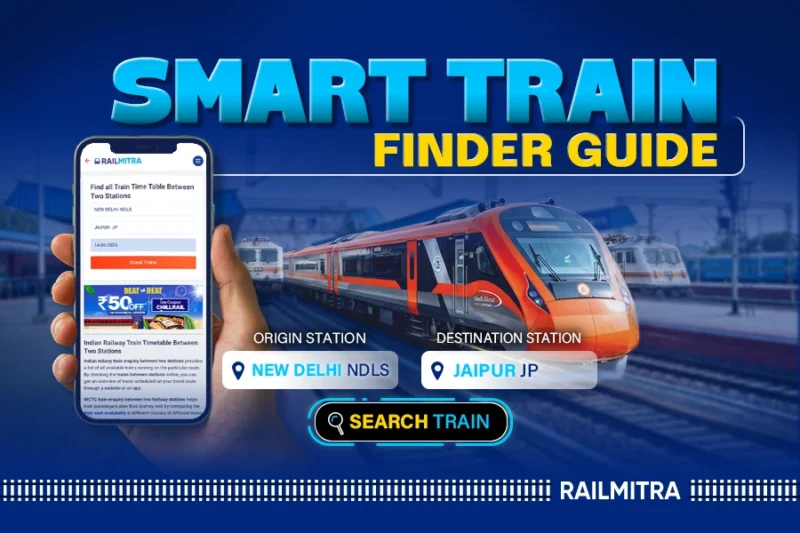
Trains Between Two Stations is the search that shows you the whole board. Origin station, destination station, travel date. Every train operating between those two points comes up: departure time, arrival time, duration, days of operation. Not just the famous ones. All of them. That one change in how you search can go from WL/54 to a confirmed berth in under five minutes.
More Trains Than You Realise Are Running Your Route
Take the Lucknow to Howrah corridor. There is the Poorva Express, yes. But there is also the Gomti Express, the Vibhuti Express, the Ganga Sutlej, and a handful of others depending on the day. Some leave well after midnight when the platform is nearly empty. A few have long halt lists, others barely stop. One might not have 1AC at all, just Sleeper and 3AC. None of this is obvious unless you search the route rather than the train.
This is where most passengers lose confirmed seats without realising it. The assumption is that if the train they know is full, the route is full. Check the full list before reaching that conclusion. On most corridors, something has seats. The trains with unfamiliar names, the ones departing at hours nobody wants, those tend to have quota sitting unused.
There is also the quota question. Each train has multiple quota types: general, remote location, emergency, roadside. Different stations draw from different pools. A train that shows WL from one station pair might show confirmed availability from a slightly different pair on the same route. That is not a glitch. That is how quota allocation works across the network.
Run the Trains Between Two Stations search. Go through the full list. Do not stop at the first familiar name.
Changing Your Station Can Open Up Seats
Major junction stations carry concentrated demand. Kanpur Central, Patna Junction, Howrah. Everyone is booking from and to these stations, so quota fills fast. But the stations immediately before or after on the same line operate on separate quota pools for the same trains.
If Kanpur Central to Delhi is showing waitlisted across everything, try Kanpur Anwarganj. Same trains stop there. The quota is separate. Confirmed seats appear where the original search showed nothing. On the destination side, Hazrat Nizamuddin and Anand Vihar Terminal are both inside Delhi, well connected by Metro, and carry their own quota on most trains. Worth checking before you assume the city is full.
This works on the route search too. Run a fresh Trains Between Two Stations search with the alternate station pair. The train list will largely overlap, but the availability picture can look completely different. Stations within 25 to 40 kilometres on the same line are worth trying. The fare difference is small. The difference in availability is sometimes the difference between a confirmed berth and a three-week waitlist.
Not every route has this option. But on high-demand corridors, it comes through often enough that it is worth the extra two minutes of searching.
The Train Schedule Tells You More Than Just Timings
Departure time and arrival time are the obvious things to check. The train schedule shows you everything else. Every station on which the train stops, the time at which it arrived, the platform number it used and at what time did the train finally depart from that station. All such information is provided by the train schedule service. A train schedule gives a detailed overview of your train’s journey.
If you are not boarding from the origin station, you need to confirm your boarding station is actually a scheduled halt. Some superfast expresses skip smaller junctions entirely. Some overnight trains arrive at intermediate stations at 2 AM and passengers miss their stop because they did not check. If you are travelling with elderly passengers or children, a train with fewer nighttime halts means less disruption through the journey.
Halt patterns also tell you about the train’s character. Lucknow to Kolkata on a train with 22 stops is a different experience from one with 5. More stops means more doors opening through the night, more noise, more slow crawls into small stations at odd hours. Less stops and the journey is quieter, faster, more predictable. Neither is wrong. It depends on what matters to you.
Compare two or three trains from your shortlist on the schedule before deciding. The travel time difference might be 40 minutes but the journey experience can be quite different.
Checking Availability Properly Takes More Than One Search
Most of the passengers on the Indian Railways operate under a single common rule. They know the name or number of the train on the route. They check seats for this train and if the seats are booked, they consider the journey a dead event. Nobody bothers to check other train options that connect this train route.
Check train seat availability for every train on your shortlist, across at least two or three classes. Sleeper full does not mean 3AC is full. 3AC full on one train does not mean 3AC is full on the next departure. Travel day matters too. Getting an available ticket on a weekend is very difficult. The same train that is fully booked on weekend days would have seats available on both the previous and the next weekdays. Holidays also often follow the same pattern.
Closer to departure, cancellations start coming in. Passengers drop tickets, refunds process, berths re-enter the pool. Sometimes a train that looked full a week out has confirmed seats 36 hours before departure. If the journey is not time-critical, checking availability again two days before travel sometimes finds options that were not there earlier.
Once You Have a Ticket, Keep Watching It
A short waitlist is not a dead ticket. WL/8 confirms on most trains. WL/20 confirms on trains with high cancellation patterns, especially business-heavy routes. The chart gets prepared four to six hours before departure, and that is when berth numbers get assigned.
PNR Status shows you exactly where you stand. Check it three or four days before travel. Check it again the night before. If your ticket has moved from WL/20 to WL/6, it is likely confirming. If it is still WL/20 two days before, you have time to look for alternatives. Knowing your berth number before you reach the station also means you are not walking the length of the train at 5 AM trying to find your coach.
For RAC tickets specifically, PNR status tells you whether you have a full berth or are sharing one. That changes how you pack and how you plan the journey.
Food on Long Journeys Needs Planning Too
The problem of getting a confirmed seat has been resolved for now. However, what hasn’t been resolved is the train food that you are going to have. Many trains don’t have a pantry car and even if they do the menu size and food quality, neither of them is up to the mark. Some platform vendors may provide good food occasionally. But in the matters of health, nobody wants to take a chance.
Pre-ordering through book food in train is cleaner. Pick a restaurant near one of the halt stations on your route, choose what you want, and the order arrives at your seat during that stop. The delivery is tied to a scheduled platform halt, so there is no guessing about when it shows up. Restaurants listed are FSSAI-approved and the range at bigger junctions covers biryanis, thalis, North and South Indian, snacks. For overnight journeys especially, getting a proper dinner delivered rather than depending on what the pantry has available at 8 PM makes the journey noticeably more comfortable.
The Search Comes First
Most confirmed bookings on busy Indian rail corridors start not with a specific train in mind, but with a route search that shows what is actually running. Searching trains between two stations is that search. It takes 30 seconds, it shows you every option, and it is usually where the confirmed seat is found. A waitlisted ticket on the train you know does not mean the route is full. It means one train out of several is full. The rest of the search takes it from there.