Navratri on a train is a specific kind of problem. You’ve got your chunri packed, maybe a small murti wrapped in an old dupatta. The bag is sorted. What you didn’t think about until now is what you’re going to eat for the next 12 hours while keeping your vrat.

The pantry car guy just walked past with samosas. Family in the next berth is pulling out parathas and achar. You’re sitting there wondering if the “veg meal” on IRCTC counts as satvik.
It doesn’t. Onion in the gravy base, regular table salt, packaged masala with ingredients you can’t verify. That’s a standard veg meal, not the same as what a Navratri fast requires. Here’s what to actually do about it.
What is Chaitra Navratri and Why Trains Get So Packed
There are technically four Navratris in the Hindu calendar. Most people observe two: Sharad Navratri in October and Chaitra Navratri in spring. Chaitra falls in the month of Chaitra (March-April) and marks the start of the Hindu new year, Vikram Samvat.
Chaitra Navratri 2026: March 19 to March 28
Falling on March 26, Ashtami marks the penultimate day before the main observance. By March 27 comes Navami, when many perform kanya puja and break their fasts. On that same date occurs Ram Navami, which follows a fixed lunar phase, Chaitra Shukla paksha’s ninth tithi. Such alignment creates rare energy, especially noticeable in Ayodhya. Preparations have quietly begun across regions tied to these traditions.
| Day | Date | Tithi | Goddess / Puja | Colour |
| Day 1 | 19 March | Pratipada | Maa Shailputri (Ghatasthapana) | Yellow |
| Day 2 | 20 March | Dwitiya | Maa Brahmacharini | Green |
| Day 3 | 21 March | Tritiya | Maa Chandraghanta | Grey |
| Day 4 | 22 March | Chaturthi | Maa Kushmanda | Orange |
| Day 5 | 23 March | Panchami | Maa Skandamata | White |
| Day 6 | 24 March | Shashti | Maa Katyayani | Red |
| Day 7 | 25 March | Saptami | Maa Kalaratri | Royal Blue |
| Day 8 | 26 March | Ashtami | Maa Mahagauri (Durga Ashtami) | Pink |
| Day 9 | 27 March | Navami | Maa Siddhidatri (Ram Navami) | Purple |
On these days, attention turns to nine forms of Goddess Durga, from Shailputri to Siddhidatri. While some followers follow the complete period, many restrict observance to just Ashtami and Navami. Each path reflects personal choice rather than fixed rule. Practice varies, yet purpose stays steady across households. Regardless of duration followed, dietary guidelines stay fixed across every variation of observance.
Few seats remain on trains heading to Katra, Haridwar, Ayodhya, Varanasi, Ujjain long before Navratri begins. Pilgrims aren’t the only ones boarding – others join simply for the feeling of being there. Some have waited months, even longer, finally deciding it can’t wait any more. For them, this moment slips through their fingers if ignored too long. Vande Bharat to Katra gets waitlisted fast. You’re on a full train, fasting, and the pantry car is useless to you. Plan before you board.
What Satvik Food Means During Navratri
What often sounds like a request for satvik meals at Navratri boils down to basics, exclude meat, eggs, onions, garlic. Entirely plant-based options fit the requirement. People also tend to go for Jain food as it completley devoid of non-vegetarain items and aslo rejects root food items.
Fueled by Ayurvedic principles, this view sees onion and garlic as tamasic believed to cloud awareness while bringing a sense of weight. Though subtle, their influence is said to linger in mental clarity, slowing responsiveness over time. People avoid them during fasting not just by habit but because the logic behind it actually makes sense to them. Someone who eats onion all year round will suddenly care very much during Navratri about whether the tadka had any in it.
Pure veg food in train already excludes meat and eggs. Jain food goes further no onion, no garlic, sometimes no root vegetables either. For a Navratri fast on a train, a Jain meal is as close to satvik as you’ll get outside your own kitchen.
The problem was never vegetarian food. The problem is the standard train veg meal has onion in the base, table salt, pre-mixed masala from a packet. That’s what breaks fasts on long journeys. The fix is ordering proper pure veg or Jain food in train from relaible platfroms.
How to Order Satvik Food in Train During Chaitra Navratri
RailMitra is one of the most reliable providers of train food delivery. What separates it from other patforms is it user centric facus. Passengers can also place a group food order in train. Most guides on this topic get vague right here. Here’s the actual process.
Open RailMitra and enter your PNR. App or website, both work. Your PNR pulls up the train, route, and journey date automatically. RailMitra then shows you which stations on your route have active food delivery. Not every stop, only the ones with vendors operating.
If you don’t want to use PNR, RailMitra also has the option to order food in train using the train name or number.
Pick your delivery station with time to spare. Ahead of the 7 AM mark, boarding begins with time on your side. By mid-morning, around 10, the initial drop-off arrives without rush. Starting near 9:15 cuts too close, better to begin earlier. Orders require at least two hours’ notice before they move out. Order when you board.
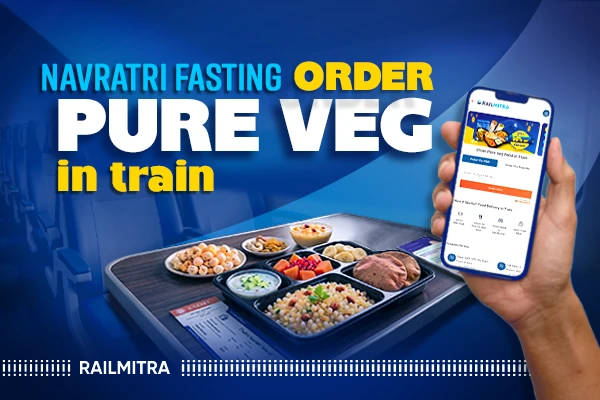
Choose your favorite meal on the train. On the menu screen, you can look for the Pure Veg tags to cut out any mixed restaurants. Then look specifically for Jain options, if your fast is strict about onion and garlic. Jain meals on RailMitra are prepared without onion, garlic, and often without root vegetables, which is exactly what Navratri fasting requires.
Delivery comes to your berth. Enter your coach and berth number in the order form. The delivery person boards at the selected station and finds you. You don’t go anywhere. Pay online at the time of ordering; much easier than managing cash from an upper berth.
App vs website: the app is faster for repeat orders since your details are saved. The website is more useful when you want to compare menus across multiple stations at once. Helpful on a long journey where you’re planning both lunch and dinner stops in advance.
What to Actually Order from RailMitra During Navratri
The menu depends on which vendors are active at your delivery station. But here’s what to look for within pure veg and Jain options on the platform.
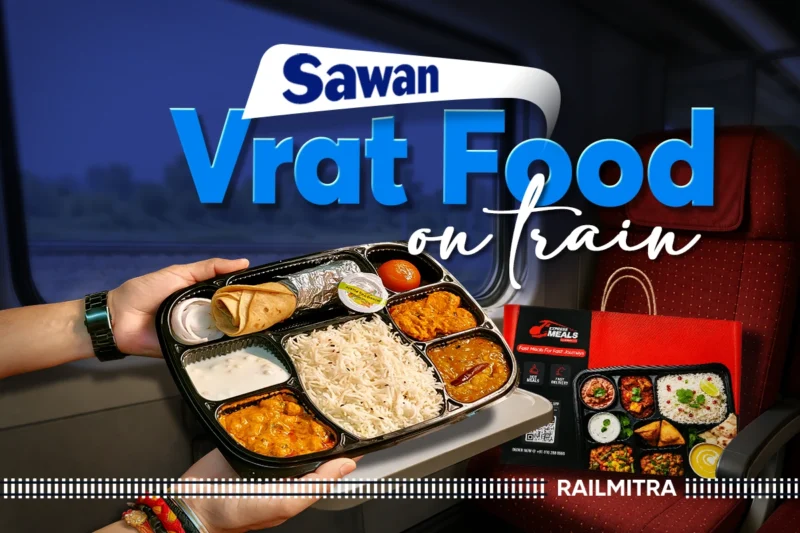
A Jain Thali stands out during Navratri because it follows strict dietary rules without fail. Fasting without onion or garlic becomes simpler when meals avoid all animal ingredients. Typically, one receives roti or sometimes rice alongside a cooked vegetable, lentils, then yogurt to complete the plate. Each part works within the limits, built as one balanced unit. Ordering separate dishes from standard menus often leads to mismatched choices, one safe, another not, while this avoids that risk entirely.
Paneer dishes from pure veg vendors are good on long journeys. Paneer holds up well in transit, it’s filling, and a proper pure veg kitchen won’t be using onion-garlic base in a paneer preparation the way a regular restaurant might. Look at the details first. Only then decide.
Curd and rice, or plain rice with ghee is the lightest option and worth having if your stomach is unsettled from hours of sitting. Simple, clean, nothing to question.
Fruit boxes are available at several stations and need no vetting at all. Order one for the afternoon slot if your main meal was lunch. Traveling in late March heat, something light and hydrating in the evening is genuinely useful, not just a backup option.
For the gap between your last home meal and the first delivery station (usually 3-4 hours), bring something from home. A banana, dry fruits, a small box of makhana with Sendha namak. RailMitra handles the main meals once you’re into your route.
Routes Where This Actually Matters Most
Delhi to Vaishno Devi (Katra): Vande Bharat (22439/22440) takes roughly eight hours; by contrast, Jammu Mail needs ten to twelve. Delivery runs smoother through Ludhiana or Pathankot – Katra’s terminal schedule leaves little room for delay. Night journey on Jammu Mail? Order dinner at Ludhiana or Jalandhar and you’re sorted.
Trains to Ayodhya: Crowds surged into Ayodhya following the temple opening early this year. On March 27, Ram Navami aligns exactly with Navami, therefore expect heavy footfall. Leaving Delhi, passengers find options like the Shramjivi Express and also take the Kashi Vishwanath line. Coming from Mumbai or Kolkata, a transfer happens in Lucknow before continuing ahead. Out of Kanpur, links stay reliable with regular trains running daily. In Lucknow, consistent service rolls through thanks to RailMitra’s network support. Along a shared route, visitors bound for Kashi Vishwanath or the Vindhyavasini shrine in Mirzapur pass through Varanasi before reaching Prayagraj. Though destinations differ, movement follows one path where cities link by necessity rather than design. This corridor carries pilgrims who cross urban stretches after winding through river-adjacent lanes. Each leg of the journey folds into the next without sharp breaks or detours. From eastward turns near temples to westbound shifts beyond ghats, flow remains uninterrupted.
Mumbai and Gujarat to Haridwar/Ujjain: Beginning in Mumbai, the journey travels through Gujarat before continuing toward either Haridwar or Ujjain by way of the Dehradun Express, covering nearly thirty-six hours on train tracks.. Meals, three across the span, are available en route, organized by RailMitra during transit.
What Experienced Train Pilgrims Figure Out the Hard Way
Don’t ask the pantry car. Onion in the gravy, table salt, packaged masala, that’s their veg meal. They’re not set up for Navratri fasting and never have been. RailMitra’s pure veg and Jain vendors are your actual option here.
Carry a small pouch of sendha namak anyway. Even from a reliable pure veg kitchen, salt choices sometimes vary. A zip-lock with sendha namak weighs nothing and removes the uncertainty.
Late March is already warm across most of India. Fasting quietly suppresses your thirst, you won’t register how dehydrated you’re getting, especially in an upper berth with afternoon sun on the coach. Thirst often arrives too late to prevent mild dehydration. Trying fixed moments for water intake helps avoid that gap. Even minor adjustments can influence daily energy levels more than expected. A steady rhythm supports consistency without relying on cues that lag behind needs. A consistent rhythm often works better than reacting to signals later. Timing beats impulse when balance matters most.
Right after getting on board, order both meals together. That moment the phone is already in grasp is the easiest chance. Waiting until hunger hits means juggling distractions. Early action prevents hurried decisions afterward. When missed, tension usually builds over time.
Conclusion
The station during Navratri has a different energy. Red and orange everywhere, “Jai Mata Di” carrying down the platforms, a crowd that’s going somewhere with real intention.
Nine days of fasting is nine days of intention. The train ride is one stretch of it. Ten minutes of planning before you leave or right after you board means you’re not breaking the fast because you were hungry and the only option was a pantry car meal with onion in it.
Enter your PNR on RailMitra. Look for pure veg or Jain food options. Order before you’re hungry. Jai Mata Di.
FAQs for Chaitra Navratri Food Delivery
Q: Is pure veg food on RailMitra suitable for Navratri fasting?
A: Yes. Pure veg on RailMitra means no meat, no eggs. When following strict Navratri fasting rules that exclude onion and garlic, consider meals made in the Jain tradition. Usually free of root vegetables, these dishes suit the dietary limits well. Their simplicity matches the requirements closely. Often seen as pure, they avoid ingredients that complicate digestion or spiritual focus. Such choices align naturally with the observance’s intent.
Q: How early can I place an order?
A: Minimum 2 hours before your delivery station. RailMitra also provides pre booking options so you don’t have to place the order at the last moment. During Navratri, placing it early is the smarter call, popular pure veg options at busy stations don’t last all day.
Q: My train is running late and I’ll miss the delivery window. What to do now? Flag it with A: Flag it with RailMitra support through the app as soon as you know about the delay. Ahead of time, reaching out improves chances for money back or new delivery dates.
Q: Can I order for multiple people with different preferences in the same compartment?A: Yes. One order can have multiple items, Jain meal for whoever is fasting, something else for whoever isn’t. All covered under a single delivery to your berth.
Q: Will pure veg or Jain food be available on Smaller stations?
A: Major junctions with heavy pilgrimage traffic have the best coverage. Haridwar, Katra, Ayodhya, Varanasi, Ujjain will have options during Navratri. Smaller intermediate stops may have less or nothing specifically suitable. Check using your PNR on RailMitra to see what’s available on your actual route.