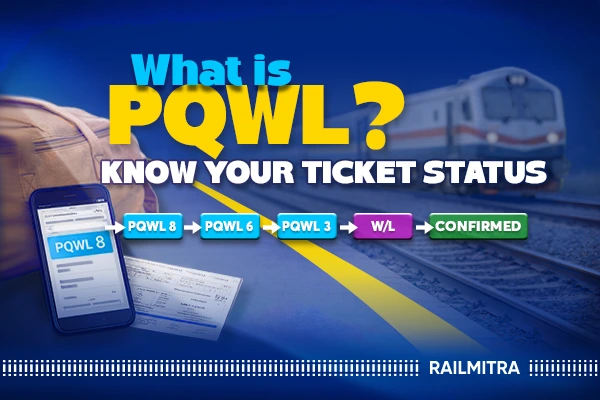
You finish booking a train ticket, the payment clears, and then you see it on your ticket: PQWL. Not confirmed, not even RAC. Just that. If you’ve been there, you know the specific frustration of staring at four letters that tell you almost nothing useful. So here’s what PQWL means, how it actually works, and what your chances are of seeing that status flip to Confirmed before you reach the station.

What PQWL Means: Full Form and Why This Quota Exists
PQWL means Pooled Quota Waiting List. That’s the full form. But saying “pooled quota” doesn’t really explain anything on its own, so let’s get into it.
Indian Railways breaks train seats into multiple quotas. There’s a quota for the origin station, one for tatkal passengers, one for senior citizens, one for defence personnel, and several others. Each quota is managed separately. The “pooled quota” is a block of berths set aside specifically for passengers travelling between intermediate stations, i.e, people who aren’t boarding at the very first stop and aren’t getting off at the last one.
Here’s the part that catches most people off guard. This pooled quota isn’t exclusive to any one pair of intermediate stations. If you’re going from Kanpur to Allahabad on a Delhi-Howrah train, you’re drawing from the same set of berths as someone going from Mughal Sarai to Dhanbad. Different journeys, same quota. That shared pool is why PQWL moves so slowly. Cancellations have to come from passengers whose journey actually overlaps with yours, not just anyone on the train.
PQWL vs GNWL vs RLWL vs TQWL
This is where confusion usually starts. These all look similar on a ticket but they behave very differently.
GNWL is the General Waiting List, and it’s what most passengers want. It covers journeys originating from the train’s starting station and draws from the largest quota. When someone with a GNWL ticket cancels, that berth goes back into the main pool. GNWL moves the fastest.
RLWL is the Remote Location Waiting List and applies to certain intermediate stations that have a small dedicated quota of their own. Your RLWL ticket only moves if someone travelling on that same specific route cancels. It’s more limited than GNWL but also more focused.
TQWL is the Tatkal Quota Waiting List. These almost never confirm. People booking tatkal already left it to the last minute. They’re not cancelling as they booked the ticket at the very last moment. However, this WL if not Confirmed is automatically cancelled by the Railways and the amount transferred back after deducting a minimal clerkage fee of ₹60.
PQWL sits between RLWL and GNWL. The pool is bigger than RLWL but shared across more passengers, so movement is slower than GNWL and harder to predict.
Confirmation Chances: What the Numbers Actually Mean
Nobody can tell you for certain whether a PQWL ticket will be confirmed. But there are patterns that hold up reasonably well.
PQWL 1 to 6 on a non-peak travel date? Worth holding onto. Occasionally, less-travelled paths like a rail line linking mid-sized cities outside peak seasons, see PQWL waitlists of 10 or 12 confirmed. Yet popular lanes such as Patna to Delhi or Mumbai to Ahmedabad during festivals including Diwali, Chhath, or school breaks rarely clear beyond PQWL 14. Demand spikes early, leaving few openings later. Few passengers cancel once booked, limiting last-minute chances.
One thing most people don’t realise: your ticket can only move up when someone with an overlapping journey cancels. A passenger cancelling a Delhi to Howrah full-route ticket doesn’t free up seats in the pooled quota the same way a cancellation from an intermediate-to-intermediate passenger does. The system is more compartmentalised than it looks from the outside.
Passengers who are unsure about the chances of confirmation for their waiting list ticket can use the PNR prediction. This service will give a probable figure of confirmation chances based on historic booking trends.
What Happens When the Chart Gets Prepared
Around four hours before a train departs from its origin, the reservation chart gets finalized. Whatever your status is at that point: confirmed, RAC, or still waiting, that’s where it stays.
If you’re confirmed, you get a seat number. If you’re in RAC, you board and share a berth. Not great, but you’re on the train. If you’re still showing as a waiting list number after charting, you don’t get on. The ticket gets cancelled automatically and a refund goes back to your payment source. It usually takes a few working days.
You don’t need to do anything manually for the auto-cancellation. But if you’ve already figured out alternate travel and want the refund processed sooner, cancelling before chart preparation gets you a better refund amount than waiting it out.
How to Track Your PQWL Status
You can easily track your PQWL status using the PNR Status check service at the RailMitra platform. You can access the website at RailMitra.com or install the application in Android as well as iOS.
Just follow these simple and easy steps:
- Go to RailMitra.com or install the application.
- Select PNR Status option.
- Enter 10-digit PNR Number.
- Hit Check PNR Status option.
Should You Stick With a PQWL Ticket or Look for Alternatives?
If you have a Low PQWL, normal travel dates and non-peak season, hold on and keep checking. There’s no reason to panic at PQWL 5 in February on a moderately busy route.
But if you’re at PQWL 20 and travelling during a major holiday, start looking now. Check other trains on the same route. Check different departure times. You can use the trains between stations service, to track all the trains operating between your route. Look at whether tatkal booking the day before departure makes more sense than waiting on a confirmation that probably isn’t coming.
Some experienced travellers on busy routes break their journey into two segments. They book separate tickets between major junctions rather than one ticket for the full intermediate stretch. It adds a connection, but both legs are more likely to come with confirmed berths. It’s a trade-off that sometimes makes sense, especially on high-demand routes.
Conclusion
In Indian Railways, PQWL means Pooled Quota Waiting List, a booking position applied when travel begins or ends at an intermediate stop, pulling from a common berth allocation. Though not starting at the train’s origin, passengers here share space pooled across multiple stops. This arrangement allows flexible boarding points without separate queues for each station pair. Instead of individual waiting lists, one combined list manages demand fairly among mid-route journeys.
Allocation depends on cancellations within that shared quota. As seats open up, they go first to those highest on the pooled waitlist. Because it covers several possible segments, movement on the list may feel slower compared to others. How fast that waiting list moves depends on who else in the same pool cancels before your chart gets prepared. Low numbers on quiet routes have a genuine shot at confirming. High numbers during festival season usually don’t. Watch your PNR closely in the days before you leave. When numbers rise, having a backup plan makes sense. Left unprepared, showing up might mean no way forward.