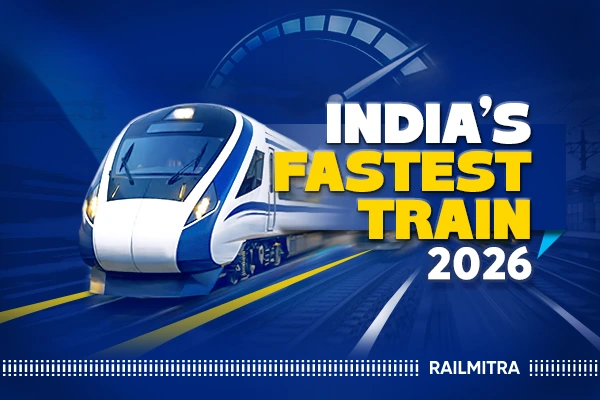
Indian Railways is the backbone of the country’s infrastructure. Millions of people depend on it for their daily sustenance. However recently it is undergoing a rapid transformation. Gone are the times where trains were slow and often delayed. Now railways are giving one of the fastest trains in India to ever operate.

Indian Railways is constantly upgrading its services and pushing the boundaries of transportation in the country. The launch of the Vande Bharat Express trains along other ambitious projects like the Bullet train are a testament to their resolve in upgrading the train services. Taking inspiration from these efforts we have compiled the list of the top 10 fastest trains running in India.
Fastest Trains in India: What Does ‘Speed’ Mean Here?
Indian rail speed coverage uses three different figures: MPS, Design Speed and Average Speed. The ranking of the fastest trains in India depends on which figure you choose. In this list, we are using MPS. Let’s understand all of these criterias and understand why we picked MPS.
MPS or Maximum Permissible Speed is what this ranking uses. Indian Railways sets a maximum Speed limit per train per track section, depending on the track geometry, signalling quality, and what the rolling stock can handle on that specific stretch. A train cannot legally be scheduled beyond it on that section.
Design speed is higher, sometimes much higher. The Vande Bharat Sleeper has a design speed of 180 km/h but runs commercially at 130 km/h MPS on its current Howrah-Kamakhya route. The track between Howrah and Kamakhya just isn’t ready for more. That gap of 50 km/h between what the train can do and what it’s allowed to do is called safety. This is also a strong call on how the railways need speedy betterment.
Average speed is what passengers experience. Total distance divided by total time including every stop, every slowdown through a station, every signal check. It’s the one passengers actually feel. The Namo Bharat RRTS runs at a 160 km/h MPS and achieves 90-100 km/h average, which is exceptional. The Vande Bharat Sleeper runs at 130 km/h MPS and achieves 69 km/h average,which tells you the route has a lot of non-upgraded sections.
The Delhi–Agra stretch, designed for 160 km/h, hosts swift services such as Vande Bharat, Gatimaan, and Shatabdi. Moving toward Kolkata, specific sections see trains reach 135 to 140 km/h. Though limited, these segments push speed boundaries. Speed gains remain limited to these select stretches. Then there’s the Delhi-Meerut RRTS: a separate system altogether, operating on exclusive tracks with zero shared usage. Most of the rest of the network is well below all of these figures. Knowing this going in, changes how you read the rankings.
Top 10 Fastest Trains in India in 2026
Ranked by Maximum Permissible Speed. Where two trains tie on MPS, I’ve used average speed and practical differences to order them.
1. Vande Bharat Express (Chair Car Variants): 160 km/h
Three trains share the 160 km/h top spot but I’ve put the Vande Bharat first because it runs that speed across more corridors than the other two. Tughlakabad-Agra is the main one. In trials it hit 180 km/h, the engineering allows 183 km/h, so 160 km/h commercially isn’t the ceiling, it’s just where the tracks currently are capable of.
Unlike every older express on this list, the Vande Bharat has no separate locomotive. No separate locomotive means the Vande Bharat is a self-propelled EMU where every coach contributes to traction. That means faster pickup off stops and less concentrated load on the track and is built entirely in India. Despite matching speeds of 160 km/h along the Delhi-Agra route, its advantage lies in reduced stoppages. Momentum builds faster after each pause, unlike the Gatimaan’s slower restarts. Efficiency gains emerge simply from spending less time stationary. What matters most isn’t peak speed but how fast service resumes after pausing. Less downtime adds up over distance. Efficiency comes from rhythm, not just raw pace.
Read More: Top 10 Fastest Vande Bharat Trains That Will Blow Your Mind
2. Namo Bharat RRTS (RapidX): 160 km/h
Namo Bharat might claim the top spot given its typical pace, though not by a large margin. Reaching 90–100 km/h on average, it falls short when lined up beside the MPS, which clocks in at 160 km/h. That ratio is dramatically better than anything else here. The reason is structural as this isn’t a train sharing track with freight and slower services. By early 2026, operation began on the Delhi-Meerut corridor , an 82 flat kilometers long track, free of crossings. Running nonstop, it avoids shared tracks altogether, dedicated only to swift movement between cities. Though distant from daily commutes, its structure supports rapid travel exclusively. Separation from standard lanes ensures unbroken speed throughout the journey. Not a single at-grade crossing interrupts its path. Since launch, movement along this stretch has remained uninterrupted. Nothing slower runs on it. 160 km/h is sustained, not touched on a good stretch and then surrendered.
Technically the Namo Bharat is a Regional Rapid Transit System, not a conventional Indian Railways express. I’ve kept it on this list because the distinction is more administrative than meaningful to most passengers, what they really care about is Delhi to Meerut in under an hour. What once lasted nearly an hour and a half now cuts through time much faster. Traveling between Delhi and Meerut by car took close to ninety minutes when traffic behaved. Today, the rail link finishes the trip in fifty-five minutes instead.
3. Gatimaan Express: 160 km/h
In April 2016, India’s rail system touched 160 km/h with the Gatimaan Express, an event unseen before. The stretch linking Hazrat Nizamuddin to Agra Cantonment spans 188 kilometers; which was roughly covered in about a hundred minutes. Suddenly returning to Delhi in time for dinner after visiting the Taj Mahal turned out to be feasible.
Nine years on it shares the 160 km/h MPS with Vande Bharat services that didn’t exist when it launched, and those services sometimes beat it on total journey time. Gatimaan’s speed record is gone. What it still has: a well-established schedule, onboard catering, and the Agra Cantt terminus which puts you in the right part of the city without additional transport logistics. It set the template. The newer trains ran past it using what it proved was possible.
Passengers who don’t want to try the train food and try something exciting can order food in train from RailMitra. With this service, you can get restaurant quality food on the train delivered right on your train seat.
4. New Delhi-Bhopal Shatabdi Express: 150 km/h
New Delhi-Bhopal Shatabdi Express was Indian Railways’ headline speed service before Gatimaan arrived. 150 km/h on Tughlakabad-Agra. Half an hour slips by every hundred eighty kilometers when trailing the leaders by ten kph – a gap that feels small at first glance. Yet once tracks stretch beyond city limits, those moments pile up without notice.
For passengers going to Madhya Pradesh, daytime options are limited and this train covers the need reliably. AC chair car, meals included, usually on time. It is just not the fastest train in India anymore, however there has been no change in its importance.This train still connects the central part of India to the national capital, which also happens to be a major city and a hub for employment and educational opportunities.
5. Tejas Rajdhani Express (Mumbai-New Delhi): 140 km/h
Rajdhani has been connecting Mumbai-Delhi since 1972. The new Tejas Rajdhani Express version with new LHB coaches, track upgrades, 140 km/h clearance, is noticeably better to ride. Less noise, less sway, covering 1,384 km at Average speed of 90 km/h.
The honest comparison of this train must be with that of a flight, and the honest answer is that flying wins on time but not by as much as the raw numbers suggest. By the time you add 2 hours waiting time at the airport, the total journey gap is around 3-4 hours on most itineraries and not 6. A lot of people who do this route regularly have worked out that the train is less painful overall. You board after dinner, you wake up there. No 5am alarm to make a flight, no queuing, no baggage carousel. Full pantry, premium tier, runs on schedule more often than the complaints on rail forums would suggest.
6. New Delhi-Kanpur Shatabdi Express: 140 km/h
440 km at 140 km/h on the upgraded Eastern sections. This is the New Delhi-Kanpur Shatabdi Express for you. Early departure from Delhi with return by nightfall. This route serves labourers more than travelers. Kanpur thrives on factories and most passengers commute for jobs or official tasks.
Nothing glamorous to say about it. The schedule has shifted a couple of times during track upgrade work on this corridor, so don’t assume the departure time you have in your head from a previous trip is still working. Check the train schedule before booking and boarding.
7. New Delhi-Howrah Rajdhani Express: 135-140 km/h
Since its first journey in 1969, New Delhi-Howrah Rajdhani Express has linked Delhi to Kolkata across 1,447 kilometers. Over decades of travel, this train has earned reliability from the people. Passengers choose this more than recent options, simply because it stayed consistent while others changed. Trust built slowly now shows clearly in who chooses to ride. The Eastern corridor sections have been upgraded to 135-140 km/h MPS, with 135 km/h used as the scheduling figure. LHB coaches replaced ICF stock some years back.
17-18 hours, Delhi to Kolkata, pantry throughout. Nobody books this for speed. They book it because it shows up, it runs, and after 55 years of doing that it has a kind of institutional trust that no newer service has earned yet.
8. New Delhi-Sealdah Duronto Express: 135 km/h
Fewer stops, faster average, that’s New Delhi-Sealdah Duronto Express for you. Achieving speeds of 130 to 140 km/h across improved stretches of the Eastern route, the Duronto concept shows practical results here. Though scheduled at 135 km/h, performance remains solid along the Delhi–Sealdah corridor.
Pick this over the Howrah Rajdhani based on where you’re going in Kolkata. Sealdah is northeast near Salt Lake, Bidhannagar, Shyambazar side. Arriving at your stop means stepping out right where you need to be. Taking the Rajdhani to Howrah? Then face another 45 minutes moving through the city, despite already spending hours onboard.
9. Vande Bharat Sleeper Express: 130 km/h
Launched in January 2026 Vande Bharat Sleeper Express had a 180 km/h trial speed. But that’s not what passengers got. Commercial MPS on Howrah-Kamakhya Vande Bharat Sleeper Express runs at 130 km/h. Average speed is 69 km/h. That’s not the train underperforming. That’s the Northeast corridor telling you exactly what condition it’s in. The track simply isn’t at that level yet.
Even at 130 km/h MPS, it’s the most advanced sleeper Indian Railways has ever run. The Northeast corridor work is in progress. Ask me to update this list in 2028 and the Vande Bharat Sleeper will probably be sitting much higher.
Read More: First Vande Bharat Sleeper Train
10. Amrit Bharat Express: 130 km/h
Last on speed but the comparison isn’t really fair. The Amrit Bharat Express runs routes the other nine don’t go near which are Tier 2 cities, smaller towns and corridors that have never had a Rajdhani or a Shatabdi. Push-pull configuration with locomotives at both ends, non-AC at an accessible price. MPS is 110-130 km/h depending on the track.
For passengers in the cities this train serves, it is often the fastest train they’ll ever take. That’s the point of it. Measuring it against the Vande Bharat misses what it’s actually doing, which is extending faster rail to places that had been left off that map.
Read More: 9 New Amrit Bharat Express Trains Launched
Passengers who have booked a train ticket and haven’t received a confirmed train ticket must constantly check their booking status for any upgrades. RailMitra’s PNR Status check provides real time updates on your booking which can be helpful in getting a confirmed ticket for your journey.
What’s Coming New
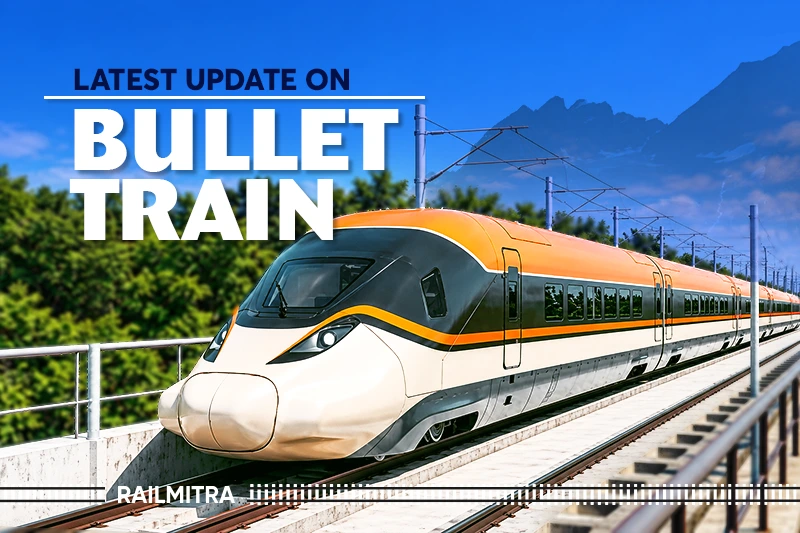
The Mumbai-Ahmedabad bullet train gets mentioned in every article about Indian rail speeds. It’s designed for 320 km/h. When it runs, the numbers on this list will look quaint. I don’t have a firm opening date and I’m not going to guess one. The timeline has moved before and might again..
The Vande Bharat Sleeper is the more concrete near-term change. 130 km/h MPS now, 180 km/h when the Northeast corridor is ready. That upgrade is in progress. The Mission Raftaar programme is also still pushing through the broader network.
But the most structurally significant development would be replicating the RRTS dedicated-corridor model on other routes. A shared track will always have a ceiling because you can’t run a 160 km/h express and a loaded freight running on the same line without compromises. A separate corridor removes that problem entirely. Whether India builds more of them and where, is what I’d actually be watching.
Conclusion
Running near 160 km/h are three trains, yet only the RRTS sustains this pace consistently. Next come Shatabdi and Rajdhani, their speeds ranging from 135 to 150 km/h depending on route conditions. Sitting lowest in performance, a pair of trains moving along at 130 km/h, but for entirely separate causes: outdated infrastructure holds back one, while the traffic induced due to freight as well as passenger trains is another reason holding train speed back.
Quick note before you book: the MPS figure is for the train’s fastest section. Your actual journey time depends on stops and how much of the total route has been upgraded. Howrah Rajdhani and Sealdah Duronto are nearly identical in speed but drop you at opposite ends of Kolkata. That’s an easy hour’s difference in total travel time depending on where you’re going.
A figure I keep returning to: Vande Bharat Sleeper hits 180 km/h yet manages only 69 km/h across today’s path. Not meant as fault toward the locomotive. It’s just an honest description and the wide divide between where the tracks are right now versus where the technology already is.