Nobody tells you this before your first long-distance train journey: the pantry car runs out of things. Or the vendor walks past your compartment right when you’re asleep. Ordering food on train in India is not complicated, but it helps to know how it actually works before you’re five hours into a journey and hungry. This guide covers the full picture.

How Food on Train Actually Reaches You
Three ways food gets to your seat on a train.
The pantry car is the one most people default to. It’s a dedicated coach that prepares and sells food on board. Staff walk through compartments with trays, usually announcing what’s available in a mix of Hindi and whatever regional language the route passes through. You can also walk to the pantry car directly. Veg thali, instant noodles, egg curry on a good day, chai in those tiny plastic cups that are too hot to hold for the first two minutes. That’s broadly the pantry menu on most trains. A Rajdhani pantry runs differently from a regular Express, better stocked, sometimes better cooked, but consistency across journeys is not something you can count on.
Station vendors are the second option. At major junctions, vendors board the train or sell through windows. Samosas, local snacks, chai, and packaged biryani in those foil containers. The good ones know exactly which compartment to walk to. You get roughly two to five minutes at a stop before the train moves again. Miss the window and you’ve missed it. The tension gets even higher if your seat is a few coaches away from the door.
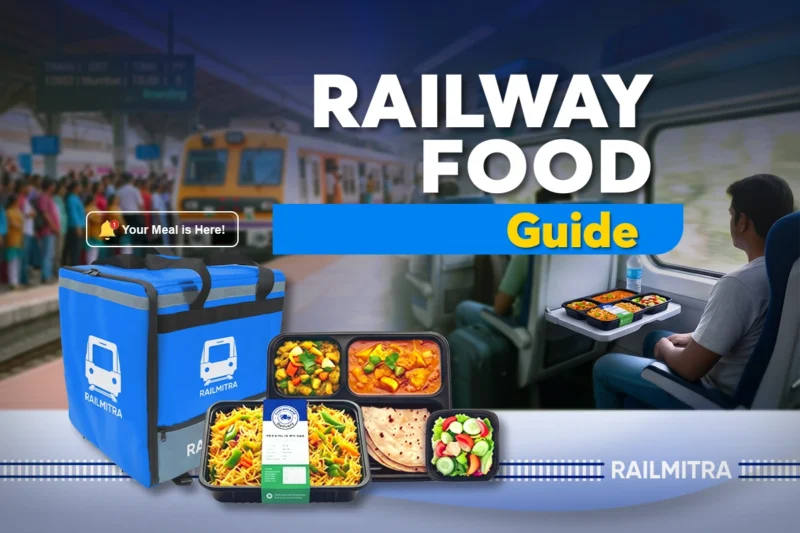
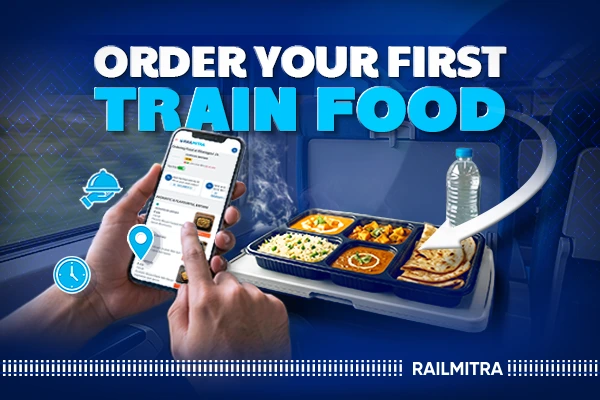
The third and perhaps the best option for you is to order from a train food app like RailMitra. You can prebook your meals or even order while you are travelling on the train. The best part of ordering food on train through such platforms is that you don’t even have to move away from your seat, the food will be brought right on to your seat. With this there is no reckless sprint to the door, wondering what the station vendor has decided to cook today or eating something that is cold or tasteless, just because that is what the pantry has.
What You Can Actually Order
The food choices available on the train depends mostly on the train route you are taking. In the southern side you will get to see southern cuisines more prominently, while in the north be prepared for kulchas and naans. Also, the exact food item also changes from restaurant to restaurant serving at a particular station.
Biryani shows up almost everywhere. Dal rice, paneer, roti sabzi, fried rice, noodles, sandwiches, the usual. Most platforms have a pure veg food in train filter and it’s worth using if you’re strict about it. Pantry kitchens are not always running separate prep for veg and non-veg, so ordering through a veg-only restaurant on the platform is a cleaner guarantee than assuming the pantry handles it right.
Idli and sambar rice at Katpadi. Curd rice at Salem. Routes through Tamil Nadu and Karnataka tend to have South Indian options at those stops. Maharashtra routes throw up misal and vada pav alongside the standard list. Delhi-originating trains make it easy to find a proper North Indian thali somewhere along the way. What’s actually available depends on which restaurants have tied up with the platform at each specific station. North Indian thalis are easy to find on Delhi-originating long-distance trains. On routes cutting through Maharashtra you’ll see misal, poha, vada pav listed alongside the usual suspects. The coverage shifts based on which restaurants have partnered with the platform at each station.
Quality also varies by station, not just by cuisine. A biryani from a decent restaurant at a major junction is a different thing from whatever comes out of a pantry car that’s been running since 6 AM. That’s not a criticism of pantry cars specifically, just how it works.
Not every station has delivery available. Major junctions almost always do. Smaller halts, not always. Worth checking before you assume.
How to Order Food on Train?
You’ll need your PNR number. That’s it. No complicated registration, no physical menu.
In the RailMitra application, you just have to enter your 10 digit PNR number. The system detects the seat, train and journey details from this number and provides you which stations are available for train food delivery. You have to pick your station, restaurant, select the required food items and proceed for payment options.
If you don’t have the PNR number, you can still place your order by entering the train name or number. You would just have to additionally mention your boarding date and station so that the system knows can provide you the stations available for your food delivery.
The order goes to a restaurant at that station. They prepare it fresh and hand it to a delivery person who boards the train and brings it directly to your seat or berth number. You don’t need to move.
For group food order, one PNR is enough. Seat numbers for the whole booking are already in the system, so you’re not entering details for five people separately. One order, everyone covered.
RailMitra takes care of the coordination end: which restaurant, tracking the order, getting it to the right coach. If you’re mid-journey and unsure how long the halt is, the tracking tells you where things stand.
Timing: When to Order
The most important element of a smooth and problem free food delivery in train is timing. And this is where most of the first timers make the error.
Train food logistics is different from your regular food delivery. If you are on your train and place an order with say 45 minutes before the departure, it is difficult for the restaurant to operate in this constrained timings. The best strategy is to prebook your meals or place your order at least 1-2 hours before the train arrives at your station. This will give the restaurant and even the delivery partner to smoothly deliver your order. You can check the most accurate live train timings using the live train status service.
Delhi to Mumbai is 16-plus hours. That’s two meals minimum, three if you board in the evening. Takes ten minutes to look at the route, figure out which stations land at lunch and dinner time, and place both orders upfront. Breakfast at Kota, lunch near Vadodara, done before the train even clears the city. Some people do the whole journey this way and don’t think about food again until the boxes arrive.
Night trains are slightly different. 10 PM departure, next afternoon arrival, there’s really only one proper meal window and it’s breakfast. Check which station the train passes between 8 and 10 AM. Order before sleeping or when you wake up, whichever you remember first. By the time you’re fully awake and actually hungry, the station you need is sometimes already behind you.
Tatkal and premium express services tend to have more delivery options than slower Mail trains. If you’re on a Mail or Express running on a less popular route, check availability early. Less footfall at intermediate stations means fewer partnered restaurants.
Paying for Your Food
UPI works fine. Cards, net banking, same. Cash on delivery exists on some orders but it’s restaurant and station-specific, not a given. If you need cash, check before placing, not after.
Meals are roughly Rs 120 to Rs 250. Biryani portions from delivery restaurants tend to run larger than the pantry car equivalent at a similar price point. Pantry chai is still Rs 10 and will probably stay that way.
Cancellations work up to 30-60 minutes before the delivery station, after which the restaurant has confirmed the order and that window closes. If you do cancel in time, the refund goes back to the payment source. A few days usually, not instant. Screenshot the confirmation before you do anything else. Station mix-ups are rare but when they happen, that number is the fastest way to get it sorted.
What Happens If Your Train is Delayed
Train delays are common. The delivery system accounts for this.
When your train is running late, the restaurant at the delivery station is notified. They adjust preparation timing so the food isn’t sitting cold by the time you arrive. The RailMitra system uses live train tracking for this, so you don’t need to call or inform anyone manually.
If a delay causes you to miss a station entirely (rare but it happens on long detours), you can usually shift the delivery to the next available station. Contact support before the original station passes.
Food on Train: What First-Timers Should Know
Some things worth knowing before the journey, not after.
Sealed packaging. Sounds small but it’s not. Pantry trays come open, they’ve been sitting, you don’t really know what touched what. Delivery orders arrive in closed containers with a bill inside. That alone is a decent reason to switch.
The food on train filter works like any regular food app. Cuisine, price, dietary type. Most people expect something outdated and are caught off guard when it isn’t.
Delivery comes to your berth. The person who boards at the station has your coach and seat number from the PNR. You stay where you are. No standing near the door, no watching through the window, no asking a stranger to watch your bags while you run to the exit. Just wait.
If you’re travelling with kids, ordering ahead changes the whole dynamic. No negotiating with a vendor through a window while holding a child, no carrying trays through a moving coach, no explaining to a six-year-old why the food cart walked past before you could stop it.
Overnight trains are a specific use case worth mentioning. If your train reaches a major junction between 7 and 9 AM, breakfast delivery is very doable. Place the order before sleeping or set a reminder to order when you wake up. That early morning chai from a vendor is fine but an actual meal at your berth without having to get up and figure it out is a different thing.
The pantry car is not going away. Fine for chai and quick snacks. For actual meals on a longer journey, delivery to your seat removes a fair amount of friction. Most people who try it once stop relying on the pantry car for proper meals. That’s not a guarantee, just what tends to happen.
Conclusion
Ordering food on train in India is easier than it sounds, mostly because the heavy lifting happens before the train moves. Enter your PNR, pick a station, and it comes to your seat. RailMitra handles tracking, restaurant coordination, and delivery so you’re not left guessing. Check availability for your route before you board. That part is worth doing early, especially on less popular corridors where options thin out.