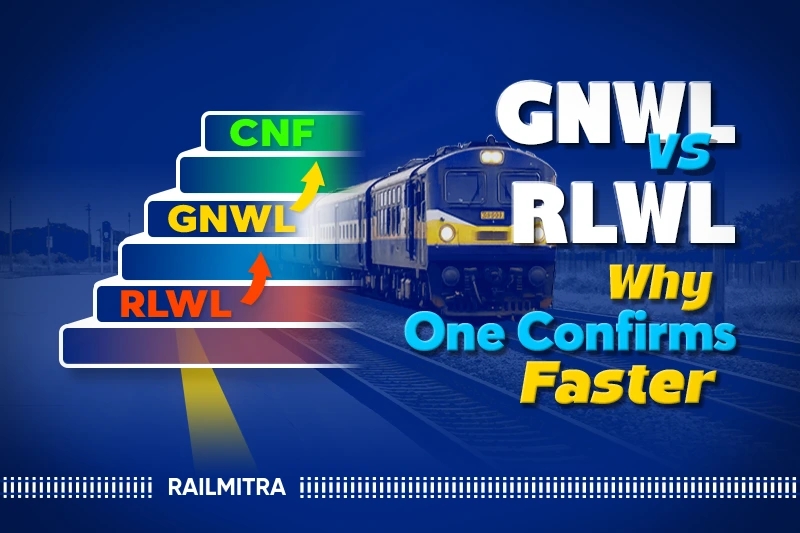
You booked a ticket. It says RLWL 8. Your friend booked on the same train and got GNWL 22. The chart comes out, your friend’s ticket confirms and yours doesn’t move an inch. This happens more than you’d think. And if you’ve been in this situation, the frustration is real, especially when you can’t figure out why a higher waitlist number was confirmed while your RLWL 8 just sat there doing nothing. The answer is in the difference between GNWL vs RLWL and once you understand how Indian Railways actually allocates these waitlists, the whole thing starts making sense.

It’s not random. It’s not unfair. It’s just a quota system that most passengers never bother to look into.
GNWL vs RLWL: What These Codes Actually Mean
Let’s get the basics down first, without overcomplicating it.
GNWL stands for General Waiting List. You get this when you’re booking a ticket from a train’s originating station or from a major boarding point that falls under the general quota. Take Delhi to Mumbai on Rajdhani. Book from Delhi, and there’s a good chance you’ll see GNWL on your ticket. That’s because Delhi is either the origin or close enough to one that the system puts you in the main queue.
RLWL stands for Remote Location Waiting List. Instead of originating stations, it covers points farther along the journey path. Passengers joining mid route usually encounter this category when checking seat availability. Not linked to departure cities, it reflects demand from secondary access points. From places like Kota or Vadodara on the Delhi to Mumbai train route, this status often applies.
Same train. Different waitlist pools. And very different odds of your seat actually showing up. A lot of passengers assume the waitlist is just one line that RLWL 5 is ahead of GNWL 30. It isn’t. These are parallel queues. They don’t interact. That’s the whole issue.
Why GNWL Confirms More Often
Sometimes called a remote location list, RLWL appears during bookings made at stops between origin and destination. From places like Kota or Vadodara on the Delhi to Mumbai line, this status often applies. Instead of originating stations, it covers points farther along the journey path. Passengers joining mid route usually encounter this category when checking seat availability. Not linked to departure cities, it reflects demand from secondary access points.along the route. GNWL draws from the general quota which is the largest allocation on any train. Every time someone with a confirmed ticket cancels from the originating station, that freed up seat goes back into the GNWL pool. The system then moves GNWL passengers forward in order, one by one.
RLWL doesn’t work that way. It pulls from a significantly smaller quota set aside specifically for intermediate stations. If someone cancels from the origin? That cancellation doesn’t touch the RLWL pool at all. RLWL only moves when a passenger who booked from that same intermediate point cancels their ticket. That’s a much less common event.
So two days before departure, when a surge of cancellations hits, say a family trip that got called off, or a corporate booking that fell through, GNWL passengers start moving up fast. RLWL passengers often see zero movement. Not because the train has no empty seats, but because those seats aren’t coming from their quota.
Exactly how the design intended, it operates without error. Not a flaw at all. The railways favor the general quota simply due to its broader passenger reach.
A Simple Example to Make This Click
Let’s say you’re travelling from Patna to Delhi.
Should your journey begin in Patna, or when Patna acts as the initial key station assigning its own share of seats, GNWL typically applies. Though exceptions exist, most passengers boarding at this point receive a General Waiting List status. Because allocations start here, the system registers demand early. When quotas are set locally, priority follows departure order. Thus, tickets issued from Patna often carry this waiting category by default. You’re in the main queue, drawing from the biggest seat pool on that train. Cancellations from anywhere along the route can filter up to you.
But if the train starts from Howrah and Patna is just a midway stop, things change. Now you’re getting RLWL. You’re in a smaller queue that only moves if another Patna-boarding passenger cancels. The train might have 40 empty berths by the time it reaches you, but if those berths came from Howrah cancellations, they don’t flow to your RLWL. They go to GNWL passengers.
GNWL 30 can confirm. RLWL 8 can stay stuck. Exact numbers? Indian Railways keeps those under wraps. Route differences twist the figures. Season matters too. So does travel class. Still, watching how quotas play out gives clues. A fuzzy image forms. That image hints at likelihoods, nothing more
What the Confirmation Chances Actually Look Like
Finding precise numbers? Not possible, Indian Railways keeps that data out of public view. Still, patterns emerge when watching how reservations actually unfold across different trains. Route matters. So does the travel period. Class choice plays a role too. A general sense can form, though, if looking at how quotas operate day to day. Rough trends show up despite missing hard figures:
- GNWL 1–15: Good odds on most routes. High cancellation means these usually clear.
- GNWL 16–30: Booking early often helps when GNWL 16–30 is the trend. Chances improve unless the journey falls on a peak holiday. Travelling far from festival seasons tends to ease waitlist stress. Earlier reservations usually mean better position shifts. A non-peak departure boosts the likelihood of confirmation. Dates avoiding big holidays make these numbers feel less risky.
- GNWL 31–50: Getting uncertain. The ticket can still be confirmed, but you need a decent run of cancellations. Have a plan B.
- GNWL above 50: Risky enough that you probably shouldn’t rely on it without a backup.
- RLWL 1–5: Some possibility, but genuinely low. The quota is small and rarely sees cancellations.
- RLWL 6 and above: On most trains, these don’t confirm. It happens, but it’s not something to count on.
The chart is prepared roughly four hours before departure. That’s when everything becomes final. GNWL clears from the general pool. RLWL only clears if its specific quota opens up. The two processes happen separately, regardless of how many overall seats free up on the train.
If you’re sitting on an RLWL ticket and want to track whether anything is moving, check your PNR Status on RailMitra. It updates in real time as the chart preparation date approaches and shows your current waitlist position clearly.
Can You Avoid Getting RLWL in the First Place?
Often, yes. A few things worth trying before you lock in a booking:
Check where the train originates. Before booking, look up the full train schedule. If the train doesn’t start from your station or a nearby quota point, RLWL is likely what you’ll end up with. Knowing this upfront saves the frustration of finding out after payment.
Search for alternate trains on the same route. This is probably the most underused trick. If one train is giving you RLWL with a high number, there may be another train on the same corridor that originates closer to your boarding station, giving you GNWL instead. Use the Trains Between Stations feature on RailMitra to quickly see all trains running between your source and destination, compare their availability, and spot which one is more likely to get you into the GNWL pool.
Book as early as the window opens. IRCTC opens bookings 60 days in advance. Getting in early means a lower waitlist number and for both GNWL and RLWL, a lower number is always better.
Consider a boarding station adjustment. On some routes, boarding from a station slightly closer to the origin shifts you from RLWL to GNWL quota. It depends on how Railways has divided the route into quota zones, so it takes some research, but worth checking if you have travel flexibility.
Look at Tatkal as a fallback. If your dates are fixed and RLWL is the only thing available on regular quota, Tatkal might be worth the extra cost. A confirmed berth is less stressful than an RLWL that never moves.
The Other Waitlist Codes You’ll Run Into
GNWL and RLWL get the most attention, but they aren’t the only codes that appear on Indian Railways tickets.
PQWL (Pooled Quota Waiting List): This appears when you’re travelling between two intermediate stations, neither the origin nor the final destination. The quota is limited, and confirmation chances are low, though generally slightly better than RLWL on well served routes.
TQWL (Tatkal Quota Waiting List): The waitlist within Tatkal. This almost never confirms. Tatkal bookings rarely get cancelled, so the queue barely moves. If you see TQWL, treat it as a dead end and look for alternatives.
RAC (Reservation Against Cancellation): Technically not a waitlist at all, it’s a half-confirmed state. You get a shared berth, usually the side lower, and you’re allowed to board the train. Many RAC passengers end up with a full berth once the chart is finalised and no-shows are accounted for. Riding on RAC beats drawing a high GNWL ticket when getting on the train is your main concern.
A traveler checking waitlist types might notice differences in confirmation odds. Usually, GNWL offers better chances than PQWL. Following that, RLWL tends to rank lower. When available, options ahead of TQWL often make it a last choice.
What Happens if the RLWL Ticket Doesn’t Confirm
If you booked through IRCTC online and your waitlist ticket doesn’t reach at least RAC by chart preparation time, it gets automatically cancelled. The refund goes back to your original payment source, no application needed, no counter visit. It usually reflects within a few working days.
Counter tickets work differently. You’ll need to go to the booking window and request the refund yourself before a certain deadline. It won’t happen automatically.
One thing a lot of passengers get wrong: an unconfirmed waitlist ticket, GNWL or RLWL does not allow you to board the train. Many still try, hoping the TTE will accommodate them. Technically the TTE has some discretion, but a WL ticket gives you no guaranteed seat, and you can be asked to deboard. RAC allows boarding. WL does not. That line doesn’t move.
If your travel date is approaching and the ticket is still on the waitlist, you can check Train Live Status on RailMitra to see if the train is running on time, useful for figuring out how much time you actually have before making a call on backup arrangements.
Conclusion: GNWL vs RLWL, Know Before You Book
The mix up between GNWL vs RLWL is one of those things that confuses passengers until they’ve been burned by it once. After that, they check every time.
GNWL pulls from the main general quota, the largest seat pool on the train, and moves every time an origin cancellation frees up a berth. RLWL draws from a smaller, station-specific allocation that only shifts when someone from that exact boarding segment cancels. Two entirely different queues running in parallel, never crossing.
When picking, go for GNWL if available. With RLWL, aim for a smaller number. As departure nears, check PNR updates often. Wait for confirmation before locking in any firm arrangements.
Just because someone knows the waitlist process inside out does not mean they will land a spot. While clarity helps, outcomes remain uncertain even with full awareness of procedures.