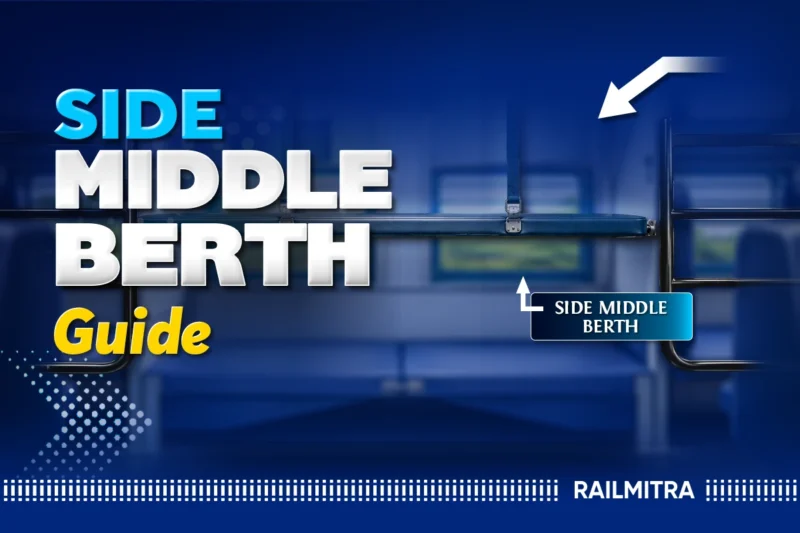
Ask any regular train traveler about the side middle berth in train coaches and you’ll get mixed reactions. Some call it the most awkward seat in the whole compartment. Others actually request it on purpose. Right above the side lower, tucked against the aisle wall, that’s where you’ll find it in sleeper and AC coaches alike, and the rules attached to it barely resemble what applies to the three main berths in a regular bay. Most people figure this out only after boarding. Kind of defeats the whole point of planning your seat in advance.

Side Middle Berth Meaning: Where It Actually Sits
The side middle berth means the upper of the two side berths that run parallel to the aisle, opposite the three main berths (lower, middle, upper) in every bay. There’s no side upper in Indian coaches, just side lower and side middle. That’s the first thing that confuses new travelers. They assume there’s a third side berth somewhere, and there isn’t.
Physically, this berth folds down from the wall during night hours and folds back up during the day so the two people sitting on the side lower have a proper backrest. It’s a shared arrangement. During the day, three people effectively use two seats.
Come nightfall though, it stops being shared. Stands on its own. It is at this point where you can finally understand the difference of side middle berth in train. The side middle berth obviously reduces the height of this seat, and it also diminishes the seat’s width, which may make it less comfortable for passengers.
Side Middle Berth Rules Every Passenger Should Know
Railway rules around this berth are stricter than people expect, and they exist mainly because of the shared daytime seating.
The side middle berth rules state that this berth can only be used for sleeping between 9 PM and 6 AM. Outside these hours, it must remain folded up so the side lower passengers get their sitting space back. This isn’t optional and TTEs do enforce it, especially on routes where the coach gets checked frequently.
Another rule that catches people off guard: the side middle berth passenger cannot ask the side lower occupant to keep their berth folded down beyond 6 AM. Once morning arrives, the space belongs to the lower berth passenger for daytime use, and any dispute usually gets resolved in favor of whoever holds the lower ticket.
There’s also a luggage angle to these rules. Storage space under the side middle is minimal to nonexistent since it’s positioned above the side lower, not below anything. So passengers on this berth typically end up keeping their bags near the side lower’s under seat storage, with permission, or holding onto smaller bags through the journey.
Side Middle Berth in Sleeper Class: What Changes
The side middle berth in sleeper class experience is noticeably different from AC coaches, mainly because of ventilation and privacy. Sleeper coaches don’t have curtains, so there’s zero visual separation between the side lower and side middle at any point in the journey. Everything happens in full view of the aisle.
Summer nights turn out surprisingly bearable here, better than the stuffier main bay berths in most cases. Winter’s a different story though, colder than most people expect. Foot traffic near the doors is the other thing nobody mentions, since sleeper coaches route more of it past the side berths simply because of where entry and exit points sit. A quiet corner? Not guaranteed here. Depends entirely on where in the coach you end up.
What You Only Understand After Actually Sitting There
There’s a strange thing about the side middle berth. Nobody explains this in advance, and it only becomes obvious once you’re actually on it for a full night.
Motion feels different too. That swaying complaint you hear from middle and upper berth passengers in the main bay barely applies here, something about running along the coach’s length instead of across it that keeps things steadier. Frequent travelers who’ve tried both often mention this without being asked.
This berth might perhaps be the only one, which allows you the complete view of the aisle while you are lying down. This might not sound like a big bonus, but is crucial if you have safety issue and want to have visibility across this unknown place. Solitary travellers, especially women can fully comprehend the importance of this feature of the side middle berth in train.
The proximity to the charging point near the side lower is another underappreciated detail. Since side middle folds directly above side lower, reaching a charging socket without leaving your berth is easier here than from a main bay upper berth.
The Real Downsides Nobody Mentions Upfront
None of this means the seat is perfect. The climbing motion required to get onto a side middle berth is different from a regular upper berth ladder, and elderly passengers or anyone with knee issues often find it more physically demanding, not less.
Space above your head is tighter too. Because the berth folds from the wall rather than being a fixed shelf like the main upper, the vertical clearance feels lower once you’re lying down. Taller passengers have reported feeling boxed in.
And then there’s the shared daytime arrangement itself. If your co-passenger on the side lower is chatty, or has different sleep timing than you, the 9 PM rule becomes a point of friction more often than people expect. A compromise between you and the nearby passengers is possible, however it can be denied as well. Therefore be prepared for all kinds of sutations.
How to Get a Side Middle Berth in Train
Indian Railways doesn;t allow passengers to select or select any berth in the train. This happens because the system itself allocates seats to the passengers. No human is directly contacted in allotting berth to passengers and is handled through an automated system. Passengers can, however, choose one berth type at the time of their booking. Whether this seat will be provided or not, depends on the seat availability and the Indian Railways. You can also get a different seat than the one entered and thus there’s not guarantee of booking any particular berth in Indian Railways.
Passengers who want a side middle berth in train need to book their ticket earlier. There are only a few trains that have these seats and even if a train has this coach, the seats would be very limited. It is thus advised to book your tickets as soon as the booking window opens. Passengers can also use RailMitra’s live seat availability check service to track the number of seats available on any train.
Tatkal booking is a whole separate chapter altogether. These tickets are the last minute resort for any desperate traveller and seat choices have little value over here. Passengers are provided whichever seats are available and even this facility remains open for only a few minutes on the most sought after trains..
Checking Your Allotted Berth Through PNR Status
Once your ticket is booked, the only reliable way to know if you got a side middle berth in train is by checking your PNR status.
Ten digits, printed right on your ticket, and your entire booking record lives behind that number. Punch it into RailMitra’s PNR Status checker and out comes your coach number, berth number, berth type, all of it laid out clearly. Side middle shows up, you’ll also get the coach layout position telling you roughly where you’re headed.
This becomes especially useful closer to the travel date, since berth allocations can shift due to chart preparation, cancellations, or RAC confirmations. A day before departure works better than trusting the number from weeks ago at booking time. Fewer surprises that way once you’re actually standing on the platform.
Checking Seat Availability Before You Book
Before locking in a booking, check train seat availability to avoid guesswork. This is especially useful if you want a side middle berth on a specific date and route. RailMitra’s seat availability tool shows live berth availability. It breaks down remaining berths across Sleeper, AC 3 Tier, and AC 2 Tier. You can check availability for your selected train before booking.
While the tool doesn’t isolate side middle specifically as a filterable category, checking overall availability trends helps you judge whether booking early on a nearly full train versus a train with more open seats will change your odds of landing a side berth. Trains running below sixty percent occupancy at the time of checking generally offer more flexibility here.
It’s also worth checking live train running status alongside availability if you’re planning a last-minute journey, since delays and schedule shifts sometimes create short-notice cancellations and return those seats to the booking pool.
Food Options for Side Middle Berth Travelers
Since your berth is in the aisle, ordering food is usually convenient during meal rounds. This depends on the train having pantry service.
For trains without onboard catering, RailMitra’s train food booking service lets you order meals in advance. You can order from restaurants near upcoming stations. Your meal arrives when the train halts. Having food delivered directly is more convenient on a folded side middle berth. It avoids juggling meals while getting in and out of your berth space.
This is especially useful on long overnight journeys. Dinner timing often clashes with the side lower berth’s folding schedule. Dinner arrives on time this way, no scrambling right before the 9 PM berth conversion kicks in.
Final Thoughts
Most people don’t request the side middle berth in train coaches first. Understandable, given how it looks on paper. But it’s far from the worst seat once you actually know how it works. Between the steadier ride, the aisle visibility, and the easier access to charging points, there are real advantages here that only become clear once you’ve spent a night on it.
The side middle berth rules around timing and shared space do require some adjustment, and the side middle berth in sleeper class experience will feel rougher than AC coaches if privacy and temperature control matter to you. Solo travelers and light packers especially tend to walk away pleasantly surprised rather than settling for a compromise.
Check your PNR status the moment your ticket confirms, keep tabs on seat availability while you’re still planning, and there won’t be a single surprise waiting for you at the platform.