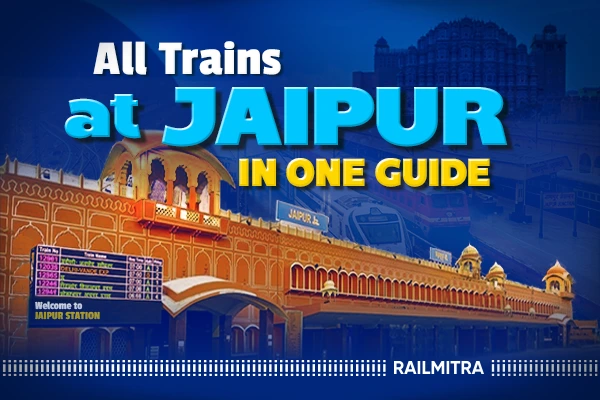
Jaipur is the capital of the Rajasthan State. This city is the administrative and financial head of the state, however in the world of Railways logistics, this city has a distinct position as well. Jaipur Junction with the station code JP also happens to be the headquarters of the North Western Railways zone. As many as 35,000 to 200,000 passengers pass through this junction daily.

Jaipur Junction is always home to a number of passengers whether it be for tourists, people travelling for religious purposes, agricultural season or students travelling to their school and colleges. This junction is situated at the logistical convergence of Delhi to Ahmedabad line, the Delhi to Jodhpur line, the Sawai Madhopur to Jaipur route along with the Jaipur to Sikar branch for regional travel.
You can clearly imagine the train traffic and people inflow, this station must go through. Train timings can change mid way, it is thus better to check live train running status and be aware of the most updated train timings.
Jaipur Junction: Station Basics Worth Knowing
Jaipur Junction is the headquarters of the North Western Railway zone. Sixteen broad gauge tracks, eight to nine platforms, full electrification wrapped up in 2020. Platform 1 handles the premium services. Platforms 6 and 7 are accessible without climbing stairs, which matters more than people realise until they’re hauling two suitcases and a toddler. Metro Pink Line has a direct foot overbridge connection into the station. Sindhi Camp bus terminus is close enough to walk to.
The Amrit Bharat Station Scheme redevelopment at Rs. 716.88 crore is still underway as of mid-2026, targeting completion by July. The rear basement work is done, the old administrative structures are gone, but expect construction activity around the concourse area.
Vande Bharat Trains From Jaipur Junction
Fastest option at JP right now. Design speed is 160 km/h but track geometry on most Jaipur corridors limits actual operation to somewhere between 110 and 130.
| Train No. | Service Name | Frequency | Key Halt |
| 20977/20978 | Ajmer–Chandigarh Vande Bharat | 6 Days/Week | Delhi Cantt. |
| 20979/20980 | Udaipur–Jaipur Vande Bharat | 3 Days/Week | Ajmer Jn. |
| 26481/26482 | Jodhpur–Delhi Vande Bharat | 6 Days/Week | Jaipur Jn. |
| 12461/12462 | Jodhpur–Ahmedabad Vande Bharat | 6 Days/Week | Abu Road |
Six days each week, train 20977 or 20978 moves between Ajmer and Chandigarh, stopping at JP by plan. From Udaipur to Jaipur, service 20979 or 20980 lasts around 6 hours and 20 minutes, running just three times weekly – often missed since it isn’t every day. The Jodhpur to Delhi Vande Bharat, numbered 26481 or 26482, pauses at JP only for pickup, making the chance to board brief. A single delayed rickshaw could mean seeing the train pull away without you. Check RailMitra first – live info shows your train’s platform. Where it waits gets clear before you move.
Out of nowhere, early 2026 saw a quiet Vande Bharat train slip into service between Delhi and Ahmedabad. Rather than the familiar Rajdhani, passengers began spotting this newer option on those tracks more regularly.
Passengers who want to find the detailed train timings of these trains can check it use RailMitra’s train schedule check service. With this service you can find the timings, stations on the route and much more, all at one place acessible online.
The Swarna Jayanti Rajdhani
One Rajdhani at JP. Just one, but it does the job.
| Train No. | Service Name | Dep. from JP | Destination |
| 12957/12958 | Swarna Jayanti Rajdhani Express | 02:50 | New Delhi / Sabarmati |
Midnight stillness breaks when Train 12957 rolls into JP – clock hits 02:40. Ten full minutes it sits, engine humming low. Not a moment more, not a second less. This pause stretches longer than any other stop along its route. People move in and out, bags in hand, voices hushed. The length of the wait hints at the crowd that swaps places here. By 02:50, doors shut, wheels start turning again. The 02:50 departure is not for everyone. Return service 12958 reaches JP around 23:55. All classes are fully air-conditioned, 1A through 3A. Prices reflect that. Those 2A and 3A spots? Gone quicker than usual when holidays stretch out. Spot them early using RailMitra’s seat checker instead of crossing fingers on waiting lists. Chance won’t save you if you wait too long.
Shatabdi, Double Decker and Ashram: Delhi Day Trains
Three options on the Delhi corridor during daylight hours, all different enough to matter.
| Train No. | Service Name | Dep. from JP | Destination |
| 12015/12016 | New Delhi–Ajmer Shatabdi Express | 10:45 (arr.) | New Delhi / Ajmer |
| 12985/12986 | JP–DEE AC Double Decker Express | 06:00 | Delhi Sarai Rohilla |
| 12915/12916 | Ashram Express | 04:30 | Old Delhi / Sabarmati |
Shatabdi is the name most people reach for first on this route. It comes through from Ajmer, picks up JP passengers, and keeps going to New Delhi which is good for day travel, catering included, no reserved berths. Most folks overlook the Double Decker, train numbers 12985 and 12986, but it’s got its perks. Before sunrise, movement begins. A train with room across two levels opens wider views outside. This journey stretches 303 kilometers toward Delhi Sarai Rohilla, finished in less than four and a half hours. When departure happens at six, arrival slips neatly ahead of crowded commutes. For those already awake, another option pulls forward at four fifteen – the Ashram Express moves quietly into motion. That one lands you in Old Delhi by ten, costs less, and sticks to sleeper class.
Trains to Mumbai, Pune and Western India
Long journeys, limited frequency on most. Weekly and bi-weekly runs are the norm here.
| Train No. | Service Name | Destination | Duration |
| 12955/12956 | Jaipur–Mumbai Central SF Express | Mumbai Central | ~17 hours |
| 12939/12940 | Jaipur–Pune SF Express | Pune Jn. | ~19h 45m |
| 12977/12978 | Maru Sagar Express | Ernakulam Jn. | 35+ hours |
| 12215/12216 | Bandra Garib Rath | Delhi Sarai Rohilla | ~4 hours |
| 14701/14702 | Aravali Express | Surat / Mumbai | Varies |
Every day, the Mumbai Central SF runs as part of this set numbered 12955 going out, 12956 returning. Stretching across 1,159 kilometers, it takes close to seventeen hours on track. People trading gems in Jaipur often board it, heading toward business spots in Mumbai where bulk goods move. Pune SF and Maru Sagar both run weekly, which means you book when the train runs or you don’t go direct. Garib Rath to Bandra (12215) is subsidised AC, genuinely affordable for what you get. Aravali covers Surat better than routing through Mumbai does.
On a 17 to 35 hour journey, pantry quality is a real variable. Order food in train through RailMitra at your scheduled halt stations rather than depending on what the pantry car has left by hour 14.
Trains to Bangalore, Chennai and South India
Direct south Indian trains from JP exist. The catch is frequency: most run bi-weekly or weekly, and journey times on this corridor are genuinely long.
| Train No. | Service Name | Destination | Frequency | Duration |
| 12975/12976 | Jaipur–Mysuru Express | Mysuru Jn. | Bi-weekly | ~44h 20m |
| 12967/12968 | Jaipur–Chennai Central SF | Chennai Central | Bi-weekly | ~36h 45m |
| 20667/20668 | Jaipur–Yesvantpur SF Express | Yesvantpur (Bengaluru) | Weekly | ~42h 45m |
| 20481 | TPJ SF Humsafar | Tiruchirappalli | Weekly | ~36h 35m |
Half a day plus change – that is what the Chennai SF train needs when things go smoothly along the Bhopal to Nagpur into Vijayawada stretch. Slower by quite a bit, the Mysuru Express eats up more than two full days just to cover the same ground. Humsafar sets like the TPJ SF (20481) have GPS passenger information and onboard vending machines, which at least reduces pantry dependency on the longer stretches. Weekly frequency across this whole group means waitlists build up fast. Check PNR Status on RailMitra after booking if your ticket is in WL, confirmation odds shift significantly in the final 48 hours.
Trains to Kolkata and Eastern India
This corridor runs heavy year-round. Migration, pilgrimage, trade in essential goods. Seats go.
| Train No. | Service Name | Destination | Dep. from JP | Duration |
| 12307/12308 | Howrah–Jodhpur Express | Howrah Jn. | 04:40 | ~24h 15m |
| 12987/12988 | Ajmer–Sealdah SF Express | Sealdah | 14:40 | ~25h 10m |
| 12315/12316 | Ananya Express | Howrah | Weekly | Varies |
Every day, Sealdah SF takes off from JP at 2:40 in the afternoon. This train stops at Kanpur Central before reaching Prayagraj along its route. On a different path, the Howrah–Jodhpur service heads the reverse way. It begins early, leaving at 4:40 AM sharp. The journey lasts one full day, ending up at Howrah. Ananya Express is weekly and skips smaller stops, faster if your dates align. Tatkal for AC classes opens 24 hours before departure if you are booking at the last minute and the general quota is closed.
Trains to Bihar, Varanasi and the Northeast
The longest routes out of JP. Guwahati at nearly 40 hours is the outer limit.
| Train No. | Service Name | Destination | Dep. from JP | Duration |
| 12395/12396 | Ziyarat Express | Patna Jn. | 02:35 | ~20h 03m |
| 14853–14866 | Marudhar Express | Varanasi Jn. | 13:59 | ~17h 02m |
| 15631/15632 | Bikaner–Guwahati Express | Guwahati | 09:10 | ~39h 40m |
| 19615/19616 | Kavi Guru Express | Kolkata / North Bengal | Varies | 30+ hours |
Ziyarat Express (12395/12396) connects the Ajmer Sharif Dargah corridor to Patna. During Urs it is oversubscribed to a degree that makes Tatkal look optimistic. Book as early as ARP allows. One thing about Marudhar Express – it doesn’t stick to just one number, changes based on the day, so look twice before you get on. That Bikaner to Guwahati ride? Takes nearly two full days, clocks in at 39 hours and 40 minutes, cuts right through busy tracks across northern India. Check Live Train Status if you’re receiving someone arriving on any of these; delays compound badly over long distances.
Food on Train From Jaipur Junction
Pantry cars exist on most long-distance trains out of JP. Whether they’re worth relying on is a different question.
Rajdhani includes meals in the ticket price, which removes the decision entirely. Shatabdi includes breakfast and evening snacks. Humsafar trains have vending machines. Every other train is pantry-dependent, and pantry quality on a route like JP to Mysuru, which crosses four catering zones over 44 hours, varies more than most people expect.
The south Indian runs are where onboard food gets complicated. Pure veg options thin out noticeably south of Nagpur, and the pantry menus change at major junctions without much notice. Using RailMitra’s food in train service to order at scheduled halts from platform restaurants gives you more control over what actually ends up in front of you. Works for group travel too as RailMitra handles group food orders so the whole compartment isn’t eating different things at different stations.
DEMU and Regional Trains
No reservations, general class only. For short hops within Rajasthan and into Haryana, these are the practical options.
| Train No. | Route | Dep. from JP |
| 79601/79602 | Ajmer–Jaipur DEMU | 17:15 (to Ajmer) |
| 79603 | Jaipur–Sikar DEMU | 10:30 |
| 79701/79702 | Jaipur–Hisar DEMU | 05:15 |
| 59805 | Jaipur–Bayana Fast Passenger | 06:40 |
Sikar and Ajmer DEMUs carry the Shekhawati commuter load, students and daily workers mostly. Hisar DEMU crosses into Haryana, used by traders working the border belt. Bayana Fast Passenger sits between a stopping train and an express in terms of speed, which makes it useful for that particular corridor.
Palace on Wheels
Runs September through April. By the second morning, just after three twenty, the royal Rajasthan journey reaches JP station. Out here, the day opens with guests arriving on a sunlit platform, met by a welcome that feels like morning light. First up, amber stone glows at Amber Fort, ancient steps leading upward without hurry. Later on, the breeze slips through Hawa Mahal’s rows of open windows, cooling the air like a quiet breath. Not far behind, Jantar Mantar waits – ancient stonework measuring sunlight, each shadow crawling carefully along curved lines. When evening pulls low, movement turns soft, tires brushing pavement as the journey drifts toward Durgapura, where stillness takes over. Departure hums again near eight o’clock, bound for Sawai Madhopur. Costs appear listed in American dollars. Not a train most JP passengers will ever board, but it does pass through and it does affect platform logistics on arrival days.
Satellite Stations Around Jaipur
JP gets congested, particularly during peak season. NWR has shifted some train stoppages to four satellite stations to spread the load.
| Station | Distance from JP | Focus |
| Gandhi Nagar (GADJ) | 5 km | Delhi-bound trains |
| Durgapura (DPA) | 7 km | Southern corridor |
| Khatipura (KWP) | 13 km | Rake maintenance, Vande Bharat |
| Getor Jagatpura (GTJT) | 10 km | Regional halts |
Gandhi Nagar handles 82 stoppages a day and is noticeably less crowded than JP for Delhi-bound trains. Durgapura runs cleaner than most stations of its size. If your train originates at either, it is usually worth going straight there rather than starting from JP and hoping the train hasn’t already filled up at the originating point.
Conclusion
Jaipur Junction is so famous and popular in the region because this train connects you to literally anywhere across the country. Do you want to go to Delhi? The Double decker takes you there in about 5 hours.Want to go to Guwahati in the east? 40 hours is the time on Bikaner Express. This station takes you to Chennai in 36 hours and even Mysuru in around 44 hours.
Indian Railways is trying to develop this station on the lines of airports. Considering the huge number of tourist footfalls, it is an important decision from the tourist’s satisfaction and convenience purpose. RailMitra acts as your helpful companion in the journey providing you quick access to important services like PNR Status check, train seat availability, live train status and even train food delivery.